Worm Gear Reducer Self-Locking: Ngano nga Mokapot Kini ug Kanus-a Dili
An engineering deep-dive on the property that defines worm geometry’s safety advantage — the friction-and-lead-angle physics, the static-vs-dynamic distinction, the applications where it’s mandatory, and the regulations that still require an active brake regardless.
Self-locking is the engineering property that puts the worm gear reducer in lifting drives, theatre stage rigs, screw jacks and solar trackers — and keeps it out of servo-driven precision positioning. The friction geometry that makes it lock the load passively is the same friction geometry that limits efficiency to 70-85%. The trade-off is intentional, well-understood, and codified in Korean and Asian industrial safety regulations. The article below walks through what self-locking actually means at the gear-mesh level, where the threshold sits, when it fails, and how to verify it on an installed unit. For a foundational introduction to worm geometry before this physics deep-dive, see our companion article on what a worm gear reducer is.
DEFINITION — TWO WAYS TO STATE IT
⊕ ENGINEERING DEFINITION
A worm gear reducer is self-locking when the lead angle of the worm thread is less than the friction angle at the worm-wheel sliding contact, so that no torque applied at the output shaft can drive the input shaft backwards.
⊕ PLAIN ENGLISH
If you push or pull on the output shaft, the input motor stays still. The friction inside the gear mesh holds the load — without applying any motor torque, without an active brake.
What “Self-Locking” Means in a Worm Gear Reducer
In any geared drive, torque travels in two directions. The motor drives the load forward; the load can also try to drive the motor backwards (gravity on a lifted weight, momentum after a fast stop, wind on a tracker, customer-leaning on a stage lift). For most drive geometries — helical, planetary, bevel, cycloidal — back-drive happens freely, and an active brake is needed to hold the output stationary under load.
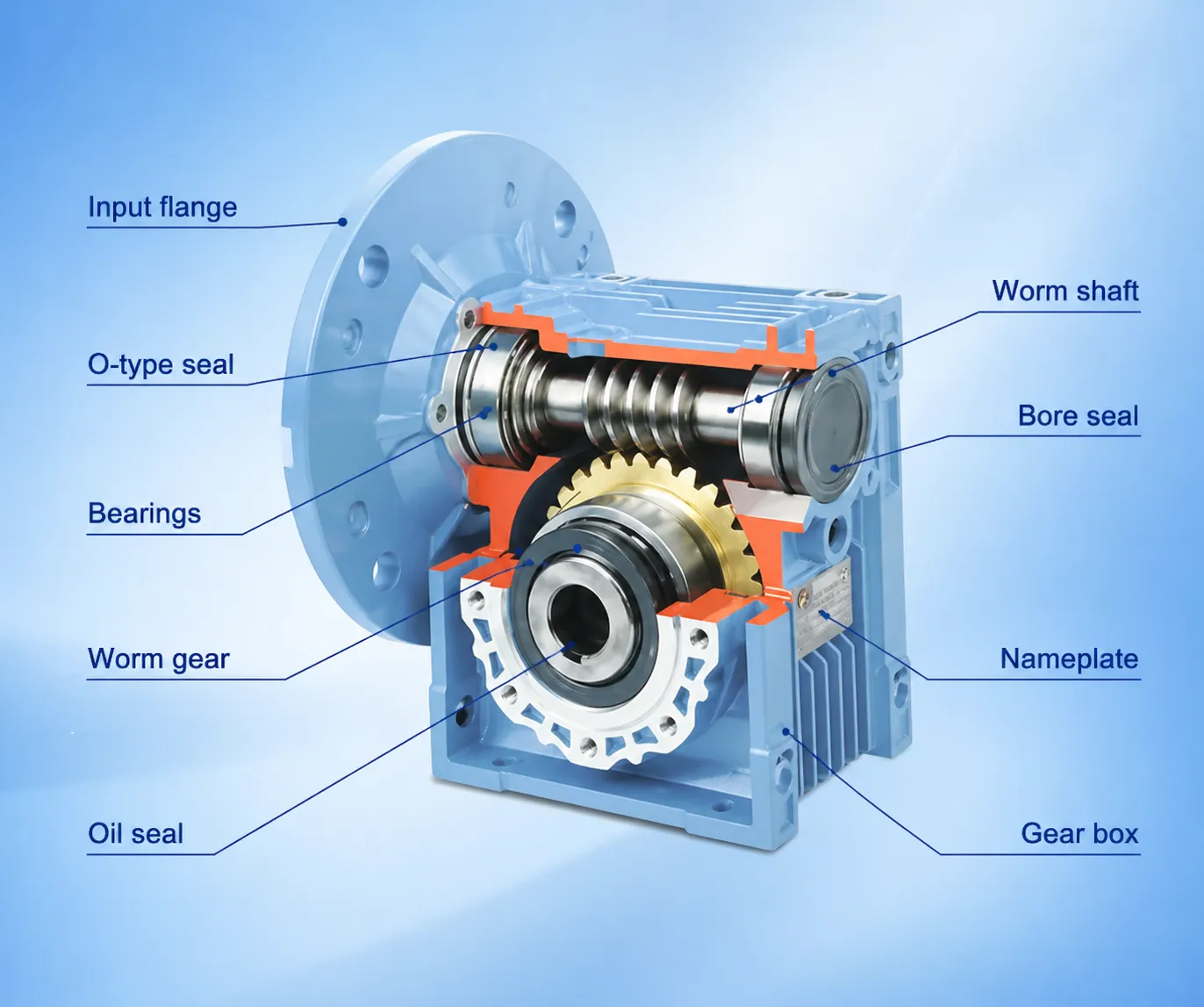
A worm gear reducer at sufficient ratio is the unique exception. The sliding contact between the worm thread (steel) and the wheel teeth (bronze) generates friction that resists reverse rotation. When the resistance is greater than the geometric mechanical advantage that the wheel would otherwise have over the worm, the drive locks itself. The load can pull on the output shaft indefinitely; the input shaft will not turn.
This passive holding torque is the worm gear reducer’s safety advantage in lifting and elevating duty. It removes one critical failure mode (active-brake malfunction) from the application’s hazard analysis and turns the gearbox itself into a redundant safety layer behind whatever brake the regulations still require.
The Friction-and-Lead-Angle Physics — Why Ratio Matters
The lead angle γ of a worm thread is the angle the thread helix makes with a plane perpendicular to the worm shaft axis. A high-ratio worm gear reducer has a low lead angle (the thread spirals nearly straight around the shaft); a low-ratio unit has a high lead angle (more like a screw than a worm). The friction angle ρ at the bronze-on-steel sliding contact under typical lubrication is around 4-6° (corresponding to friction coefficient μ ≈ 0.07-0.10 in mineral oil, dropping to 0.04-0.06 in synthetic PAG).
Self-locking holds reliably when γ < ρ. The reference table below shows the lead angle for typical catalogue worm gear reducer ratios, alongside the self-locking confidence at standard operating temperatures.
| Ratio i | Lead Angle γ | γ vs ρ (4-6°) | Self-Locking Confidence |
|---|---|---|---|
| 5 | 11-13° | γ > ρ | No — back-drives freely |
| 10 | 8-10° | γ > ρ | No — back-drives under load |
| 20 | 5-7° | γ ≈ ρ | Marginal — assumes synthetic oil |
| 30 | 3-4.5° | γ < ρ | Yes — confident static lock |
| 50 | 2-3° | γ << ρ | Yes — robust at all temperatures |
| 80-100 | 1-2° | γ <<< ρ | Yes — locks even on broken seal |
The ratio ≥ 30 threshold for confident self-locking is the engineering rule of thumb across Korean and Asian worm gear reducer catalogues. Below i = 30, designers either accept that an active brake is needed for any holding duty, or specify high-ratio frames with built-in mechanical advantage they don’t strictly need. Above i = 30, the gearbox holds passively across the full operating-temperature range.
Static vs Dynamic Self-Locking — Two Different Engineering Conditions
Self-locking does not behave the same way under all motion conditions. The three states below distinguish when a worm gear reducer locks, when it slips, and when it back-drives — a distinction that catches casual specifiers out and shows up as field-failure data on lifting drives that were specified without checking dynamic behaviour.
Load not moving, motor off
The lifted weight pulls on the output shaft; the worm thread cannot spin the wheel teeth backwards because friction at the contact resists motion.
Result: Locked at all i ≥ 30. Holds indefinitely without motor torque.
Motor stops, load coasting
After a power-off command, the load’s inertia continues to drive the output shaft for several rotations. Static friction must overcome dynamic momentum before lock engages.
Result: Locks after coast-down stops, typically 0.5-3 seconds.
Sustained reverse drive from load
If the load applies a continuous high reverse torque (overhead crane in upper gear, fast-stopped solar tracker), wear, vibration or shock can momentarily break the static lock and let the load creep down.
Result: Active brake required regardless of self-locking.
Six Applications Where Self-Locking Is Mandatory
Across Korean and Asian industry, six application classes specify worm gear reducer geometry primarily for the self-locking property — alternative drive types either don’t fit the safety case or add cost-of-brake without compensating advantage. Browse the corresponding configurations in our broader katalogo sa reducer sa worm gear for sized lifting-duty units across these classes.
PERSONNEL LOAD
Construction screw jack
Jump-form lifting platforms 4-16 jacks synchronised. Worm geometry holds multi-tonne load passively if power fails mid-lift.
PROPERTY LOAD
Theatre stage lift
Orchestra-pit and scene-change platforms. Self-locking eliminates back-drive on sudden equipment power loss during a performance.
EQUIPMENT LOAD
Solar tracker drive
Holds the panel face at the commanded angle against gusts and wind shear without applying motor torque hour after hour.
PROPERTY LOAD
Bucket elevator drive
Loaded chain prevents reverse-drift on power loss — bucket contents would otherwise dump back into the boot causing flooding.
PERSONNEL LOAD
Scissor lift / aerial work platform
Self-locking redundancy behind the active brake — second layer that holds even if hydraulic or electrical brake malfunctions.
PROCESS LOAD
Slow-speed agitator (high viscosity)
Self-locking holds the impeller stationary against viscous drag during shut-down to keep blades in their parked position.

Why Active Brakes Are Still Required by Safety Regulations
Across Korean, Japanese and Chinese industrial safety regulations, a worm gear reducer’s self-locking property is treated as a redundant safety layer rather than a primary safety. The primary safety on any personnel-lifting platform must be an active mechanical brake — disc, drum or fail-safe spring-applied — that engages on power loss independent of the gearbox geometry.
⊞ REGULATORY REFERENCES
- KR Korean Industrial Safety and Health Act, Article 38 — active brake required on all personnel-lifting drive systems
- JP JIS B 0903 / Japanese Industrial Safety Law — fail-safe brake mandatory on lifting and elevating drives
- CN Chinese GB 6067 series — independent brake required regardless of drive geometry self-locking property
- EU EN 81-50 / Machinery Directive — active brake plus secondary safety device on lift platforms
The regulatory reasoning is straightforward: friction-locked geometry depends on contact-surface conditions that can degrade (wear, lubricant pollution, temperature swing) over the gearbox’s service life, while an active brake’s holding capacity is verifiable through periodic test-load procedures. For applications where back-drive prevention is the primary safety case but personnel are not directly suspended — heavy-load conveyors, package indexers, automation gantries — designers sometimes specify planetary gearbox drives with active brakes instead, where the brake does all the holding and the gearbox doesn’t need to.
When Self-Locking Fails — Three Failure Modes
Self-locking is not perfectly absolute. Three field-observed failure modes account for almost all reported incidents where a worm gear reducer back-drove unexpectedly under load. Each is preventable with the right specification or maintenance discipline. For the broader troubleshooting context — including how self-locking failure presents alongside ten other field symptoms — see our worm gear reducer troubleshooting guide.
FAILURE MODE 01
Vibration release
External vibration (impact loads, high-speed reversal upstream) momentarily reduces effective friction at the contact, allowing the load to creep down a few degrees before re-locking. Cumulative creep over hours can drift a tracker or stage lift visibly.
FAILURE MODE 02
Lubricant film lift-off
Hot synthetic PAG running below 30 cSt viscosity creates a thicker hydrodynamic film that reduces effective friction at borderline ratios (i = 20-30). On older PAG that has thickened oxidatively, the opposite happens — friction rises and self-locking strengthens.
FAILURE MODE 03
Worn bronze wheel
Wear of the bronze wheel over decades changes the effective tooth profile and contact geometry. A worm gear reducer that locked confidently new may need re-tooth or replacement after 30,000-50,000 hours to restore the original holding capacity.
Verifying Self-Locking on an Existing or Installed Unit
For procurement engineers receiving a worm gear reducer specification with no prior service history, or for maintenance teams revalidating a long-installed unit, the four-step procedure below confirms self-locking under representative load before commissioning lifting duty.
Confirm catalogue ratio is i ≥ 30
Read the nameplate. Below i = 30, self-locking cannot be assumed regardless of any other factor.
Apply rated load to output shaft, motor de-energised
Hang or load the rated holding torque on the output shaft. The input shaft must remain stationary for at least 60 seconds without creep.
Apply controlled vibration excitation
Strike the housing with a rubber mallet or run a small motor unbalance for 30 seconds. Confirm input shaft remains locked.
Document the test, repeat at scheduled intervals
Record the ambient temperature, lubricant grade, applied load and result. Re-verify every 10,000 operating hours or every 5 years, whichever comes first.
Self-Locking Engineering FAQ
Q: Can I rely on worm gear reducer self-locking as the only holding device on a small lifting drive?
A: For non-personnel and non-property-load drives at i ≥ 50, sometimes — light-duty stock movers, parking-arm drives, equipment trim adjusters. For any drive holding personnel weight or property of significant value, no. Korean and Asian safety regulations require an active brake regardless of self-locking, and the regulatory case is solid: friction-locked geometry depends on contact conditions that degrade with wear, while an active brake’s holding capacity stays verifiable across the service life.
Q: Does self-locking weaken at high oil temperature?
A: Slightly, in a predictable way. Hotter oil has lower viscosity, and the hydrodynamic film between worm thread and bronze wheel becomes thinner — which means more metal-to-metal sliding, higher friction, stronger self-locking. The effect is opposite to what intuition suggests. Cold-start at very low temperatures actually has the larger effect on the other side: thick oil at start-up creates a thicker film that reduces friction temporarily until the gearbox warms up.
Q: How does a 2-stage helical-worm worm gear reducer compare on self-locking?
A: The worm secondary stage carries the self-locking property; the helical primary stage does not. Combined ratio matters less than the worm-stage ratio alone. A 2-stage helical-worm with helical i = 4 and worm i = 30 (combined i = 120) self-locks confidently because the worm stage alone is at the i ≥ 30 threshold. A 2-stage with helical i = 30 and worm i = 4 (also combined i = 120) does not self-lock because the worm stage is below threshold.
Q: How can I quote a holding-torque rating for a worm gear reducer specification?
A: Most catalogue worm gear reducer ratings publish either holding torque directly (in Nm) or back-driving torque limit. The relationship is roughly: at i = 30, holding torque ≈ 1.5× catalogue rated output torque under SF=1.0 conditions. At i = 50, holding torque ≈ 2× rated. At i = 80+, holding torque ≈ 2.5× rated. For specifications outside catalogue range, request the manufacturer’s holding-torque test data on the specific frame and ratio combination.
Q: What happens to self-locking when the bronze wheel reaches wear limit?
A: Holding torque drops gradually before failing. As the wheel teeth thin, the effective contact area shrinks and contact pressure rises beyond the bronze fatigue limit. The unit may still hold static loads but with reduced safety factor. Field-wear monitoring on a worn worm gear reducer should re-verify self-locking using the four-step procedure above before extending service life past wear-limit warnings.
Q: Are there worm gearbox geometries that intentionally don’t self-lock?
A: Yes. Multi-start worm geometry (2-start, 3-start or 4-start threads) deliberately uses higher lead angles to increase efficiency, at the cost of losing self-locking. Multi-start worm gear reducer designs at i = 5-10 with 2-3 start threads achieve 88-92% efficiency vs 85% for the corresponding single-start unit, but back-drive freely. They are the right choice for continuous-duty drives where energy cost matters and self-locking is not needed (most pump and conveyor drives).
Specifying a Worm Gear Reducer for Lifting or Holding Duty?
Send the holding torque, application class, ambient and duty cycle. Our Korean engineering team verifies the ratio threshold, recommends frame and ratio with confirmed self-locking margin, and identifies the applicable safety regulation for the active-brake specification — typically within 24 to 48 hours.
Editor: Cxm