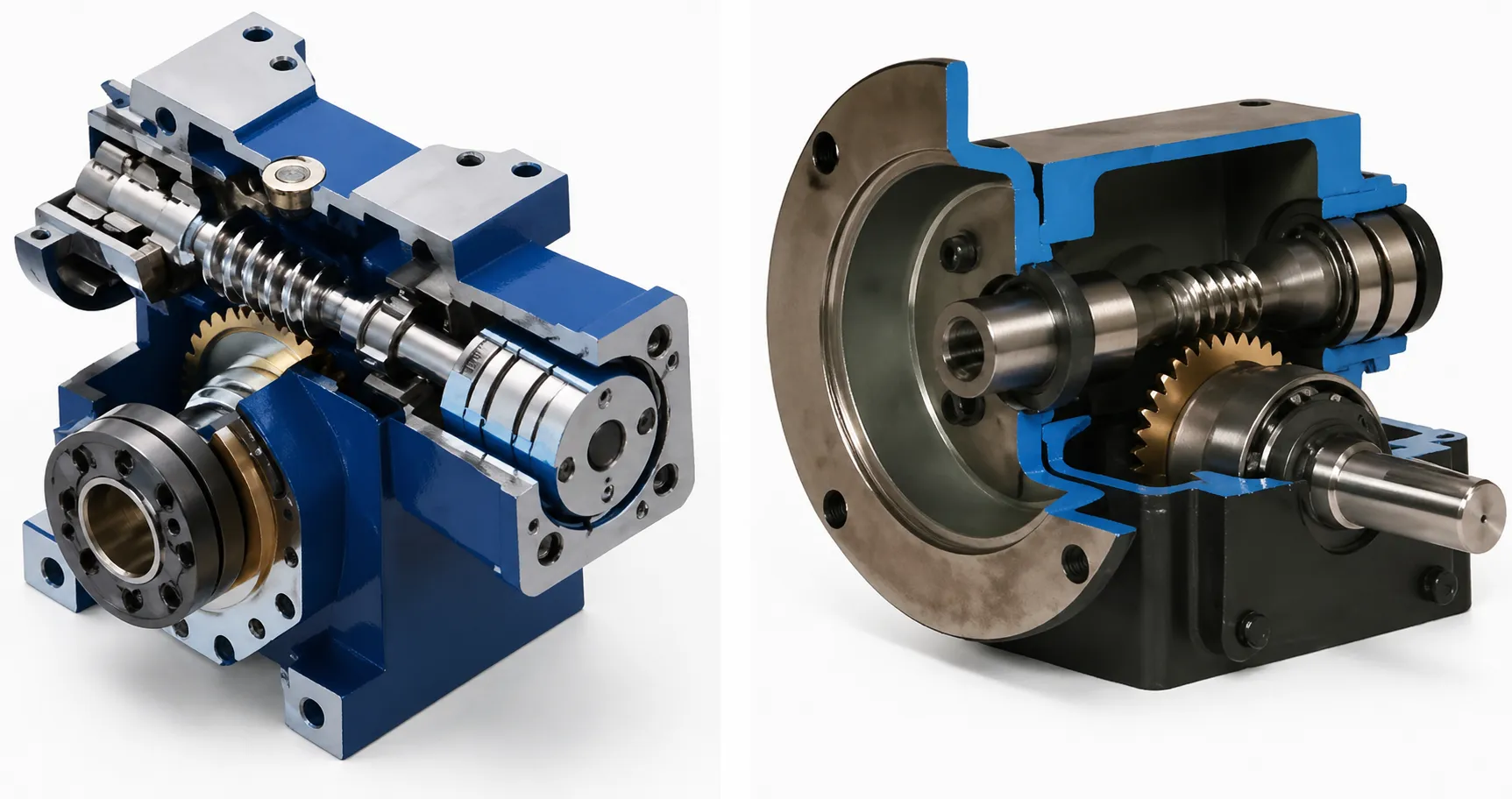
Rubber processing subjects mechanical drives to a combination of extreme torque, high temperature and aggressive chemical contamination that few other industries match. A Banbury internal mixer — the heart of every rubber and tire factory — generates torque spikes of 300-500% of running torque during the mastication phase as cold, hard rubber compound is broken down and mixed with fillers, oils and curatives. The mixer ram drives, rotor door mechanisms, calender roll adjusters, tire building drum indexers, and curing press platen positioners all use worm gear reducer architecture for the self-locking, compact layout and high torque multiplication these positions demand. A single tire plant producing 30,000-50,000 tires per day operates 100-400 worm gear reducer positions across mixing, preparation, building, curing and finishing departments.
The environmental challenges in rubber processing are threefold. First, carbon black dust — the primary reinforcing filler in rubber compounds — coats every surface in the mixing area at concentrations of 5-20 mg/m³ continuously, with peak concentrations of 50-200 mg/m³ during mixer charging. Carbon black is extremely fine (20-100 nm primary particle size), deeply penetrating, and abrasive to seal surfaces. Second, process oils and chemical curatives (sulfur, accelerators, antioxidants) create a chemically aggressive vapour atmosphere that attacks standard NBR seals and alkyd coatings. Third, vulcanisation temperatures of 140-200 °C in curing presses and autoclaves subject nearby worm gear reducer positions to radiant heat comparable to steel mill and plastics barrel proximity. This article walks the mixer shock loading, calender precision, tire building indexing, curing press thermal endurance, and sized recommendations for each rubber processing category.

Banbury Mixer Auxiliary Drives — Extreme Shock and Chemical Exposure
The Banbury internal mixer operates at 30-60 rpm rotor speed with motor power of 500-3,000 kW — the main rotor drive uses helical or planetary gearboxes. However, the mixer auxiliary positions use worm gear reducer: the ram drive (raising and lowering the 500-2,000 kg ram that forces compound into the mixing chamber), the rotor door mechanism (opening and closing the mixer discharge door under 50-200 tonne clamping force), and the batch-off conveyor drive (transporting the hot mixed compound to the calender or mill). The ram drive experiences the full force of the mixing torque spikes — when the ram is fully seated and the mixer rotors engage fresh compound, the ram reaction force spikes to 300-500% of running force. SF 2.0-2.5 is mandatory for Banbury ram and door 웜 기어 감속기 drives.
The mixer discharge environment exposes the worm gear reducer to compound temperatures of 100-150 °C (the mixed rubber batch exits the mixer at these temperatures), carbon black dust from the weighing and charging system, and chemical vapour from process oils and accelerators. FKM seals are mandatory — NBR seals swell and fail within 2-4 months in the oil and accelerator vapour environment. Housing coating must resist both the chemical vapour and the physical impact of compound fragments that fall from the batch-off conveyor: high-build epoxy at 300+ μm with chemical-resistant topcoat. Self-locking on the mixer door drive holds the door closed under the full clamping force during mixing — any door opening during mixer operation would release hot compound at high velocity, creating a severe safety hazard for operators.
Calender Roll Precision and Carbon Black Dust Defense
Calender machines produce rubber sheet, rubberised fabric and tire inner liner by passing the compound through precision-set roll gaps. The worm gear reducer on calender roll gap adjusters positions the movable roll within ±0.02-0.05 mm of the target gap — determining the finished sheet thickness tolerance. Self-locking holds the gap setting under the full nip force (100-500 kN per calender roll pair) without drift during continuous production. Backlash specification of 6-12 arc-minutes is standard for calender gap adjusters — tighter than general industrial but less demanding than printing press register because the rubber sheet tolerance (±0.05-0.1 mm) is wider than print register (±0.05 mm).
Carbon black dust is the dominant contaminant in the mixing and preparation areas of every rubber factory. Carbon black primary particles (20-100 nm) are smaller than any other industrial dust encountered in worm gear reducer applications — they penetrate standard seals by capillary action through microscopic surface imperfections that would block larger particles. The defense requires ultra-high-quality FKM seals with lapped running surfaces (surface roughness Ra ≤ 0.2 μm on the shaft), plus the felt collar pre-filter and sealed desiccant breather standard in dusty environments. Even with these measures, some carbon black ingress is inevitable over time — the mitigation is more frequent oil analysis (every 6 months rather than annually) to detect carbon black contamination before it reaches concentrations that accelerate bearing and mesh wear. Synthetic PAG lubricant suspends carbon black particles less readily than mineral CLP, allowing the particles to settle to the housing bottom where they can be flushed during oil changes — a practical advantage that extends bearing life by 30-50% compared to mineral CLP in the same carbon black environment.
Tire Building Drum Indexing and Curing Press Thermal Endurance
Tire building machines assemble the multiple rubber and textile components (inner liner, body plies, bead wire, belt package, tread, sidewall) onto a rotating drum. The worm gear reducer on the drum indexing drive rotates the drum to precise angular positions for each component application — typically 8-16 index positions per tire, with positioning accuracy of ±0.5-1.0° at the drum surface. Self-locking holds the drum at each index position during component application (3-15 seconds per station) without drift under the tension of the applied rubber and textile layers. A tire building machine operating at 120-180 tires per shift accumulates 960-2,880 index cycles per shift — 280,000-850,000 per year, requiring C3 bearings for indexing fatigue endurance.
Curing (vulcanisation) presses operate at 140-200 °C internal temperature for 8-20 minutes per tire, with press clamping forces of 200-3,000 tonnes. The worm gear reducer on curing press platen height adjusters, mold loading mechanisms and press opening/closing drives operates in radiant heat fields of 60-100 °C ambient — comparable to steel mill delivery table and paper mill dryer section temperatures. Thermal derating for curing press worm gear reducer follows the familiar formula: at 80 °C + continuous 3-shift duty, usable power is 28-35% of catalogue. The press opening/closing drive must move the heavy upper platen (5-20 tonnes) reliably at every cycle — failure to open the press after curing traps the tire inside, requiring emergency manual extraction at production cost of $500-$2,000 per event. Self-locking holds the press platen at the fully open position during tire loading and unloading, preventing the platen from descending under its own weight.
Industrial Rubber Products: Hose, Belt and Gasket Production
Beyond tire manufacturing, the industrial rubber sector produces hydraulic hoses, conveyor belts, gaskets, seals, vibration mounts and moulded rubber components — each with distinctive worm gear reducer drive requirements. Hose production lines use worm gear reducer drives on mandrel winding and braiding machines (precise mandrel rotation at 30-120 rpm with self-locking hold during braid layer application), hose wrapping machines (continuous spiral wrapping at controlled tension), and autoclave loading mechanisms (positioning heavy mandrel racks inside the vulcanisation autoclave at 150-180 °C). Conveyor belt production uses worm gear reducer drives on the belt building drum (similar to tire building but at larger scale — belt drums up to 2,000 mm diameter), fabric tension rolls, and press loading systems. These positions share the same carbon black dust, chemical vapour and high-temperature challenges as tire production but at different scale and cycle rate.
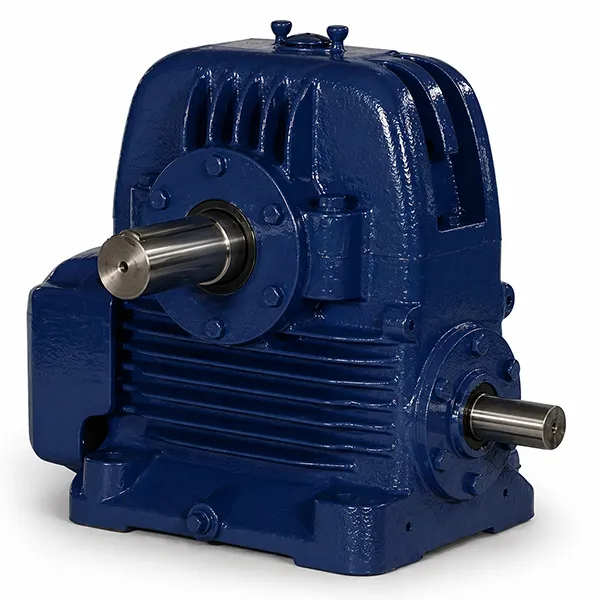
Gasket and seal production — typically smaller-scale batch manufacturing — uses worm gear reducer drives on compression moulding press platen adjusters, transfer moulding injection mechanisms, and die-cutting machine feed drives. These positions operate at lower power (0.37-3 kW) and lower cycle rate than tire production, but the precision requirements can be tighter: medical-grade silicone gaskets for pharmaceutical equipment require mould compression uniformity within ±0.01-0.02 mm, demanding reduced-backlash worm gear reducer specification (6-10 arc-minutes) on the moulding press platen adjuster. Self-locking holds the platen at the exact compression distance during the cure cycle (2-30 minutes depending on compound and thickness), preventing thickness drift under the sustained press force that would produce out-of-tolerance gaskets.
Fleet Management for Rubber Factory Worm Gear Reducer Positions
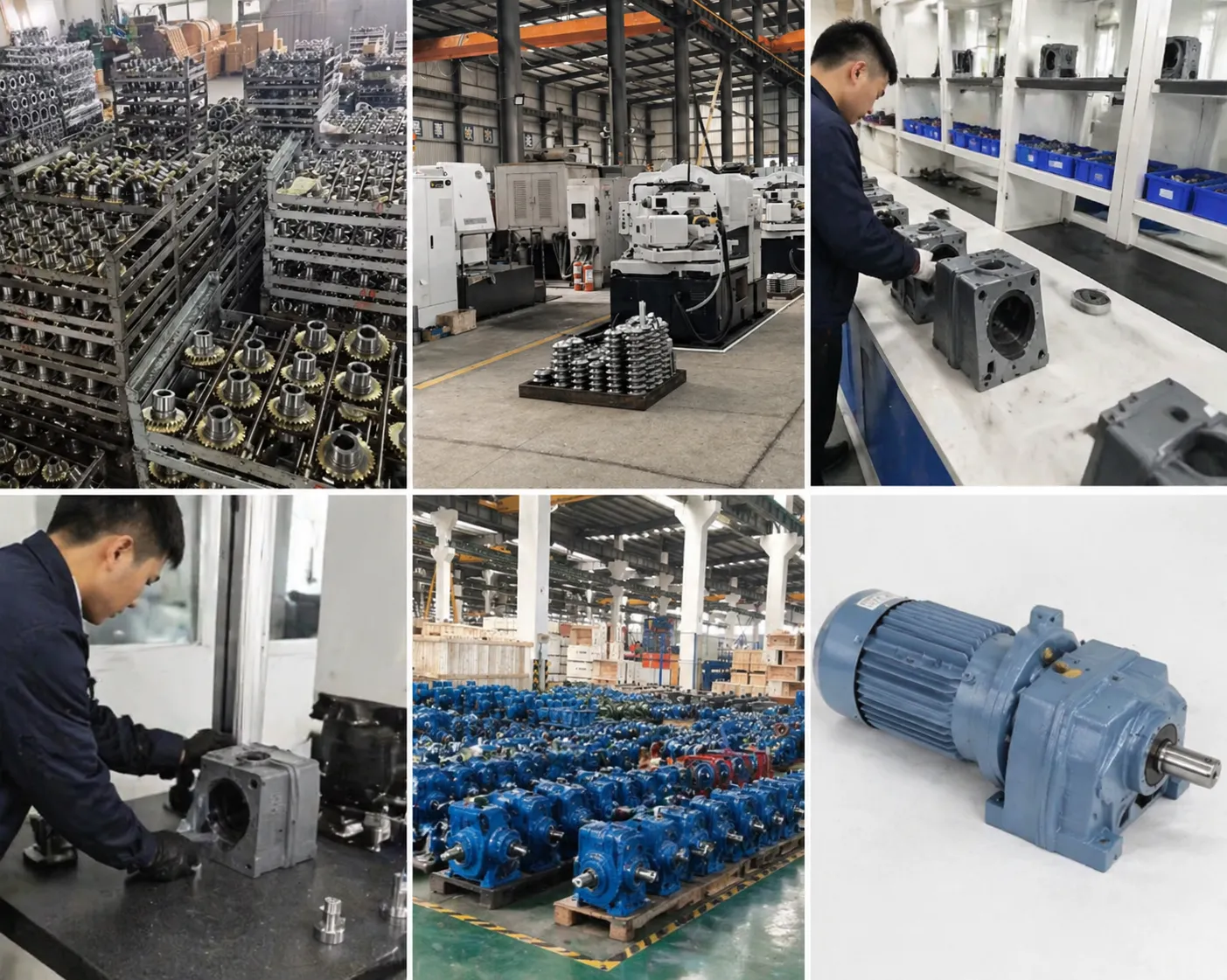
A tire factory operating 100-400 worm gear reducer positions benefits from zone-based fleet management similar to paper mill and steel mill approaches. The rubber factory divides into four specification zones: Zone A (mixing department — highest SF, highest chemical, highest carbon black), Zone B (preparation and calendering — moderate SF, moderate chemical, high carbon black), Zone C (building department — moderate cycle, moderate precision, low chemical), and Zone D (curing and finishing — high temperature, moderate SF, low chemical). Each zone uses the same 2-3 standardised frame families but with zone-specific seal material (FKM grade), lubricant (PAG standard versus PFPE for curing press proximity), coating system (high-build chemical-resistant for Zone A versus standard epoxy for Zone C) and maintenance interval (6-monthly oil analysis for Zone A versus annual for Zone C). This zoned specification approach optimises cost by concentrating the highest-specification worm gear reducer components on the zones with the highest environmental severity, while avoiding unnecessary over-specification on lower-severity zones.
The spare parts strategy for a 100-400 unit rubber factory fleet maintains 6-12 pre-assembled spare worm gear reducer units at a central maintenance store (2-3 per standardised frame family, filled with the appropriate zone lubricant and fitted with the appropriate zone seal configuration). This inventory capital of $15,000-$40,000 covers every position in the factory with a single visit to the store — recovering its cost within the first avoided unplanned line stoppage on a high-output tire building or curing press line where downtime costs $5,000-$20,000 per hour in lost tire production.
Sizing for Common Rubber Processing Drives
Five rubber processing categories account for the majority of 웜 기어 감속기 demand:
◎ RUBBER 01
Banbury mixer ram and door
Motor 5.5-30 kW per auxiliary. Frame WPDS 200+. SF 2.0-2.5 for mixing shock. Self-locking door hold under 50-200 tonne clamp. FKM for chemical vapour. Carbon black dust defense. 24/7 3-shift.
◎ RUBBER 02
Calender roll gap adjuster
Motor 2.2-11 kW. Frame WPA 130-WPDS 200. Self-locking under 100-500 kN nip force. Backlash 6-12 arc-min. Precision ±0.02-0.05 mm sheet thickness. Carbon black defense. 60-80 °C ambient.
◎ RUBBER 03
Tire building drum indexer
Motor 1.5-5.5 kW. 8-16 index positions per tire. Frame NMRV 075-WPA 130. C3 bearings (280K-850K cycles/year). Self-locking index hold. ±0.5-1.0° precision. Moderate temperature.
◎ RUBBER 04
Curing press platen and mold loader
Motor 3-15 kW. Frame WPA 130-WPDS 200. 60-100 °C ambient from press radiant heat. Self-locking platen hold. Thermal derating 3-4× motor. FKM for vulcanisation fumes. SF 1.4-1.6.
◎ RUBBER 05
Extrusion and finishing auxiliary
Motor 0.75-7.5 kW. Tread extruder die adjuster, cooling line conveyor, trim cutter, inspection conveyor. Frame NMRV 063-WPA 130. Self-locking die hold. Precision for tread profile. Moderate environment.
Common Rubber Processing Drive Mistakes
NBR seals in mixing area chemical vapour
Process oils and accelerator vapour swell and degrade NBR within 2-4 months. FKM seals are mandatory on every worm gear reducer in the mixing and preparation departments — no exception.
SF 1.5 on Banbury mixer ram drive
Mixing shock generates 300-500% torque spikes during mastication. SF 2.0-2.5 is mandatory. Under-sizing produces tooth and bearing failure within 6-18 months of production — typically during peak production periods when the mixer runs hardest compounds.
Annual oil analysis in carbon black environment
Carbon black penetrates seals continuously — annual oil analysis misses the window where contamination accelerates bearing wear. Every 6 months is the recommended interval in carbon black environments to detect contamination before it causes irreversible damage.
No thermal derating on curing press drives
Curing press radiant heat at 60-100 °C ambient reduces usable worm gear reducer thermal power to 28-50% of catalogue. Under-sizing produces thermal failure within 12-24 months on 3-shift tire production.
Rubber Processing Worm Gear Reducer FAQ
Q: How many worm gear reducer positions does a typical tire plant operate?
A: A tire plant producing 30,000 tires/day operates 100-400 worm gear reducer positions: 10-30 mixing department auxiliaries (Banbury ram, door, batch-off), 15-40 preparation and calendering drives, 30-100 tire building drum indexers and component feed drives, 30-150 curing press platen and mold loader drives, and 15-50 finishing, inspection and material handling drives. Standardising on 3-5 frame families reduces the spare inventory to 8-15 units covering the entire plant.
Q: What service life is expected in rubber processing?
A: Banbury auxiliaries (extreme shock + chemical + carbon black): 4-6 years to overhaul with proper SF 2.0+ and FKM specification. Calender gap adjusters (moderate duty): 8-12 years. Tire building drum indexers (moderate cycle, clean environment): 8-12 years. Curing press drives (high temperature, moderate cycle): 5-8 years. Under-specified units in the mixing department: 3-12 months. The mixing department is the hardest environment in the tire factory — invest the highest specification here.
Q: Does self-locking matter in rubber and tire production?
A: Yes — critically for five positions. Banbury door hold under 50-200 tonne clamp force (safety-critical). Calender gap hold under 100-500 kN nip force (quality-critical). Tire building drum index hold during component application (quality-critical). Curing press platen hold during tire loading/unloading (safety-critical — prevents platen descent on operator). Tread extruder die hold for profile accuracy (quality-critical). In each case, self-locking at ratio ≥30 provides passive hold without requiring separate brakes or hydraulic clamps.
Q: How do I get a sized recommendation for my rubber processing machinery?
A: Send our engineering team the factory details: process type (tire, industrial rubber, hose, belt, gasket), equipment list (mixer, calender, building machine, curing press, extruder), motor power per position, ambient temperature per zone, carbon black exposure level, chemical exposure (compounds used), operating hours and shift pattern, and total drive count. We return sized recommendations with SF calculation, chemical resistance specification, thermal derating and fleet pricing within 48-72 hours.
Q: What maintenance schedule applies to rubber factory worm gear reducer?
A: Zone A (mixing): monthly visual, every 6 months oil sample and felt collar replacement, 12-monthly oil replacement with synthetic PAG. Zone B (calendering): monthly visual, 6-monthly oil level, 12-monthly oil sample, 24-monthly oil replacement. Zone C (building): quarterly visual, annual oil sample, 24-36 monthly oil replacement. Zone D (curing press): monthly visual, 6-monthly oil sample (thermal degradation monitoring), 12-18 monthly oil replacement. Every 3-5 years across all zones: bearing vibration analysis on high-duty positions. All maintenance scheduled during planned production shutdowns — most rubber factories operate weekend maintenance windows that provide 16-36 hours of continuous access for drive fleet maintenance activities across all zones simultaneously.
Sourcing Worm Gear Reducer for Rubber Processing?
Send us process type, equipment list, carbon black exposure and curing temperature. Our Korean engineering team returns sized recommendations with SF calculation and chemical defense specification within 48-72 hours.
편집자: Cxm