An alternate system uses a fog or good mist injected in to the intake air stream. Although a number of commercial systems can be found, growers can assemble and install their own system using a ruthless piston pump and fog nozzles. The essential components are demonstrated in Fig. 1. A two-stage system managed by a two- stage thermostat enables more water to be employed on excessively warm, shiny days. Temperature settings should be 5-10°F apart.
Algae growth in the pads can become a problem that will decrease the effectiveness of the machine and lead to accelerated deterioration of the pads. The addition of an algaecide to the drinking water supply can help in control.
It really is desirable, especially in hard water areas, to include a wetting agent to the drinking water to obtain additional uniform wetting of the pads. A commercial materials or liquid home detergent at the price of 2 tablespoons per 100 gallons can be used.
Drinking water for the pads ought to be clean and low in mineral content to prevent clogging and coating of the pads. A pump, pipes and gutters are used to recirculate the drinking water. A flow rate 113 gallon per minute per linear foot of pad system should be provided to assure adequate wetting.
In the most common coolant system (fan and pad), the fans draw air through wet pads 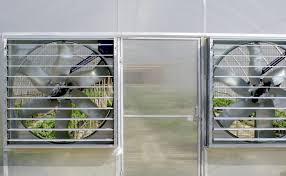 that expand the length of one endwall or sidewall. Aspen and covered cellulose are common pad materials that usually have life of 1 to 3 years. Approximately one square foot of pad are is necessary for 20 square foot of floor area.
To check out a full summary of Greenhouse Exhaust Fan click.