Elevators represent the single largest installed base of worm gear reducer applications in the built environment. Every passenger elevator, freight elevator, dumbwaiter and home lift requires at least two worm gear reducer positions: the door operator (opening and closing the landing and car doors at each stop) and, on geared traction systems, the main traction machine (raising and lowering the car through the hoistway). A mid-rise residential building with four elevators contains 8-12 worm gear reducer units; a 40-storey commercial tower with eight high-speed elevators may contain 16-32 units. Globally, the installed base exceeds 18 million elevators, with 700,000-1,000,000 new installations per year — each requiring purpose-specified worm gear reducer drives that satisfy the most stringent safety standards in any mechanical equipment category.
The worm gear reducer dominates both elevator drive positions for the same reason it dominates escalators and cranes: self-locking. On the traction machine, self-locking prevents the car from free-falling if the motor fails — the most catastrophic elevator failure mode. On the door operator, self-locking holds the door in the open or closed position without continuous motor energisation, reducing energy consumption and preventing uncontrolled door drift. This article walks the two elevator drive positions, EN 81 safety requirements, noise control for residential and hospital environments, precision leveling demands, and sized recommendations across the major elevator categories.
Two Elevator Drive Positions — Door Operator and Traction Machine
The door operator and traction machine impose fundamentally different load profiles on the worm gear reducer, and each carries a different safety consequence of failure.
EN 81 Safety Standard and Self-Locking Anti-Fall Protection
EN 81-20/50 (Safety rules for the construction and installation of lifts) governs elevator safety across Europe and most global markets through harmonised adoption (ASME A17.1 in North America, GB 7588 in China, KS B 6201 in Korea). The standard requires that the elevator car must be held at any position in the hoistway by at least one mechanical device independent of the motor — either a mechanical brake on the traction sheave, or a self-locking gear mechanism, or both. A geared traction machine using a self-locking worm gear reducer satisfies this requirement inherently: even without the mechanical brake engaged, the worm mesh geometry prevents the car from moving under the weight imbalance between car and counterweight.
This dual-holding architecture — mechanical brake plus worm self-locking — provides two independent anti-fall mechanisms. If the brake fails (pad wear, contamination, solenoid failure), the worm self-locking holds. If the worm self-locking is compromised (which requires actual tooth breakage — extremely rare), the brake holds. The probability of both failing simultaneously is the product of their individual failure probabilities — typically reducing the anti-fall failure rate from 10⁻⁵ per year (single brake alone) to below 10⁻⁹ per year (brake plus self-locking), well within the safety integrity levels required for passenger-carrying equipment.
For machine-room-less (MRL) elevator configurations — increasingly the global standard for new residential and commercial installations — the geared traction machine sits at the top of the hoistway rather than in a separate machine room. The worm gear reducer in MRL installations must meet tighter noise and vibration requirements because the drive mechanism is now inside the hoistway, transmitting sound directly to the building structure and ultimately to occupied spaces on adjacent floors. Noise specification for MRL worm gear reducer typically targets <48 dB(A) at 1 metre — requiring precision-ground worm, cast iron housing and vibration-isolation mounting as baseline rather than optional extras.
Noise Control for Residential and Hospital Elevator Environments
Elevator noise complaints are the single most common post-installation issue in residential buildings — the worm gear reducer traction machine runs at floor level next to living spaces (in MRL configuration) or in a machine room directly above the top-floor penthouse. Hospital elevators face even stricter requirements: patient areas demand ambient noise below 35-40 dB(A), and elevator drive contribution must be inaudible within patient rooms.
The noise control methodology for elevator worm gear reducer follows the same four-measure approach as escalator drives but at even tighter targets. Cast iron housing reduces radiated noise by 3-5 dB(A). Precision-ground worm shaft (ISO class 4 or better for hospital/luxury residential) reduces tooth-mesh noise by 6-10 dB(A). Synthetic PAG lubricant contributes 1-2 dB(A) damping. Vibration-isolation mounting on elastomeric pads prevents structural transmission — this fourth measure is particularly critical in MRL installations where the machine sits directly on the building structure. The combined effect: a well-specified elevator worm gear reducer produces 42-50 dB(A) at 1 metre, versus 65-75 dB(A) for a standard industrial unit at the same power — a 20-30 dB(A) reduction that makes the difference between inaudible and complaint-generating.
VFD Precision Leveling and Ride Quality
Modern elevator installations universally use VFD (variable frequency drive) control for smooth acceleration, deceleration and precision floor leveling. The worm gear reducer interacts with VFD control in two important ways. First, the backlash in the worm mesh creates a positional dead zone during direction reversal (when the car decelerates and stops). The VFD controller must compensate for this backlash during the final leveling approach — typically the last 10-30 mm of travel. At standard catalogue backlash (15-25 arc-minutes), the corresponding linear dead zone at the traction sheave is 0.5-2.0 mm — within acceptable leveling tolerance for most passenger elevators (±5 mm). For hospital bed elevators and freight elevators where leveling accuracy of ±3 mm is required, reduced-backlash specification (8-12 arc-minutes) may be necessary.
Second, VFD operation at very low speed during the leveling phase (typically 0.05-0.15 m/s, corresponding to 2-8 rpm at the worm gear reducer output) creates a smooth-running challenge. At these low speeds, individual tooth-mesh impacts become perceptible as vibration and low-frequency noise — a “rumbling” or “grinding” sensation that passengers associate with poor ride quality. Precision-ground worm and wheel surfaces are the primary countermeasure: the smoother tooth profiles reduce individual mesh impact amplitude, maintaining ride quality down to the lowest leveling speeds. Synthetic PAG lubricant provides supplementary film damping at low speed where hydrodynamic lubrication transitions to boundary lubrication.
Geared Worm Traction vs Gearless Permanent Magnet — Market Positioning
The elevator industry has undergone a significant shift toward gearless permanent-magnet (PM) traction machines over the past two decades, particularly in high-rise and premium commercial segments. However, geared worm gear reducer traction machines retain a substantial and stable market share for compelling technical and economic reasons. At the 2-6 floor residential segment (which accounts for approximately 45% of global new elevator installations by unit count), the worm gear reducer traction machine costs 30-50% less than an equivalent PM gearless machine. The energy efficiency advantage of gearless (85-92% system efficiency vs 70-82% for geared worm) produces annual savings of $200-$600 per elevator at typical residential usage rates — meaning the PM premium requires 8-15 years to recover through energy savings on low-rise buildings where daily trip counts are modest.
For freight elevators, the worm gear reducer advantage is even more pronounced. Freight loads generate starting torque spikes of 150-250% of rated when forklifts enter and exit the car — shock loads that PM gearless machines handle less gracefully than the inherently robust worm mesh and bronze wheel combination. The self-locking characteristic also provides passive holding during forklift loading operations without continuous brake engagement, reducing brake pad wear and maintenance frequency. For modernisation and retrofit projects — replacing aging traction machines in existing buildings — worm gear reducer units offer dimensional compatibility with legacy installations that PM gearless machines frequently cannot match without extensive hoistway modification.
Door Operator — The Hidden High-Cycle Worm Gear Reducer Position
The elevator door operator is frequently overlooked in worm gear reducer specification because the motor power is small (0.1-0.55 kW) and the torque is modest. However, the door operator accumulates more mechanical cycles than the traction machine by a factor of 2-4×: every elevator trip requires one door open and one door close, but many trips involve multiple door re-openings (passenger hold, obstruction sensing, floor re-routing). A busy commercial elevator executing 600 trips per day with an average of 1.3 door cycles per trip accumulates 780 open-close cycles daily — 285,000 per year, or 5.7 million over a 20-year life. This cycle count is comparable to packaging machinery indexing duty and demands the same bearing specification: C3 internal clearance with anti-fretting cage geometry rated for oscillating service.
The door operator worm gear reducer also faces a unique noise challenge: the door mechanism operates at ear level with passengers standing immediately adjacent. Door noise is perceived differently from traction machine noise — traction machine sounds are muffled by distance and structure, while door mechanism sounds are direct and close-range. Precision-ground worm specification on the door operator is therefore as important as on the traction machine for passenger perception of ride quality, despite the much lower power level. A quiet, smooth door operation is one of the first quality indicators passengers notice — and a noisy, rough door operation brands the entire elevator installation as low-quality regardless of the traction machine specification.
Sizing for Common Elevator Categories
Five elevator categories define the snäckväxelreducerare sizing landscape for vertical transport:
◎ CATEGORY 01
Passenger elevator — residential (630-1,000 kg)
Traction: 3-7.5 kW. Door: 0.1-0.25 kW. Speed 1.0-1.6 m/s. Frame WPA 130-WPDS 175 (traction), NMRV 040-050 (door). Noise-critical: precision-ground for MRL. 100-300 trips/day.
◎ CATEGORY 02
Passenger elevator — commercial (1,000-2,500 kg)
Traction: 7.5-22 kW. Door: 0.15-0.37 kW. Speed 1.6-3.0 m/s. Frame WPDS 175-WPDS 250 (traction). 300-800 trips/day. Higher duty SF 1.2-1.4.
◎ CATEGORY 03
Hospital bed elevator (2,500-5,000 kg)
Traction: 11-30 kW. Wide doors (1,100-1,400 mm): door motor 0.25-0.55 kW. Leveling ±3 mm for bed wheel transition. Noise <45 dB(A). 200-500 trips/day. Premium noise specification mandatory.
◎ CATEGORY 04
Freight / goods elevator (2,000-10,000 kg)
Traction: 11-45 kW. Speed 0.5-1.0 m/s (slower, heavier). Frame WPDS 200+. SF 1.4-1.6 for forklift loading shock. Noise less critical. Industrial IP54-IP65 environment.
◎ CATEGORY 05
Home / platform lift (250-500 kg)
Traction or screw: 0.75-3 kW. Speed 0.15-0.5 m/s. Frame NMRV 075-WPA 110. Ultra-compact — gearbox fits within the guide rail structure. Self-locking critical for unattended home installation where maintenance is minimal. Noise <50 dB(A) for domestic environment.
Common Elevator Drive Specification Mistakes
◎ MISTAKE 01
Standard-hobbed worm in residential MRL installation
Standard worm produces 65-75 dB(A) — audible through walls into adjacent apartments. MRL residential requires precision-ground worm at ISO class 4-5 to achieve <48 dB(A). The noise premium recovers immediately in avoided resident complaints and building management disputes.
◎ MISTAKE 02
No vibration isolation on MRL traction machine
Without elastomeric isolation pads, worm gear reducer mesh vibration transmits through the building structure to adjacent floors. Even a precision-ground unit at 45 dB(A) airborne can produce 55+ dB(A) structure-borne noise in the apartment above without isolation.
◎ MISTAKE 03
Ignoring door operator cycle count endurance
A busy commercial elevator door opens and closes 500-1,000 times per day — 180,000-365,000 cycles per year. Over 15-20 years, that is 3-7 million cycles. Standard bearings fail from indexing fatigue within 3-5 years. Specify indexing-rated C3 bearings on door operator worm gear reducer for commercial and metro applications.
◎ MISTAKE 04
Freight elevator sized without forklift impact SF
Forklift entry generates 150-250% of static car weight as dynamic impact load. SF 1.4-1.6 is mandatory for freight elevators with forklift access. Sizing at SF 1.0 produces traction machine bearing failure within 2-4 years.
Elevator Worm Gear Reducer FAQ
Q: Is geared traction still relevant given the growth of gearless (permanent magnet) machines?
A: Yes — geared traction using worm gear reducer remains dominant in two segments. First, low-rise residential (2-6 floors) where the lower capital cost of geared machines (30-50% less than gearless) outweighs the energy efficiency advantage of gearless on short travel distances. Second, freight and goods elevators where the high torque and shock-loading resistance of worm gear reducer architecture suits heavy-duty service better than the permanent-magnet designs optimised for smooth passenger ride. Gearless dominates high-rise (>10 floors) and premium commercial segments where energy cost over 20 years justifies the capital premium.
Q: What is the expected service life of an elevator snäckväxelreducerare?
A: Traction machine: 15-25 years to major overhaul (bronze wheel replacement) on residential duty, 10-15 years on heavy commercial duty. Door operator: 10-15 years on residential, 5-8 years on heavy commercial/metro (high cycle count). The traction machine housing typically serves the full 25-30 year elevator lifecycle with one or two wheel replacements. Door operators may require full replacement once during elevator lifecycle on heavy-traffic installations.
Q: What maintenance schedule applies to elevator worm gear reducer?
A: Monthly: visual inspection integrated into mandatory elevator maintenance visit — oil level, leaks, abnormal noise, brake pad condition. Every 12-18 months: oil sample analysis (synthetic PAG) or oil replacement (mineral CLP). Every 3-5 years: bearing vibration analysis. Every 5-7 years: backlash measurement and brake adjustment. The worm gear reducer maintenance aligns entirely with the elevator statutory maintenance programme — no dedicated visits are required beyond what the elevator maintenance contract already provides.
Q: How many worm gear reducer units does a typical building require?
A: Each geared-traction elevator requires one traction machine worm gear reducer (main lift) plus one door operator worm gear reducer (door opening/closing) — total 2 per elevator. A 10-storey residential building with two elevators: 4 units. A 30-storey commercial tower with six elevators: 12 units. A metro station with four escalators and two elevators: 8 worm gear reducer units (4 escalator main drives + 2 elevator traction + 2 elevator doors). For building-wide fleet pricing and standardised specification, send the full vertical transport schedule to our engineering team.
Q: How do I get a sized recommendation for my elevator project?
A: Send our engineering team the elevator details: type (passenger/freight/hospital/home), rated load (kg), speed (m/s), rise (metres), number of stops, traction machine motor power, door type and width, noise requirement (dB(A)), and applicable safety standard (EN 81, ASME A17.1, GB 7588). We return sized recommendations for both traction machine and door operator with noise class, anti-fall verification and lead time within 24-48 hours.
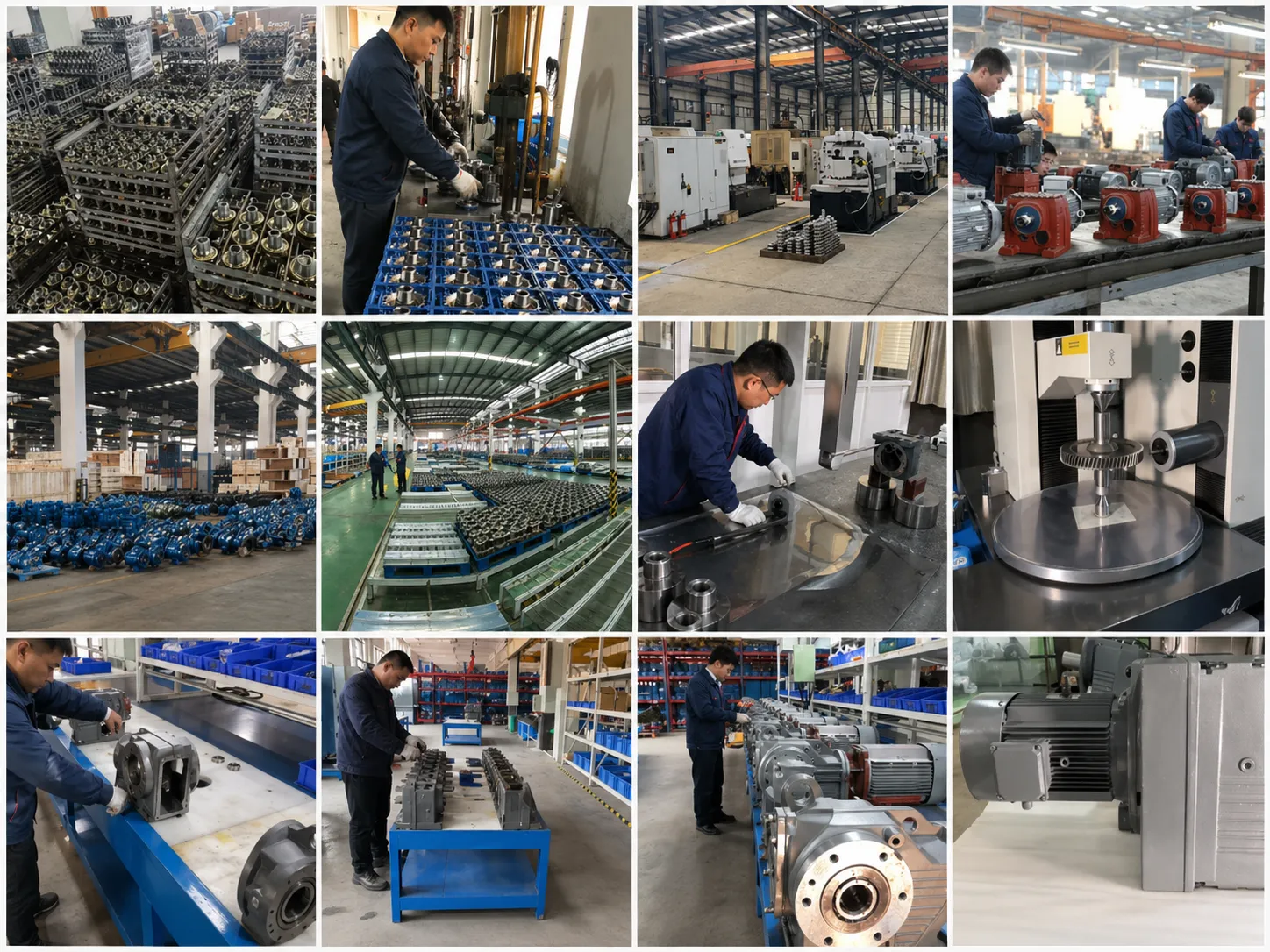
Sourcing Worm Gear Reducer for Elevator Project?
Send us elevator type, rated load, speed, rise and noise requirement. Our Korean engineering team returns sized recommendations for traction machine and door operator with EN 81 compliance verification within 24-48 hours.
Redaktör: Cxm