Utility-scale and commercial-scale solar tracking installations have grown from a niche premium option to the default architecture for ground-mounted photovoltaic plants, with single-axis tracker penetration exceeding 70% of new installations in high-irradiance markets across the Middle East, Southeast Asia, Australia and southern US. Every tracker row requires at least one rotational drive — and for dual-axis configurations, two — to follow the sun path across the sky while resisting wind-induced moments that can exceed 50 kNm on a fully deployed tracker wing. The dominant drive architecture for this duty is the enclosed slew drive, which is fundamentally a worm gear reducer integrated with a slewing bearing into a single sealed housing.
The engineering question facing EPC contractors and tracker OEMs is whether to specify a proprietary slew drive module — typically 2-3× the capital cost of a standard industrial unit — or to achieve equivalent performance from a properly specified standard worm gear reducer with appropriate mounting and sealing modifications. This article walks the technical comparison, the wind load holding torque calculation, the self-locking mechanism that makes worm architecture uniquely suited to solar tracking, outdoor environmental defense layers, and sizing across the major tracker configurations.
Why Solar Trackers Rely on Worm Architecture Over Competing Gearbox Types
Three architectural advantages make the worm gear reducer the default drive mechanism for solar tracking applications, ahead of helical, planetary and cycloidal alternatives. The first and most critical is inherent self-locking. At ratios above approximately 30:1, the worm thread lead angle falls below the friction angle of the bronze-on-steel contact — meaning the output shaft cannot back-drive the input. In solar tracker terms, this translates to passive wind-load holding: if power is lost during a storm event, the tracker panel remains locked at its current tilt angle without requiring an external brake, battery backup, or emergency motor intervention. Helical and planetary alternatives lack this characteristic entirely, requiring electromechanical brakes that add weight, cost, wiring and a failure mode (brake pad wear, solenoid failure, battery depletion) to every row in a 100+ MW solar field.
The second advantage is the compact right-angle layout. Solar tracker torque tubes run horizontally; the drive motor mounts vertically or near-vertically. The 90° input-to-output axis change inherent in worm gear reducer architecture fits this geometry without intermediate coupling stages that add length, weight and potential failure points. A typical tracker row requires 150-200 mm of axial envelope for the drive unit — well within the dimensional envelope of standard worm gearbox frames from NMRV 075 through WPA 150.
The third advantage is cost-density. Worm gear reducer units in the 0.55-4 kW power range — the band covering most single-axis tracker configurations — cost 35-55% less per unit than equivalent-rated helical-bevel or planetary alternatives, and 60-70% less than proprietary slew drive modules from specialist manufacturers. At 100-500 rows per solar field, this per-unit differential compounds into a significant capital advantage.
Single-Axis vs Dual-Axis Solar Tracker Drive Requirements
Single-axis and dual-axis trackers impose fundamentally different load profiles on the worm gear reducer. Understanding these differences before sizing prevents both over-specification (excess capital) and under-specification (field failure).

Slew Drive Module vs Standard Worm Gear Reducer: Technical Comparison
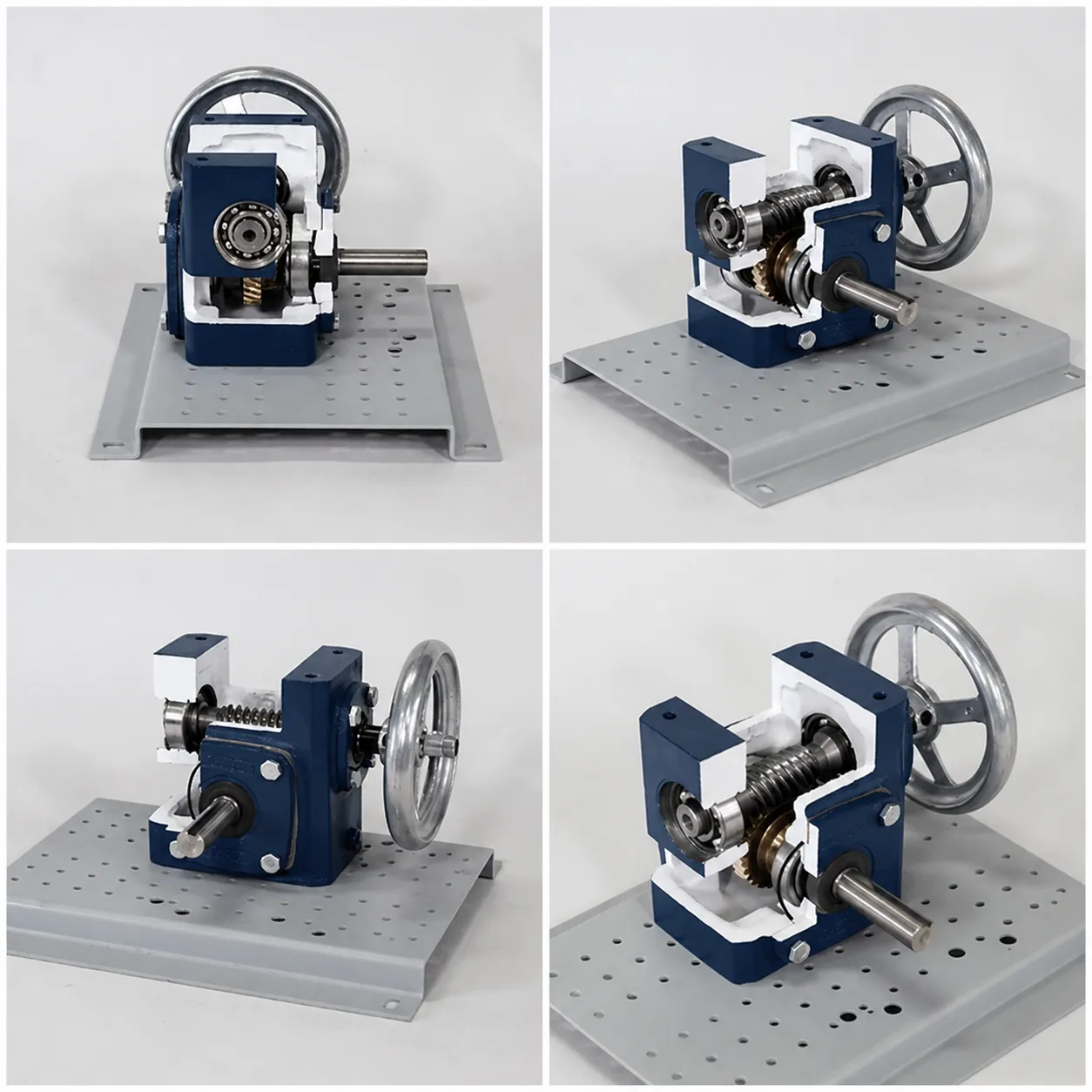
A proprietary solar slew drive is an integrated module — worm gearbox, slewing ring bearing, output flange, seals and housing in one unit. A standard industrial worm gear reducer requires separate external bearing support but offers significant flexibility and cost advantages. The comparison below maps the trade-offs:
| Parametro | Proprietary Slew Drive | Standard Worm Gear Reducer |
|---|---|---|
| Integration level | Fully integrated unit | Requires separate bearing support |
| Capital cost per unit | 100% baseline (high) | 35-50% of slew drive |
| Axial load capacity | High (integrated bearing) | External bearing required |
| Radial load capacity | High (slewing ring) | Medium (output bearings only) |
| Field replaceability | Entire module swap | Gearbox-only swap (bearing stays) |
| Supply chain flexibility | Single-source (OEM-specific) | Multi-source (standard frames) |
| Self-locking | Yes (integral worm stage) | Yes (ratio ≥ 30) |
| Lead time | 8-16 weeks (specialty) | 2-4 weeks (stocked frames) |
The practical decision: for single-axis trackers with moderate row lengths (40-90 panels per string), a standard worm gear reducer with external pillow-block bearing support delivers equivalent functional performance at 35-50% capital cost. For dual-axis trackers where the azimuth drive carries the full array weight (high axial + radial combined load), the integrated slew drive module is typically warranted. For large single-axis installations (>500 rows), the capital savings from standard gearbox specification compounds to millions of dollars in total project cost reduction.
Wind Load Holding Torque Calculation for Solar Trackers
The dominant design load for a solar tracker worm gear reducer is not the tracking torque (which is small — panels move slowly under low friction) but the wind-load holding torque during storm events. The worm gear reducer must hold the tracker in stow position (typically 0° horizontal or maximum-tilt defensive angle) against wind-induced aerodynamic moments without back-driving. The calculation combines three parameters:
T_hold = 0.5 × ρ × V² × A × C_m × L_arm × SF_wind
ρ (air density)
1.225 kg/m³ at sea level, 15 °C. Adjust for altitude: at 1,500 m ≈ 1.06 kg/m³.
V (design wind speed)
3-second gust at hub height. Typical: 40-55 m/s (IEC 61400 wind class I-III equivalent).
A × C_m (panel area × moment coefficient)
Panel area: 40-120 m² per row. C_m: 0.3-0.7 depending on tilt angle and wind incidence.
L_arm × SF_wind
Lever arm from torque tube centre to wind-pressure centroid (typically 1.2-3 m). SF_wind: 1.3-1.5 typical safety margin.
Worked example: A 90-panel single-axis tracker row, panel area 85 m², design wind 50 m/s, C_m at stow position of 0.35, lever arm 2.2 m, SF_wind of 1.35. T_hold = 0.5 × 1.225 × 50² × 85 × 0.35 × 2.2 × 1.35 ≈ 63,200 Nm. The worm gear reducer output torque rating must exceed 63.2 kNm — pointing to heavy-frame units (WPDS 175 or larger). Note that this calculation frequently surprises specifiers who size based on the small tracking torque (typically <200 Nm) rather than the dominant wind-holding torque.
Self-Locking as Passive Storm Safety Mechanism
Self-locking transforms from a mechanical convenience into a critical safety mechanism in solar tracker applications. During a storm event, grid power may be lost, communication links to the central tracker controller may fail, and backup battery capacity may be depleted. In any of these scenarios, the worm gear reducer’s inherent self-locking holds each tracker row at its last commanded position — stow angle, maximum defensive tilt, or any intermediate position — without requiring any active energy input, mechanical brake engagement, or control system intervention.
The physics behind this passive holding capability: at ratio ≥ 30, the worm lead angle (typically 3-5°) falls below the friction angle (typically 6-11° for hardened steel worm against CuSn12 bronze ruota a vite senza fine with mineral or synthetic lubrication). The output torque from wind loading attempts to back-drive the worm, but the friction angle exceeds the thread geometry and the output remains locked. This is not a wear-dependent feature — it is geometry-dependent, meaning the self-locking capability does not degrade with age as a brake pad would.
The practical consequence for solar field operations: worm architecture eliminates the need for emergency brake systems on each tracker row. For a 200 MW utility-scale solar plant with 2,000-3,000 tracker rows, this eliminates 2,000-3,000 brake mechanisms, associated wiring, commissioning time and 20-year maintenance liability. The TCO advantage from brake elimination alone typically exceeds the entire capital cost of the worm gear reducer fleet.
IP and Environmental Defense for Outdoor Solar Field Operation
Solar tracker worm gear reducer units operate fully exposed to ambient weather for 20-30 year design lives. No factory roof, no enclosure, no climate control — direct sun, rain, dust storms, salt spray (in coastal installations), and temperature cycling from sub-zero overnight to 60+ °C surface temperature in desert midday. Five environmental defense layers combine to protect the drive:
IP65 minimum sealing
Dust-tight and low-pressure water-jet protected. IP65 is the baseline for all solar field installations, including arid-climate sites where rain is rare but dust storms are frequent. IP66 preferred for coastal, tropical and monsoon-climate deployments.
UV-resistant epoxy + polyurethane coating
Standard alkyd enamel paint degrades within 2-4 years under continuous UV exposure. Two-pack epoxy primer + UV-stabilised polyurethane topcoat extends coating life to 15-20 years. Total film thickness 200-280 μm.
FKM (Viton) output shaft seals
Standard NBR seals harden and crack within 3-5 years under continuous UV + thermal cycling (10-65 °C daily range in desert applications). FKM seals withstand -25 °C to +200 °C and resist UV degradation for 15+ years.
Sealed pressure-equalising breather
Day/night thermal cycling causes the air inside the housing to expand and contract, pulling in moist ambient air through standard open breathers. Sealed PTFE membrane breathers equalise pressure while blocking moisture and dust ingress.
Synthetic PAG lubricant with wide temperature range
Mineral CLP oxidises rapidly at sustained 60+ °C oil-bath temperatures in desert midday, and thickens excessively at sub-zero overnight temperatures. Synthetic PAG with viscosity index (VI) > 180 maintains film protection across -30 °C to +120 °C, matching the full operational envelope of a solar field worm gear reducer through seasonal extremes.
Sizing Worm Gear Reducer for Common Solar Tracker Configurations
Five common solar tracker configurations account for the majority of field-deployed worm gear reducer demand. Each configuration carries a distinctive torque, speed and environmental envelope:
◎ CONFIG 01
Small single-axis (30-60 panels)
Output torque 800-2,500 Nm (wind hold). Motor 0.37-0.75 kW. Frame NMRV 075-NMRV 110. Ratio 60-100. Residential / commercial rooftop scale.
◎ CONFIG 02
Utility single-axis (60-120 panels)
Output torque 3,000-15,000 Nm. Motor 0.75-2.2 kW. Frame WPA 110-WPDS 175. Ratio 80-150. Utility-scale 50-500 MW fields — the highest-volume configuration globally.
◎ CONFIG 03
High-wind single-axis (cyclone zone)
Wind hold torque 15,000-65,000 Nm at 50-55 m/s design gust. Frame WPDS 175-WPDS 250. SF_wind 1.5. Oversized for typhoon-rated installations (Philippines, India, Queensland, Gulf Coast).
◎ CONFIG 04
Dual-axis azimuth drive
Output torque 5,000-25,000 Nm. Motor 1.5-4 kW. Frame WPA 150-WPDS 200. Ratio 100-300. Combined axial + radial loading — integrated slew drive module often specified at this scale.
◎ CONFIG 05
Dual-axis elevation drive
Output torque 500-3,000 Nm. Motor 0.37-1.5 kW. Frame NMRV 090-WPA 130. Ratio 60-150. Gravity-assisted on downward tilt; self-locking critical for holding at maximum tilt angle against wind. Lower torque and cost than the azimuth unit on the same pedestal.
Common Solar Tracker Drive Specification Mistakes
◎ MISTAKE 01
Sizing to tracking torque instead of wind holding torque
Tracking torque is typically <200 Nm. Wind holding torque is typically 2,000-65,000 Nm. Sizing to the former produces a gearbox that fails in the first significant wind event — potentially catastrophic for both the tracker hardware and adjacent rows.
◎ MISTAKE 02
Using IP54 sealing for outdoor field deployment
IP54 is a factory-floor standard. Solar field worm gear reducer units sit fully exposed to weather for 20-30 years — IP65 minimum, IP66 for tropical/coastal. IP54 allows water and dust ingress within months of deployment.
◎ MISTAKE 03
NBR seals in desert applications
Standard NBR seals harden and crack within 3-5 years under sustained UV and thermal cycling. FKM seals are mandatory for any solar field with a 20+ year design life. The per-unit cost difference is typically $2-5 — trivial against 20-year field replacement logistics.
◎ MISTAKE 04
Mineral oil in thermal-cycling environments
Mineral CLP thickens at overnight lows (sub-zero in desert highlands), causing dry-start wear at sunrise. Synthetic PAG with VI >180 maintains film across the full -30 to +120 °C solar field envelope.
◎ MISTAKE 05
Specifying ratio <30 (losing self-locking)
Ratios below 30 do not reliably self-lock — the lead angle may exceed friction angle, allowing the output to back-drive under wind load. Solar tracker worm gear reducer ratio must be ≥30 (preferably ≥50) to guarantee passive wind hold across all operating conditions and lubrication states.
Solar Tracker Worm Gear Reducer FAQ
Q: What is the expected service life of a worm gear reducer on a solar tracker?
A: A properly specified unit (IP65+, FKM seals, UV-stable coating, synthetic PAG, ratio ≥50) is designed for 20-25 year service life matching the PV panel warranty period. The actual limiting factor is seal degradation and lubricant condition — with mid-life seal replacement at year 10-12 and oil change at 5-7 year intervals, the bronze wheel and hardened worm typically outlast the solar field itself. Generic industrial-spec units without outdoor modifications typically fail within 3-7 years, triggering field-wide replacement campaigns that exceed the original capital savings many times over.
Q: How many worm gear reducer units does a typical 100 MW solar plant require?
A: A 100 MW single-axis tracker plant at typical 500 kWp per row deploys approximately 200 tracker rows, each with one worm gear reducer. At larger row configurations (90-120 panels, 800-1,200 kWp per row), the count decreases to 80-125 units. Dual-axis installations double the count (two units per pedestal). Total drive fleet value ranges from $80,000-$200,000 for standard worm gear reducer at 100 MW, vs $300,000-$600,000 for proprietary slew drive modules — a $200,000-$400,000 differential at 100 MW scale alone.
Q: Can a worm gear reducer handle the coastal salt-spray environment of a seaside solar farm?
A: Yes — with the marine-equivalent specification: IP66 sealing, ISO 12944 C4/C5-M coating system (two-pack epoxy + UV-stable polyurethane), 316L stainless fasteners on all external bolts, and FKM triple-lip seals. This adds 25-40% to unit cost vs standard outdoor specification but extends service life to 18-25 years in C4-C5 corrosivity categories. Without the marine-equivalent specification, housing corrosion typically appears within 2-5 years at distances under 2 km from coastline.
Q: What maintenance schedule applies to solar field worm gear reducer?
A: Annual: visual inspection of coating condition, seal integrity, breather condition, fastener torque. Every 5-7 years: lubricant replacement (synthetic PAG fill) with oil sampling before replacement for condition monitoring. Year 10-12: planned seal replacement campaign (FKM output seals, breather membrane) across the field. The maintenance cost per unit per year runs $15-30 for properly specified outdoor worm gear reducer — low enough that some EPC contracts build it into O&M flat-rate agreements at <$0.50/kWp/year for the drive fleet.
Q: How does the worm architecture compare to linear actuator drives on single-axis trackers?
A: Linear actuators are a competing architecture for single-axis trackers, using a push-rod mechanism rather than rotary drive. The trade-off: linear actuators offer lower unit cost at small scales (<40 panels) but scale poorly — longer rows require multiple actuators per string while a single worm gear reducer handles the full row. Linear actuators also lack inherent self-locking (require mechanical latches or brakes for wind hold), have shorter service life (piston seals degrade in 5-8 years), and cannot handle combined axial + radial loads (limiting to tilt-only single-axis). Above 60 panels per row, worm architecture dominates on TCO, reliability and wind-load holding.
Q: How do I get a sized recommendation for my solar tracker project?
A: Send our engineering team the tracker configuration (single-axis or dual-axis), row length (number of panels), panel area, design wind speed (3-second gust at hub height), site altitude, climate zone (arid / tropical / temperate / coastal), and annual irradiance hours. We return a sized recommendation with wind hold torque calculation, frame specification and fleet pricing within 48-72 hours. Browse our complete worm gear reducer catalogue for frame variants suitable for solar tracking duty.
Sourcing Worm Gear Reducer for a Solar Tracker Project?
Send us tracker configuration, row size, design wind speed, site climate and project volume. Our Korean engineering team returns sized recommendations with wind hold torque calculation, outdoor defense specification and fleet pricing within 48-72 hours.
Redattore: Cxm