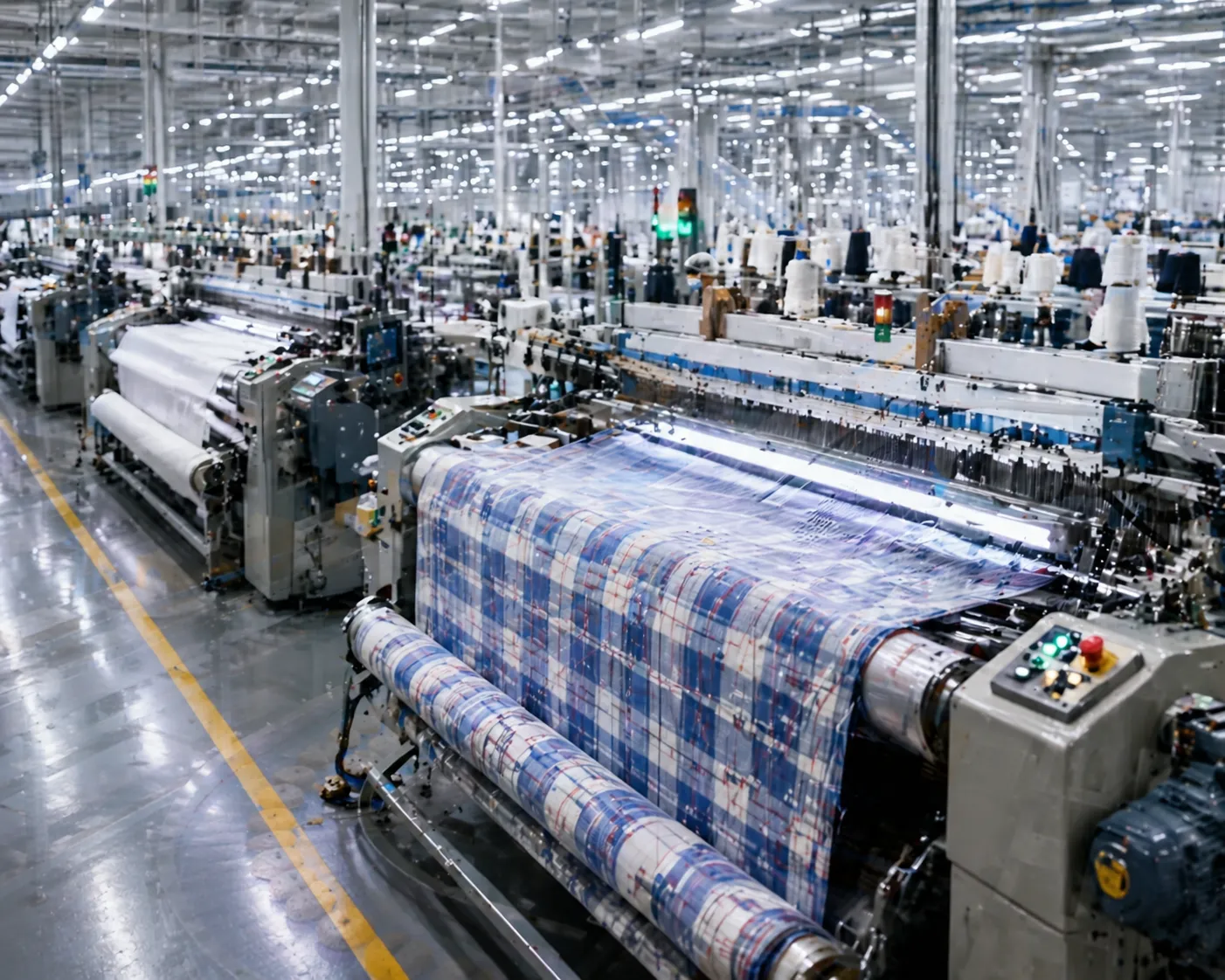
The textile industry is one of the oldest continuous users of geared mechanical drives — and the worm gear reducer remains fundamental to textile production from raw fibre to finished fabric. A modern integrated textile mill operates 500-3,000 individual rotating drive positions across spinning, winding, warping, weaving, dyeing, finishing and packaging lines. Of these, 30-60% are low-speed, high-torque positions served by worm gear reducer: ring spinning frame main drives at 8,000-15,000 rpm spindle speed reduced through intermediate gearing to 20-60 rpm roller output, loom drives requiring precise 15-40 rpm with near-zero vibration, dye vessel agitator drives at 5-30 rpm, and finishing calender roll drives at 10-50 rpm.
What makes textile worm gear reducer specification uniquely challenging is the simultaneous demand for precision, cleanliness, continuous duty and dust defense. Yarn tension must be controlled within ±2-5% throughout the entire production path — any gearbox-induced torque variation, vibration or backlash translates directly into yarn tension variation that produces visible defects in the finished fabric. Textile mills generate enormous quantities of fibre dust (cotton lint, polyester fly, viscose fibre fragments) that penetrate every unsealed surface, and cotton dust in particular creates ATEX Zone 22 classified explosive atmospheres in spinning and carding areas. And the duty is relentless: textile mills in Asia and the Middle East typically operate 24 hours per day, 330-350 days per year — 7,900-8,400 operating hours annually, equivalent to the most demanding continuous-process industries. This article walks the tension control methodology, dust and ATEX defense, continuous-duty thermal sizing, vibration specification for loom drives, and sized recommendations for the major textile machinery categories.
Constant-Tension Yarn Control Through Smooth Drive Delivery
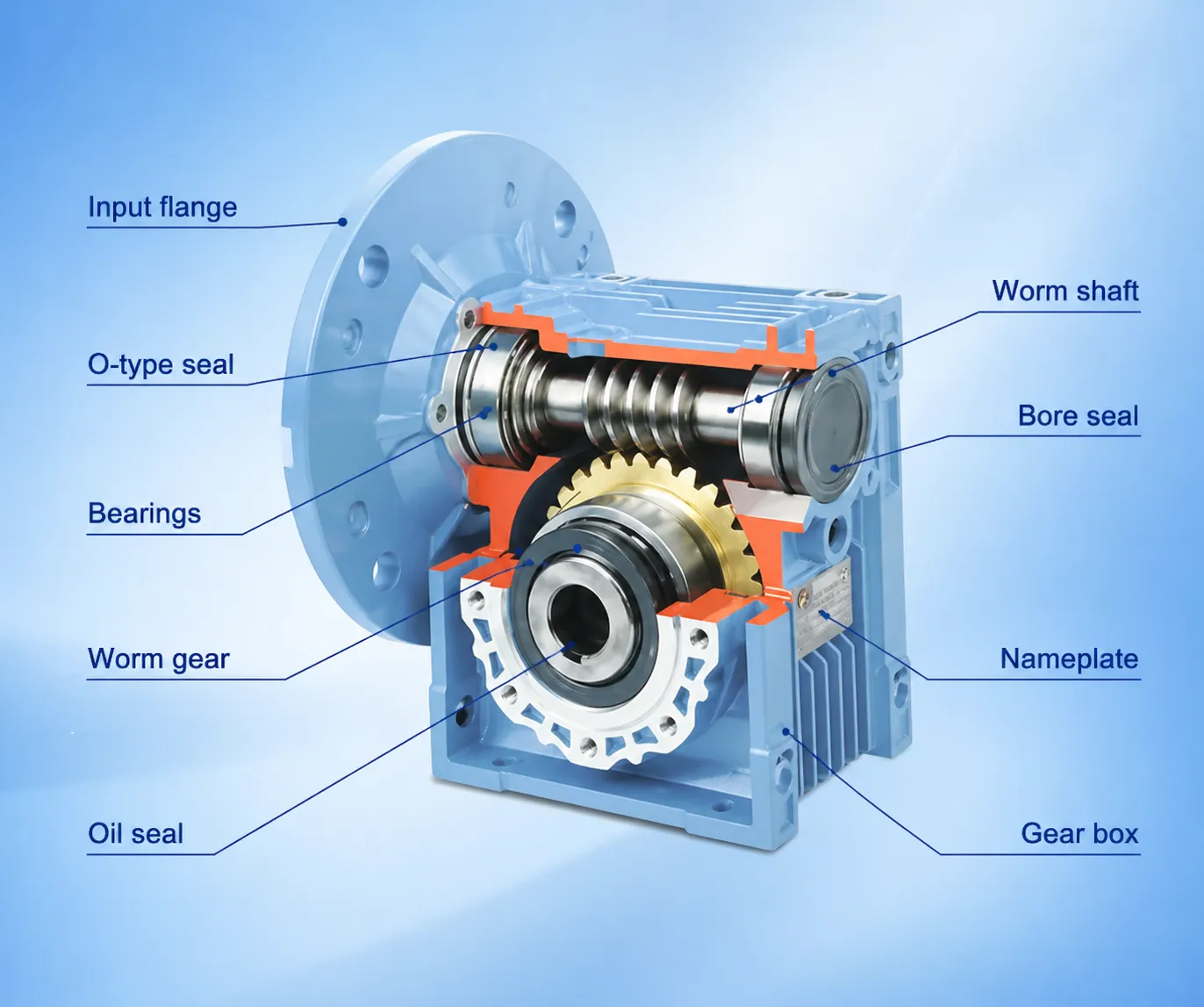
Yarn tension control is the overriding quality parameter in textile production. From spinning frame draft rollers to loom weft insertion, every yarn-contacting drive must deliver smooth, pulsation-free torque at the specified speed — because any torque fluctuation translates directly into tension variation in the yarn, and tension variation produces visible defects in the finished product: streaks, bars, uneven dyeing, and structural weakness. The riduttore a vite senza fine contribution to tension control is twofold: smooth mesh engagement (the sliding contact of the worm on the bronze wheel provides inherently smoother torque delivery than the rolling contact of spur or helical gears) and high reduction ratio in a single stage (eliminating the multi-stage gear trains that can amplify mesh-frequency vibration through resonance between stages).
Precision-ground worm specification is particularly important for textile service. Standard hobbed worm surfaces produce periodic torque ripple at the mesh frequency — perceptible in yarn tension as a regular oscillation that produces horizontal barring in woven fabric (visible as faint stripes across the cloth width). Precision-ground worm (ISO class 5 or better) reduces mesh-frequency torque ripple by 60-80%, bringing the residual torque variation below the threshold of visibility in the finished fabric. For premium fabric production (high-count cotton, silk, technical textiles), precision-ground is mandatory. For commodity production (basic polyester, denim, industrial fabric), standard hobbed quality is often adequate because the inherent yarn irregularity from the spinning process masks the gearbox-induced variation.
Cotton Dust ATEX Defense and Fibre Contamination Prevention
Cotton processing areas (blow room, carding, combing, drawing and spinning) generate airborne cotton dust that creates explosive atmospheres classified as ATEX Zone 22 (combustible dust — atmosphere not likely to occur in normal operation but may for short periods). Cotton dust has a minimum ignition energy (MIE) of approximately 160 mJ and a minimum explosive concentration (MEC) of 40-60 g/m³ — parameters that define the ATEX equipment category required in the classified zone. Worm gear reducer units operating in Zone 22 must satisfy ATEX Category 3D (equipment suitable for Zone 22) — requiring that the maximum surface temperature does not exceed the dust layer auto-ignition temperature (typically 300-400 °C for cotton dust) minus a safety margin, and that the housing design does not provide ignition-capable hot spots under normal or foreseeable fault conditions.
Beyond ATEX compliance, fibre dust contamination of the worm gear reducer interior is a significant reliability concern. Cotton lint and synthetic fibre fragments that penetrate the seal lip accumulate around the output shaft seal, forming a compacted ring that abrades the seal running surface and eventually creates a leak path for lubricant egress and dust ingress. The defense for textile service mirrors the approach for cement and mining dust environments: double-lip FKM seals with intermediate dust exclusion groove, plus a felt or labyrinth pre-filter collar on the output shaft that intercepts the majority of fibre before it reaches the primary seal. Replacement interval for the felt collar in heavy cotton spinning environments: every 6-12 months — a low-cost maintenance task that prevents the high-cost seal failure and internal contamination that follows if the felt is not replaced.
24/7 Continuous Mill Duty Thermal Sizing
Textile mills in the major producing regions (Bangladesh, India, Pakistan, Vietnam, Turkey, Egypt) operate in ambient temperatures of 30-45 °C for much of the year — higher than the 20 °C standard assumption in catalogue thermal ratings. Combined with 24-hour continuous duty, the thermal derating for textile mill worm gear reducer is substantial. At 40 °C ambient, 24 h/day: P_textile = P_catalogue × 0.80 (duty) × 0.80 (temperature) = 0.64 × P_catalogue. A 3 kW spinning frame drive requires catalogue rating of 3 / 0.64 = 4.7 kW — approximately 1.6× the application power.
For weaving mills where the looms generate significant radiant heat (air-jet looms run compressors that reject heat into the weaving shed), the effective ambient around the worm gear reducer may reach 45-50 °C — increasing the thermal derating to 0.50-0.55 × P_catalogue and pushing the required frame size to 2× the application power. Humidification systems in cotton weaving sheds (maintaining 65-75% relative humidity for yarn quality) add a moisture defence requirement: the higher humidity accelerates internal condensation on the worm gear reducer housing during cool-down periods (night shift in non-air-conditioned mills), requiring sealed desiccant breather to prevent water accumulation in the oil bath that would emulsify the lubricant and accelerate bearing corrosion.
Vibration Specification for Loom and Sensitive Fabric Production
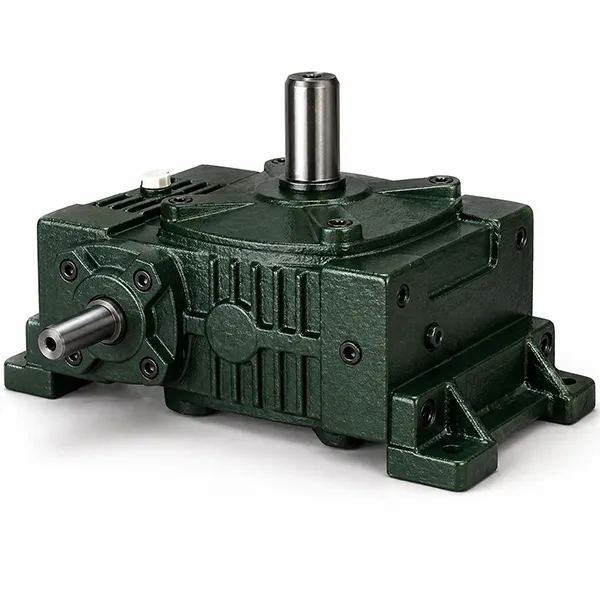
Weaving looms are the most vibration-sensitive application for any worm gear reducer in the textile industry. The loom drive must deliver rotation to the shedding mechanism, reed beat-up and weft insertion at precisely controlled speed — typically 200-800 picks per minute (PPM) depending on loom type and fabric construction. Any vibration transmitted from the worm gear reducer through the drive train to the loom frame manifests as beat-up force variation, producing visible defects: uneven pick spacing (bars), filling shiners (weft yarn visible on the fabric face), and selvedge irregularity.
The vibration specification for loom-drive worm gear reducer targets two frequency bands. First, low-frequency vibration below 50 Hz (from shaft imbalance, bearing defects and housing resonance) — specified below 2.5 mm/s velocity at the output shaft bearing, equivalent to ISO 10816 vibration class A for sensitive machinery. Second, tooth-mesh-frequency vibration at the worm rotation frequency multiplied by the number of thread starts (typically 50-200 Hz for single-start worm at 50-200 rpm) — specified below 1.0 mm/s velocity, achievable only with precision-ground worm and lapped bronze wheel. Elastomeric mounting pads between the gearbox and the loom frame provide an additional 6-10 dB vibration isolation, preventing mesh-frequency vibration from exciting the loom frame structure and amplifying through resonance.
VFD Multi-Drive Synchronisation in Textile Production
Modern textile machinery relies on VFD-controlled multi-drive synchronisation — where 4-20 individual motor/worm gear reducer pairs on a single machine must run at precisely coordinated speeds to maintain yarn tension across the entire production path. A ring spinning frame, for example, coordinates draft zone rollers, ring rail traverse, spindle drive and winding mechanism through separate VFD-controlled worm gear reducer drives, all synchronised to maintain consistent yarn count (tex/denier). Any speed mismatch between synchronised drives produces draft variation that appears as yarn count variation — measured as coefficient of variation (CV%) in the finished yarn and detectable by the quality laboratory within seconds of production.
The worm gear reducer contribution to multi-drive synchronisation is ratio accuracy. Standard catalogue ratio tolerance of ±1-2% means that two worm gear reducer units with nominal ratio 30:1 may have actual ratios of 29.4:1 and 30.6:1 — a 4% speed mismatch at the same motor frequency, far exceeding the ±0.5% tolerance for spinning frame draft synchronisation. For multi-drive textile applications, specify ratio-matched worm gear reducer sets at ±0.3% tolerance — the same approach used in bottling line synchronisation. The per-unit cost premium for ratio matching is 5-15%, but the quality improvement in yarn CV% and fabric uniformity justifies the investment on any production line targeting premium fabric grades.
Energy Efficiency Considerations for Large-Scale Textile Mills
In a textile mill operating 500-1,000 worm gear reducer positions at 24/7 duty, drive system efficiency directly impacts electricity cost — the largest operating expense in textile manufacturing after raw material. Worm gear reducer efficiency at typical textile ratios (20-60) ranges from 75-88% depending on ratio, speed and lubrication. At 80% average efficiency, the 20% friction loss across 500 drives at average 3 kW each represents 300 kW of continuous waste heat — approximately 2.4 million kWh per year at $0.08-$0.15/kWh = $190,000-$360,000 annual electricity cost attributable to gearbox friction losses alone.
Two measures reduce worm gear reducer friction losses in textile service without changing the gearbox architecture. First, synthetic PAG lubricant provides 3-5% higher efficiency than mineral CLP at the same operating conditions, through reduced friction coefficient in the worm mesh sliding contact. Across 500 drives, this 3-5% improvement saves $12,000-$25,000 per year — recovering the per-unit lubricant cost premium within 3-6 months. Second, correct thermal sizing (avoiding oversized frames that run at partial load with proportionally higher friction losses) optimises the power-to-loss ratio. A worm gear reducer running at 60-80% of rated load operates at peak efficiency; one running at 20-30% of rated load (because it was oversized for thermal reasons) operates 3-8% below peak. The thermal sizing must balance the need for thermal headroom against the efficiency penalty of excessive oversizing — a trade-off that requires case-by-case analysis rather than a blanket one-frame-up rule.
Sizing for Common Textile Machinery Drives
Five textile machinery categories account for the majority of riduttore a vite senza fine demand in fibre-to-fabric manufacturing:
◎ TEXTILE 01
Spinning frame (ring, open-end, air-jet)
Motor 5.5-22 kW. Draft roller 20-60 rpm. Frame WPA 110-WPDS 175. ATEX Zone 22 for cotton. Felt collar mandatory. Precision-ground for premium yarn. 24/7 continuous. SF 1.0-1.2 (smooth load).
◎ TEXTILE 02
Weaving loom (rapier, air-jet, projectile)
Motor 2.2-7.5 kW. Loom speed 200-800 PPM. Frame NMRV 075-WPA 130. Vibration critical: <2.5 mm/s at output. Precision-ground + lapped wheel. Elastomeric mounting. 16-24 h/day. Noise <72 dB(A).
◎ TEXTILE 03
Dyeing vessel agitator
Motor 1.5-11 kW. Output 5-30 rpm. Frame WPA 110-WPDS 175. IP65 for steam and chemical splash. FKM seals for dye and auxiliary chemical resistance. Self-locking holds fabric position during dwell cycles.
◎ TEXTILE 04
Finishing calender / stenter frame
Motor 3-22 kW. Roll speed 10-80 m/min. Frame WPA 130-WPDS 200. Precision tension ±2%. Heated roll proximity (100-200 °C) requires thermal derating. VFD speed control for fabric weight adjustment.
◎ TEXTILE 05
Nonwoven line (needle punch, spunbond)
Motor 3-30 kW. Calender roll 10-60 rpm. Frame WPA 130-WPDS 200. Precision cross-web uniformity ±1-3%. ATEX Zone 22 for some synthetic fibre processes. Continuous duty 24/7. Multiple synchronised drives per line.
Common Textile Drive Specification Mistakes
Standard-hobbed worm on premium fabric loom
Hobbed worm mesh-frequency torque ripple produces visible horizontal barring in woven fabric. Precision-ground worm gear reducer at ISO class 5 reduces ripple by 60-80% — mandatory for high-count cotton and silk production.
No felt collar in cotton spinning area
Cotton lint accumulates around the output shaft seal at remarkable speed. Without felt collar pre-filtration, the primary seal fails within 12-24 months from compacted lint abrasion. A $3 felt collar replaced every 6-12 months prevents $200-$500 seal failure repair.
Rigid mounting on loom frame
Rigid bolting transmits worm gear reducer mesh vibration directly to the loom frame structure. Elastomeric isolation pads provide 6-10 dB vibration reduction — the difference between visible fabric defects and acceptable fabric quality at 400+ PPM loom speeds.
Catalogue thermal rating at 40-45 °C mill ambient
At 45 °C + 24/7: usable thermal power is 50-55% of catalogue. Sizing at catalogue value produces thermal failure within 2-3 years. Specify one frame size up for any worm gear reducer position in non-air-conditioned textile mills in tropical and subtropical regions.
Textile Machinery Worm Gear Reducer FAQ
Q: How many worm gear reducer positions does a typical textile mill operate?
A: An integrated spinning-weaving mill producing yarn and fabric operates 200-800 worm gear reducer positions: 30-100 spinning frame main drives, 50-300 loom drives, 20-60 warping and winding machine drives, 10-30 dyeing and finishing drives, and 20-50 auxiliary drives (ventilation, humidification, waste handling). A vertically integrated mill adding dyeing and finishing may operate 400-1,200 positions. Standardising on 3-5 worm gear reducer frame families across the mill simplifies spare parts inventory and reduces training complexity for the maintenance team.
Q: What service life is expected in 24/7 textile mill service?
A: Properly specified (thermally derated, precision-ground where required, felt collar, synthetic PAG, FKM seals): 8-12 years to major overhaul (bronze wheel replacement) on 24/7 spinning and weaving duty. Loom drives typically last 10-15 years because the power per drive is lower and thermal stress is correspondingly reduced. Under-specified units (standard hobbed, mineral CLP, no felt collar) on the same 24/7 duty: 2-4 years. The 30-50% specification premium recovers within the first avoided production stoppage caused by gearbox failure on a multi-loom weaving line.
Q: Does self-locking matter in textile machinery?
A: Yes — for specific positions. Dyeing vessel agitator drives use self-locking to hold the fabric batch at a defined position during dwell cycles (chemical absorption, heat soak). Finishing calender drives use self-locking to hold roll position during threading and setup. Winding machine drives use self-locking to hold yarn package position during doff (package removal). For spinning frame main drives and loom drives, self-locking is not functionally critical — these drives run continuously in one direction and do not require position hold during normal operation.
Q: What maintenance schedule applies to textile mill worm gear reducer?
A: Weekly: visual inspection and felt collar condition check on spinning positions. Monthly: oil level verification on all positions. Every 6-12 months: felt collar replacement on cotton spinning and carding positions. Every 12-18 months (synthetic PAG): oil sample analysis. Every 24-36 months: oil replacement. Every 3-5 years: vibration baseline measurement on loom drives, bearing play check. All maintenance should be scheduled during the weekly planned maintenance window (typically 4-8 hours per week in 24/7 mills) rather than during production time.
Q: How do I get a sized recommendation for my textile machinery?
A: Send our engineering team the machinery details: machine type (spinning frame, loom, winder, dye vessel, calender, nonwoven line), motor power and speed, output speed requirement, fibre type (cotton, polyester, viscose, blended), ATEX zone classification (if applicable), ambient temperature, operating hours per day, and fabric quality grade (commodity, standard, premium). We return sized recommendations with vibration class, thermal derating calculation, dust defense specification and fleet pricing within 24-48 hours.
Sourcing Worm Gear Reducer for Textile Machinery?
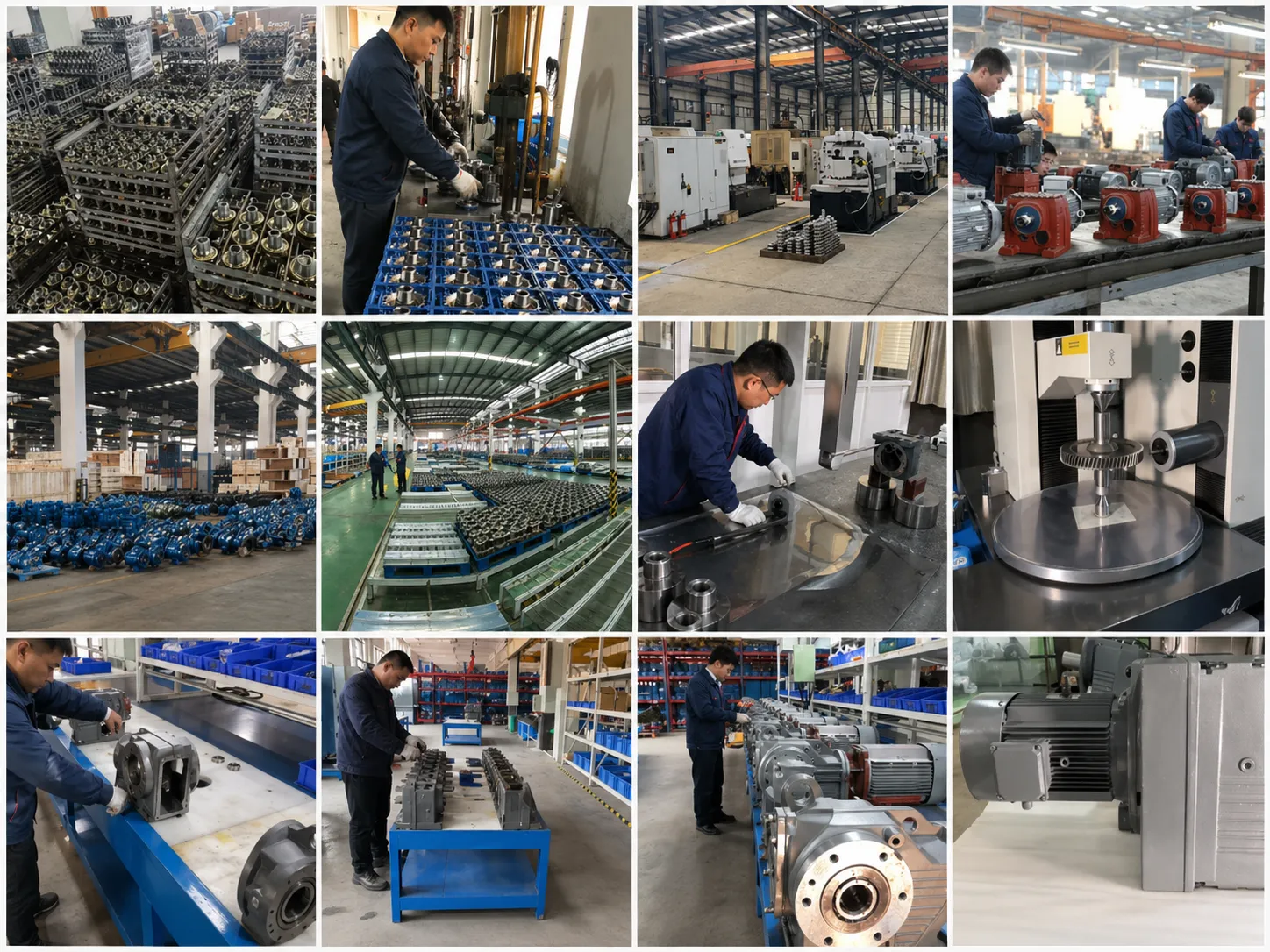
Send us machine type, fibre, operating hours and quality grade. Our Korean engineering team returns sized recommendations with vibration class, ATEX compliance and thermal derating calculation within 24-48 hours.
Redattore: Cxm