Automotive manufacturing is the world’s largest single-industry consumer of precision mechanical drives. A modern automotive assembly plant producing 250,000-400,000 vehicles per year operates 1,000-3,000 individual drive positions across four major production zones: the stamping shop (where flat steel sheet becomes body panels), the body shop (where panels are welded into body-in-white structures), the paint shop (where bodies receive primer, basecoat and clearcoat), and final assembly (where drivetrain, interior and electrical systems are installed). The worm gear reducer serves critical functions in each zone — from the AGV (Automated Guided Vehicle) drive trains that transport bodies between stations, to the welding cell rotary tables that position bodies for robotic welders, to the paint shop conveyors that must operate in explosive-atmosphere compliance, to the final assembly line tilt-and-rotate fixtures that present the body at ergonomic angles for human operators.

What distinguishes automotive assembly worm gear reducer specification from general industrial applications is the combination of three demands. First, precision positioning — welding fixtures must position the body-in-white within ±0.5 mm of the robot teach point, and AGV docking must align within ±2 mm of the station position. Second, cleanliness — the paint shop operates under positive-pressure filtration to prevent dust contamination on wet paint surfaces, and any worm gear reducer lubricant leak contaminates the finish. Third, uptime — an automotive assembly line running at 60 jobs per hour produces one car every 60 seconds; a single drive failure stops the entire line at $15,000-$50,000 per hour in lost production. This article walks the four production zone drive requirements, ATEX compliance for paint shop, noise control, Industry 4.0 integration, and sized recommendations for common automotive assembly drives.
Four Production Zone Drive Requirements
Each automotive production zone imposes a distinctive set of demands on the worm gear reducer, and drives specified for one zone are rarely interchangeable with another without respecification.
AGV Navigation Drive Specification
AGVs (Automated Guided Vehicles) transport car bodies, engines, transmissions and sub-assemblies between work stations throughout the automotive plant. A typical automotive AGV fleet comprises 50-200 vehicles, each containing 2-4 worm gear reducer drive positions (traction wheels, steering actuators, lift table drives). The worm gear reducer on AGV traction drives converts the servo motor output (typically 0.5-2 kW at 3,000 rpm) down to wheel speed (100-500 rpm), providing the high torque density needed to move 500-2,000 kg payloads through tight factory aisles at speeds of 0.5-2 m/s.
AGV worm gear reducer specification priorities differ from stationary drives. Weight is critical — every gram of gearbox weight reduces payload capacity or battery range. Aluminum NMRV frames (NMRV 050-075) are standard for AGV traction, providing adequate torque at 40-60% lower weight than cast iron equivalents. Backlash specification of 8-15 arc-minutes supports ±2 mm docking precision through the VFD-controlled servo positioning loop. Self-locking at ratio ≥30 provides passive parking hold — the loaded AGV stays at its docked position without continuous motor energisation, preserving battery charge. Noise below 65 dB(A) is essential for AGVs operating in final assembly zones where human operators work alongside the vehicles. Synthetic PAG lubricant provides the wide temperature range needed for AGVs that transit between air-conditioned assembly halls and non-conditioned logistics areas.
Welding Cell Rotary Table and Fixture Positioning
The body shop contains 100-300 robotic welding cells, each with a rotary table or tilt fixture that positions the body-in-white for robot access to weld points. The ウォームギア減速機 on each fixture must deliver precision positioning within ±0.5 mm at the robot teach point — a tolerance determined by the spot weld gun electrode alignment with the panel joint. At typical fixture arm radius of 1,200-2,000 mm, ±0.5 mm linear corresponds to approximately ±1.5-2.5 arc-minutes at the output shaft — tighter than standard catalogue backlash and requiring precision-ground specification.
Welding spatter is a distinctive environmental hazard: hot metal particles (1,500-1,700 °C) ejected during resistance spot welding can land on the worm gear reducer housing, seal surfaces and output shaft. Spatter accumulation on the output shaft seal lip accelerates seal wear and can weld to the shaft surface, scoring the seal running surface. The defense: stainless steel spatter shields covering the output shaft seal area, and spatter-resistant housing coating (silicone-modified polyurethane) that allows cooled spatter to be brushed off rather than bonding permanently. Self-locking holds the fixture at the welded position without drift during the 2-5 second dwell while the robot completes its weld sequence — eliminating the need for pneumatic or hydraulic clamps on the rotary axis.
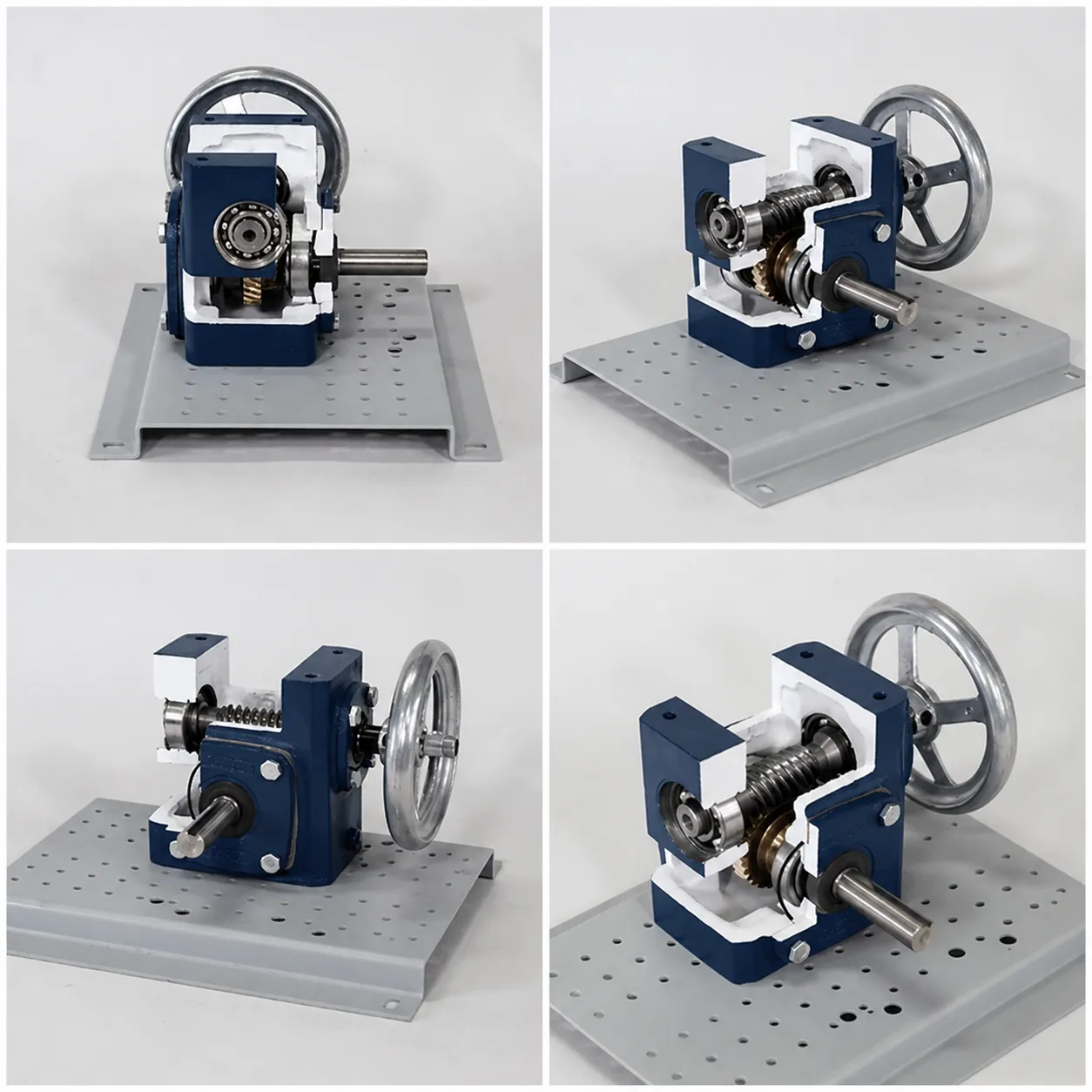
Paint Shop ATEX Compliance and Zero-Leak Specification
The automotive paint shop is classified as an ATEX Zone 1 or Zone 2 hazardous area due to solvent vapour from basecoat and clearcoat spray operations. Organic solvents (xylene, butyl acetate, methyl ethyl ketone) at concentrations near or above their lower explosive limit (LEL) are present in the spray booth and surrounding ventilation zones. Every electrical and mechanical device in the classified zone — including the worm gear reducer — must satisfy ATEX Directive 2014/34/EU or equivalent regional explosion-protection standard (NEC 500 in North America, KS C IEC 60079 in Korea).
The worm gear reducer contribution to ATEX compliance focuses on two requirements. First, surface temperature: the maximum external surface temperature of the gearbox housing must not exceed the auto-ignition temperature of the solvent atmosphere minus a safety margin — typically T3 (200 °C) or T4 (135 °C) temperature class depending on the specific solvent blend. At normal operating conditions, a properly sized worm gear reducer does not approach these limits, but thermal derating verification is required to demonstrate compliance at the maximum ambient and maximum load condition. Second, zero-leak: any lubricant leak creates a contamination risk on painted surfaces and, in the worst case, a pool of combustible liquid in the ATEX zone. Double-lip FKM seals with leak-detection groove (the intermediate space between the two lip seals is connected to an external drain port that signals seal failure before lubricant reaches the external environment) satisfy the zero-leak requirement for paint shop service.
Industry 4.0 Predictive Maintenance Integration
Automotive assembly plants are early adopters of Industry 4.0 predictive maintenance — using vibration sensors, temperature monitors and oil condition sensors to predict worm gear reducer failure 4-8 weeks before it occurs, enabling planned replacement during scheduled non-production windows (weekends, model changeover shutdowns) rather than mid-production emergency stops. The integration approach mounts a compact wireless vibration/temperature sensor on the worm gear reducer housing, transmitting data to the plant MES (Manufacturing Execution System) via industrial IoT gateway. The MES analytics engine compares real-time vibration signatures against baseline patterns established during commissioning, flagging trend deviations that indicate bearing degradation, tooth wear or lubricant deterioration.
For worm gear reducer specification, Industry 4.0 readiness means: flat mounting pad on the housing for sensor attachment (not all cast housings have suitable flat surfaces), tapped hole for sensor bolt (M8 standard), and vibration-isolation mounting that does not attenuate the diagnostic vibration signal (rubber pads that isolate structural vibration can also mask bearing deterioration signals). Some specifiers now require worm gear reducer suppliers to provide baseline vibration signatures (measured at factory during run-in testing) as part of the unit documentation package — enabling the plant analytics system to set accurate alarm thresholds from day one rather than waiting 3-6 months to build a statistical baseline from field data.
Sizing for Common Automotive Assembly Drives
Five automotive drive configurations account for the majority of ウォームギア減速機 demand in vehicle manufacturing:
◎ AUTO 01
AGV traction drive
Motor 0.5-2 kW servo. Output 100-500 rpm. Frame NMRV 050-075 aluminum (weight priority). Ratio 5-15. Backlash 8-15 arc-min. Self-locking for parking hold. Noise <65 dB(A). 50-200 AGVs per plant.
◎ AUTO 02
Welding cell rotary table / positioner
Motor 1.5-7.5 kW. Output 5-30 rpm. Frame WPA 110-WPDS 175. Precision backlash 4-8 arc-min. Spatter shield + silicone coating. Self-locking for weld dwell. 100-300 fixtures per plant.
◎ AUTO 03
Paint shop conveyor (ATEX zone)
Motor 1.5-5.5 kW. Continuous low speed. Frame WPA 110-WPA 150. ATEX Zone 1/2 T3/T4. Zero-leak double-lip FKM with drain groove. Thermal verification for T-class compliance. 20-60 drives per paint shop.
◎ AUTO 04
Stamping press transfer mechanism
Motor 2.2-11 kW. High-frequency indexing synchronised with press stroke. Frame WPA 130-WPDS 175. C3 bearings for indexing endurance. SF 1.4-1.6 for press vibration. Anti-vibration mount.
◎ AUTO 05
Final assembly ergonomic fixture (tilt/rotate)
Motor 0.75-3 kW. Output 2-10 rpm. Frame NMRV 075-WPA 110. Self-locking holds body at tilt angle for operator access (underbody work, dashboard installation). Noise <70 dB(A) for operator hearing protection. Compact profile within fixture envelope.
Common Automotive Assembly Drive Mistakes
Catalogue backlash on welding fixture
Standard 15-25 arc-min produces ±1-3 mm position error at fixture radius — exceeding the ±0.5 mm weld-point tolerance. Specify precision-ground worm gear reducer at 4-8 arc-min for body shop fixtures.
No spatter shield on body shop drives
Welding spatter at 1,500+ °C welds to exposed shaft surfaces and burns through standard NBR seals within months. Stainless spatter shields + FKM seals are mandatory on any worm gear reducer within 3 metres of welding robots.
Standard seals in paint shop ATEX zone
A standard single-lip seal leak in the paint spray booth creates both an explosion hazard (lubricant pool in ATEX zone) and a paint defect source. Double-lip FKM with leak-detection drain groove is mandatory for ATEX paint shop service.
Cast iron AGV traction drive (weight excess)
Cast iron worm gear reducer at NMRV 075 weighs 12-15 kg; aluminum equivalent weighs 5-7 kg. On a battery-powered AGV, every kg of drive weight reduces either payload or range. Specify aluminum for all mobile AGV positions.
Automotive Assembly Worm Gear Reducer FAQ
Q: How many worm gear reducer positions does a typical automotive assembly plant operate?
A: A plant producing 300,000 vehicles/year typically operates 300-800 worm gear reducer positions: 100-400 AGV drives (2-4 per vehicle × 50-100 AGVs), 100-300 body shop fixture drives, 20-60 paint shop conveyor drives, and 50-100 final assembly fixture drives. At automotive-grade specification (precision backlash, ATEX compliance where required, spatter protection, Industry 4.0 sensor readiness), total drive fleet capital runs $300,000-$1,200,000 — approximately 0.02-0.05% of total plant capital but a disproportionate contributor to line uptime.
Q: What is the cost of an unplanned worm gear reducer failure on an automotive line?
A: A single body shop fixture failure stops the welding cell — if on the critical path, it stops the entire body shop at $15,000-$50,000 per hour in lost production. A paint shop conveyor failure stops the paint line at similar cost. An AGV failure reduces fleet capacity but typically does not stop the line unless the AGV blocks a traffic lane. Total annual worm gear reducer-related downtime cost on a poorly specified plant: $200,000-$800,000. On a well-specified plant with predictive maintenance: $20,000-$80,000. The specification and monitoring investment recovers many times over in avoided downtime.
Q: Does self-locking matter on automotive assembly drives?
A: Yes — for three critical scenarios. First, welding cell fixtures must hold the body-in-white at the programmed position during the 2-5 second weld dwell without drift. Second, final assembly tilt fixtures must hold the body at the ergonomic work angle while operators work underneath — self-locking provides passive holding without relying on pneumatic or hydraulic clamps that could fail. Third, AGV parking hold — self-locking prevents the loaded AGV from rolling on inclined floor sections during station docking. In all three cases, self-locking at ratio ≥30 provides the holding function as a geometric property, independent of power, brakes or control systems.
Q: How do I get a sized recommendation for my automotive assembly project?
A: Send our engineering team the project details: production zone (stamping, body, paint, final assembly), drive positions (AGV, fixture, conveyor, transfer), motor power and speed, positioning tolerance, ATEX classification (if paint shop), noise requirement, Industry 4.0 sensor requirement, and total drive count. We return sized recommendations with zone-specific specification, backlash class, ATEX verification and fleet pricing within 48-72 hours.
Q: Does EV (electric vehicle) manufacturing change the worm gear reducer specification?
A: EV assembly introduces two new drive requirements. First, battery pack handling fixtures for 400-800 kg battery modules require worm gear reducer drives with self-locking to hold the battery at precise underbody marriage positions — the positioning tolerance is tighter (±1 mm) than conventional powertrain marriage (±2-3 mm) because battery tray bolt patterns are less forgiving of misalignment. Second, EV motor and inverter assembly areas may classify as clean-room environments (ISO class 7-8) to prevent particulate contamination of high-voltage connections — requiring the worm gear reducer to use sealed, zero-leak specification equivalent to paint shop ATEX drives. The body shop and stamping shop specifications remain essentially unchanged between ICE and EV manufacturing since the body construction process is similar regardless of powertrain type.
Q: What maintenance strategy applies to automotive plant worm gear reducer fleet?
A: Automotive plants typically run predictive maintenance using vibration monitoring on critical-path drives (body shop fixtures, paint shop conveyors) and time-based maintenance on non-critical drives (AGV, final assembly fixtures). The schedule: weekly visual during production walkthrough, quarterly oil level verification on stationary drives, annual oil sampling and vibration baseline on monitored positions, 2-3 year oil replacement (synthetic PAG). AGV drives follow the AGV fleet maintenance schedule (typically 3-6 month intervals aligned with battery service). All maintenance must align with the plant production calendar — most automotive plants have one major shutdown per year (2-4 weeks for model changeover or summer/winter break) and one or two minor shutdowns (weekends or holiday periods) for scheduled drive replacements.
Sourcing Worm Gear Reducer for Automotive Assembly?
Send us production zone, drive positions, ATEX requirements and total fleet size. Our Korean engineering team returns zone-specific recommendations with precision and compliance verification within 48-72 hours.
編集者: Cxm