Worm Shaft Hardening: Case, Induction and Through-Hardening Methods
An engineering reference on the heat-treatment processes that deliver HRC 58-62 surface on the worm shaft — the wear surface that must outlast 25,000-40,000 hours of bronze-on-steel sliding contact.
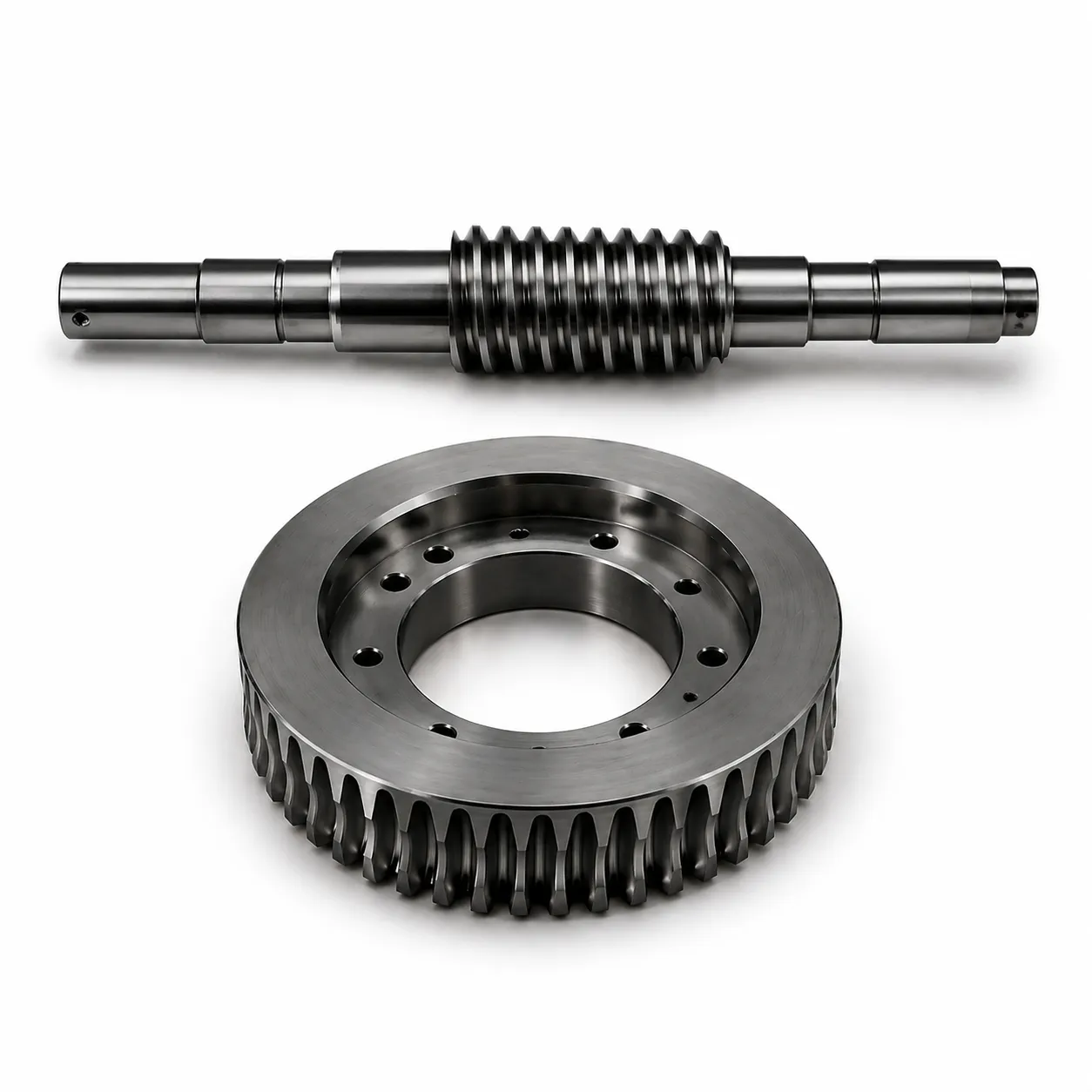
The worm gear reducer worm shaft hardness is the unglamorous engineering parameter that decides whether a worm gear reducer reaches its catalogue service life or fails prematurely through worm-thread polishing. The bronze wheel deliberately wears as the engineered consumable; the worm shaft must not. To stay serviceable across two or three bronze re-tooth cycles, the worm shaft surface must hold HRC 58-62 hardness against a bronze wheel sitting at roughly 90 HB — a 5-7× hardness ratio that the metallurgy below explains and the heat-treatment processes deliver. For the bronze companion materials this hardened surface meshes against, see our bronze wheel materials guide.
Carburise + Quench
Surface HRC 58-62 / depth 0.8-1.5 mm
Workhorse — modern catalogue default, balanced cost and performance.
RF Coil + Quench
Surface HRC 55-60 / depth 1.0-2.0 mm
Selective — large frames where furnace deformation is unacceptable.
Austenitise + Temper
Uniform HRC 35-45 throughout
Specialty — small-diameter fine-thread shafts only.
Why the Worm Shaft Must Be Harder Than the Bronze Wheel
The hardness ratio between the worm shaft (steel) and the worm wheel (bronze) sits at the centre of the wear-pair design. The worm gear reducer shaft is engineered to outlast multiple bronze wheels — a typical worm gear reducer housing accepts 2-3 re-tooth cycles before retirement, with the same worm shaft serving across all of them. To stay essentially unchanged dimensionally across 80,000-120,000 cumulative operating hours, the shaft surface must be hard enough that the bronze runs against it without abrading the steel.
The 5-7× hardness ratio (steel HRC 58 vs bronze 90 HB ≈ HRC 5-8 equivalent) is large enough that the bronze wears almost exclusively. Tribology research on worm gear reducer wear at Korean and Japanese universities consistently shows that hardness ratios above 4× drive over 95% of total wear into the softer member — meaning the steel worm shaft sees less than 5% of the contact wear that the bronze wheel sustains. Across 30,000 service hours, the bronze wheel may lose 0.4-0.8 mm of tooth profile while the worm shaft loses 5-15 micrometres on its thread crest. The steel essentially does not wear in any service-life sense. Note that this hardness-ratio approach is unique to sliding-contact gear types — rolling-contact alternatives like planetary gearboxes distribute wear evenly across both members and don’t require this asymmetric hardness specification.
Fall short of the worm gear reducer hardness target — through inadequate carburising depth, over-tempered surface, or failed quench — and the wear distribution shifts. A worm shaft surface at HRC 45 instead of HRC 60 sees 15-20% of the contact wear instead of 5%. Service life of the wear pair drops by a factor of 2-3× through faster shaft polish and accelerated bronze wear in the worsened contact geometry. The hardness specification on the worm shaft is the single largest determinant of wear-pair life.
Three Hardening Methods Across the Industry
Three heat-treatment approaches deliver the required worm shaft surface hardness across modern worm gear reducer manufacturing. They differ in process complexity, equipment cost, achievable case depth, and the deformation control they offer. Most Korean and Japanese gearbox factories operate either case hardening or induction hardening as their standard process, with through-hardening reserved for specialty applications where the dimensional needs argue against case approaches.
The selection between methods at any given factory depends primarily on production volume, frame size mix, and capital equipment availability. Worm gear reducer case hardening lines amortise across high-volume small-frame shafts; induction lines suit lower-volume larger frames; through-hardening serves specialty thin-section shafts that the other two methods would crack or distort. A buyer evaluating a worm shaft hardness specification needs to recognise which process the manufacturer uses to interpret the resulting hardness profile correctly.
Case Hardening (Carburising) — The Workhorse Process
Case hardening (carburising) carries the bulk of small- and mid-frame worm shaft production across Korean, Japanese and European worm gear reducer factories. The process diffuses carbon into the surface of a low-carbon steel substrate at 900-950 °C in a carbon-rich atmosphere (gas, paste or salt bath), then quenches and tempers to lock in a hard martensitic case while leaving a tough core.
▣ PROCESS PARAMETERS
- ▸ Steel substrate: 16MnCr5 / 20MnCr5
- ▸ Carburise temperature: 900-950 °C
- ▸ Atmosphere: gas (CO+CH₄) or paste
- ▸ Quench: oil bath, 60 °C
- ▸ Temper: 180-200 °C, 2 hours
✓ RESULTING PROFILE
- → Case depth: 0.8-1.5 mm
- → Surface hardness: HRC 58-62
- → Core hardness: HRC 25-35
✗ TRADE-OFFS
- ✗ Furnace heating distorts long shafts
- ✗ Post-quench grinding required
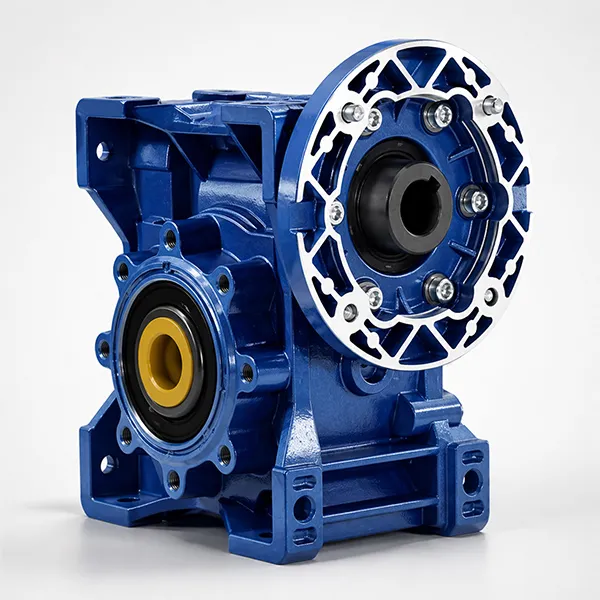
Carburising remains the cost-balanced default for worm gear reducer shafts up to about 80 mm diameter and 800 mm length. The process integrates well with high-volume manufacturing — a single batch furnace handles 50-100 shafts per cycle — and the resulting case profile delivers the standard catalogue hardness for the bulk of industrial worm gear reducer production.
Induction Hardening — The Precision Local-Treatment Option
Induction hardening uses an electromagnetic coil at radio frequency to heat the worm thread surface only, leaving the bulk of the shaft at its supply hardness. The localised treatment avoids the through-shaft heating that distorts long carburised shafts, making it the standard choice for large-frame worm gear reducer production where dimensional accuracy matters more than absolute case depth.
▣ PROCESS PARAMETERS
- ▸ Steel substrate: 42CrMo4 / 1045 / S45C
- ▸ Coil frequency: 10-50 kHz
- ▸ Surface temperature: 850-900 °C
- ▸ Quench: water/polymer spray
- ▸ Temper: 150-180 °C, 1-2 hours
✓ RESULTING PROFILE
- → Case depth: 1.0-2.0 mm
- → Surface hardness: HRC 55-60
- → Core unchanged from supply (HRC 28-32)
✗ TRADE-OFFS
- ✗ Higher per-shaft equipment cost
- ✗ Coil profile must match thread shape
Induction hardening dominates Korean worm gear reducer production at frame sizes 100 mm and above where shaft length exceeds 1 metre. The process completes in 30-90 seconds per shaft (vs hours per furnace cycle for carburising) and avoids the warpage that would otherwise require post-treatment straightening on long thin shafts.
Through-Hardening — The Specialty Alternative
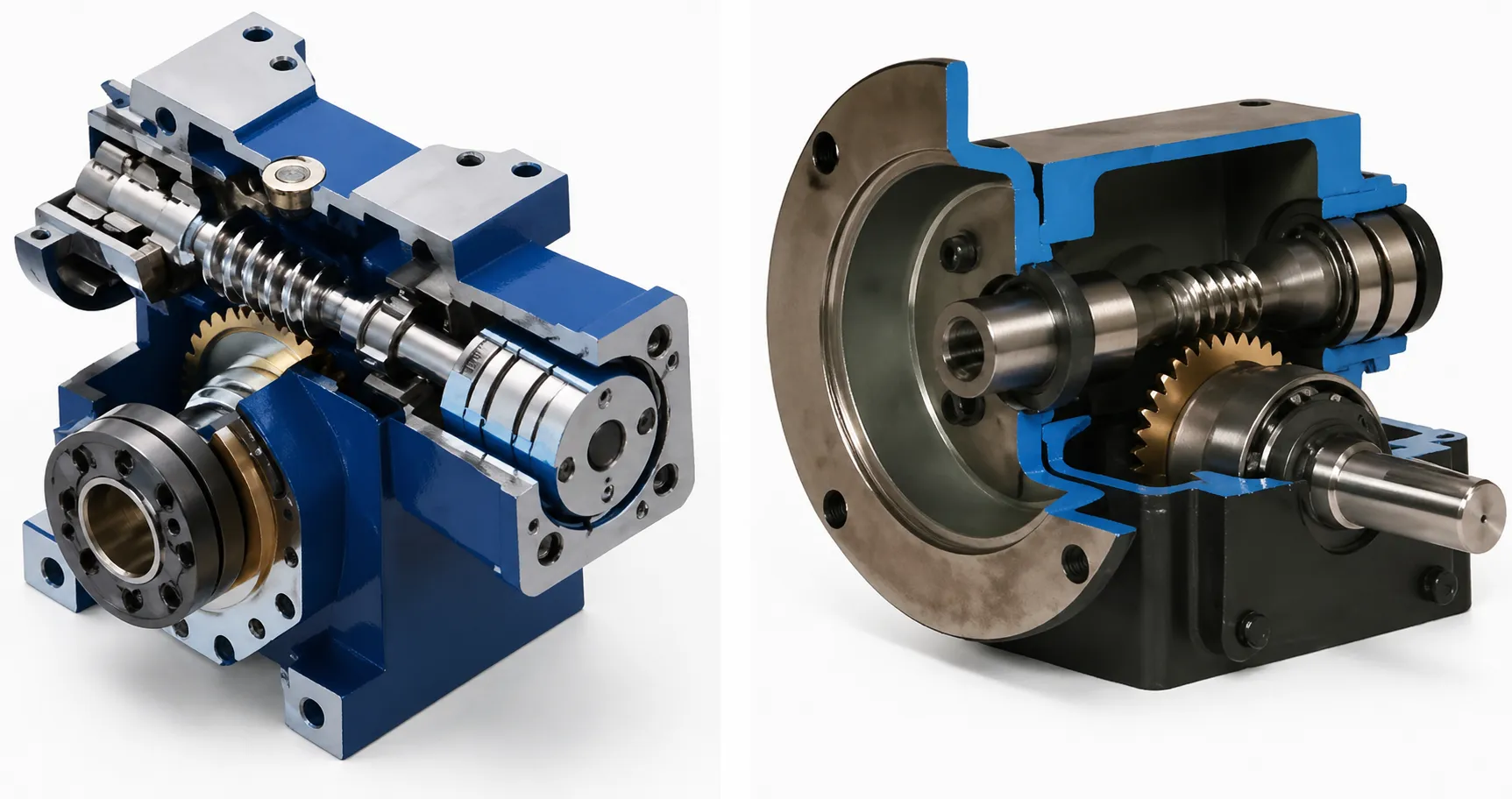
Through-hardening heats the entire worm gear reducer shaft to its austenitising temperature, quenches uniformly, then tempers to a balanced strength-toughness combination. The result is uniform hardness throughout the shaft cross-section rather than a hard case over a soft core. The process suits small-diameter (under 30 mm) worm shafts with fine threads where case hardening would crack the thin section.
▣ PROCESS PARAMETERS
- ▸ Steel substrate: 4140 / 42CrMo4
- ▸ Austenitise: 820-850 °C
- ▸ Quench: oil, 60 °C
- ▸ Temper: 450-550 °C, 2-4 hours
- ▸ Result: uniform martensite + tempered carbides
✓ RESULTING PROFILE
- → Hardness: HRC 35-45 throughout
- → No case-core boundary (no spalling risk)
- → Higher fatigue strength than carburised
✗ TRADE-OFFS
- ✗ Lower surface hardness (faster wear)
- ✗ Service life 50-65% of case-hardened
Through-hardening appears in worm gear reducer specifications mainly for compact screw-jack worm shafts under 25 mm diameter, where the thread crests are too thin to support a 0.8 mm carburised case without through-cracking. The lower surface hardness limits service life; specifications usually compensate with reduced duty cycle or scheduled replacement at 15,000-20,000 hours rather than chasing higher contact wear performance.
Reading Hardness Specifications — HRC, HV, HB
Hardness specifications across modern worm gear reducer datasheets typically use one of three measurement scales: Rockwell C (HRC), Vickers (HV), or Brinell (HB). HRC dominates worm shaft documentation in Korea, Japan and Europe; HV appears occasionally on European specifications; HB appears on older legacy nameplates. The conversion table below covers the practical range for hardened worm shafts and bronze wheels.
| HRC | HV | HB | Typical Material at This Hardness |
|---|---|---|---|
| 62 | 746 | — | Carburised case maximum (worm thread crest) |
| 60 | 697 | — | Catalogue spec — case-hardened worm |
| 58 | 653 | — | Catalogue spec — induction-hardened worm |
| 45 | 441 | 418 | Through-hardened upper bound (small shafts) |
| 35 | 344 | 325 | Through-hardened lower bound; case-hardened core |
| 25 | 266 | 255 | Carburised core minimum |
| ≈ 5 | ≈ 100 | 90-95 | CuSn12 bronze wheel (the soft mating member) |
When reading a hardness specification, verify three things. First, the scale — HRC 60 and HV 60 differ by an order of magnitude in actual hardness. Second, the location — surface vs core hardness can both appear on a single shaft, and the spec usually means the surface unless stated otherwise. Third, the test method — bench Rockwell tests pin the thread crest and may not represent the full thread profile.
Failure Modes from Inadequate Hardening
Four failure modes account for almost all worm gear reducer worm shaft hardening defects we see returned for warranty review across Korean and Asian installations. Each presents a distinct visual signature once the housing is opened, and each traces to a specific process variation that the manufacturer’s quality system should catch.
⚠FAILURE MODE 01
Inadequate case depth → case crushing
Case under 0.6 mm collapses under contact pressure within 5,000 hours. Surface flakes off in irregular plates exposing soft core; rapid wear-pair degradation follows.
⚠FAILURE MODE 02
Over-tempered surface → surface spalling
Tempering above 220 °C drops surface HRC below 55. Pitting forms within 8,000-12,000 hours; small craters expand and connect across the thread profile.
⚠FAILURE MODE 03
Through-hardened too soft → core deformation
Through-hardened shafts below HRC 32 yield under shock loading. Thread profile compresses unevenly, increasing backlash gradually rather than wearing visibly.
⚠FAILURE MODE 04
Quench distortion → thread profile error
Long shafts warp during oil quench. Post-quench grinding restores straightness but may shift the thread profile relative to the design pitch line, causing localised contact wear.
Quality Verification at Receipt
For procurement engineers receiving worm gear reducer shipments where hardness specification is critical (lifting drives, mining auxiliary, marine deck machinery), the four-step receipt-verification procedure below confirms hardening quality before commissioning. Browse our broader worm gear reducer catalogue for sized frames with documented hardness certification across all three heat-treatment processes.
Surface hardness test on the thread crest
Portable Rockwell or Leeb hardness tester at three points along the thread; verify all three readings within HRC 58-62 for case-hardened or 55-60 for induction-hardened.
Microstructure inspection on a sample shaft
Cross-section a sample shaft, etch with nital, examine under metallograph for uniform martensitic case with no retained austenite or grain-boundary carbides.
Case depth measurement
Microhardness traverse from surface to core; case depth defined as the depth at which hardness drops to HV 550 (≈ HRC 53). Verify ≥ 0.8 mm for case-hardened, ≥ 1.0 mm for induction-hardened.
Match-mesh inspection against reference wheel
Run-in the worm shaft against a reference bronze wheel for 100 hours under rated load; verify contact pattern covers ≥ 80% of expected tooth area with no localised wear concentration.
Worm Shaft Hardening FAQ
Q: How can I tell which hardening process was used on a delivered worm gear reducer?
A: Read the manufacturer datasheet first — it usually states “case-hardened to HRC 60” or “induction-hardened to HRC 58” or similar. If unstated, three indirect methods help. First, frame size: worm shafts above 80 mm diameter are usually induction-hardened; smaller shafts usually case-hardened. Second, surface finish: induction surfaces have a slightly coarser appearance than carburised. Third, hardness profile: a microhardness traverse shows a gradual hardness decrease from surface to core for case-hardened, a sharp transition zone for induction-hardened, or uniform hardness for through-hardened.
Q: Does higher surface hardness always mean longer worm gear reducer service life?
A: Up to about HRC 62, yes. Above HRC 62, the surface becomes brittle enough that fatigue cracks initiate and propagate faster than wear thins the case. The optimum sits in the HRC 58-62 band — hard enough that bronze wears 95% of total wear pair material, but tough enough that the surface absorbs occasional shock loads without spalling. Specifications below HRC 55 underuse the steel; specifications above HRC 64 risk fatigue failure.
Q: Can a soft worm shaft be re-hardened in service, or must it be replaced?
A: Re-hardening is technically possible but rarely economical. Returning the shaft to a heat-treatment facility, re-carburising or re-induction-hardening, then re-grinding the thread profile to restore tolerance — costs more than half a new worm shaft and takes 4-6 weeks. New replacement is faster and carries factory hardness verification. The exception is one-off legacy worm gear reducer specifications where new shafts are not catalogue-stocked; for those, re-hardening avoids the lead time of a custom-machined replacement.
Q: Why use 16MnCr5 substrate for case hardening rather than higher-carbon steel directly?
A: Worm gear reducer case hardening produces a high-carbon hard surface over a low-carbon tough core — both halves of the property combination needed in a worm shaft. For worm gear reducer construction, starting with low-carbon 16MnCr5 (0.16% C) and diffusing carbon into only the surface layer yields a 0.6-0.8% C case (the hardenable composition) over a 0.16% C core (the impact-tough composition). Starting with high-carbon steel directly would produce a hard but brittle uniform shaft prone to fatigue failure under shock loading.
Q: What surface finish is required on a hardened worm thread for proper meshing?
A: Ra 0.4-0.8 micrometres on the working flank surface. Worm gear reducer hardening processes leave the surface coarser than this, so post-treatment grinding is mandatory on case-hardened shafts and most induction-hardened shafts. Through-hardened shafts may not need grinding if the hardness allows the supply machined finish to remain. The grinding step removes 0.2-0.4 mm from the surface, so case depth specifications include this allowance — a 1.0 mm “effective” case depth is typically 1.2-1.4 mm before grinding.
Q: Do certified worm gear reducer manufacturers provide hardness test certificates per shaft?
A: Most ISO 9001 manufacturers provide a per-batch certificate showing hardness measurements on a sampled subset (typically 1 in 20 shafts). Per-shaft certificates are usually only available on premium specifications or by special request, with a 5-15% cost adder. For lifting-duty and personnel-safety applications, request per-shaft certification — the documentation supports the safety-case justification and confirms the heat-treatment delivered the specified hardness on each unit shipped.
Need a Worm Gear Reducer with Documented Hardness Certification?
Send the application — load class, duty cycle, frame size and certification level required. Our Korean engineering team returns a configuration recommendation with the specified heat-treatment process, hardness certificate format and verification documentation within 24-48 hours.
Editor: Cxm