The primary advantage of worm gears is their capability to provide high reduction ratios and correspondingly high torque multiplication. They may also be used as speed reducers in low- to medium-rate applications. And, because their decrease ratio is founded on the amount of gear teeth by itself, they are smaller sized than other styles of gears. Like fine-pitch lead screws, worm gears are typically self-locking, which makes them suitable for hoisting and lifting applications.
Although the sliding contact minimizes efficiency, it provides very quiet operation. (The usage of dissimilar metals for the worm and equipment also contributes to quiet operation.) This makes worm gears suited to use where noises should be minimized, such as for example in elevators. In addition, the utilization of a softer material for the gear means that it could absorb shock loads, like those skilled in major equipment or crushing devices.
The meshing of the worm and the gear is a mixture of sliding and rolling actions, but sliding contact dominates at high reduction ratios. This sliding actions causes friction and heat, which limits the efficiency of worm gears to 30 to 50 percent. To be able to minimize friction (and therefore, warmth), the worm and gear are constructed with dissimilar metals – for example, the worm could be made of hardened metal and the gear made of bronze or aluminum.
Like a ball screw, the worm in a worm gear might have a single start or multiple starts – and therefore there are multiple threads, or helicies, on the worm. For a single-start worm, each full turn (360 degrees) of the worm advances the gear by one tooth. Thus a gear with 24 teeth provides a gear reduction of 24:1. For a multi-begin worm, the gear reduction equals the amount of teeth on the gear, divided by the number of begins on the worm. (That is different from almost every other types of gears, 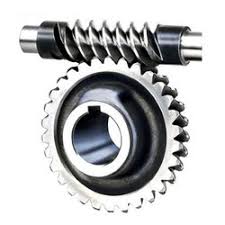 where in fact the gear reduction is normally a function of the diameters of both components.)
Contact us to be well-informed concerning Worm Gear Shaft.