Every power station, refinery, chemical plant, data centre, commercial HVAC system and industrial process with heat rejection operates cooling towers — and every mechanical-draft cooling tower uses a fan drive to move air through the fill media. The global installed base runs into the millions of fan drive positions. The majority of these drives below 30 kW use a worm gear reducer to convert motor speed (typically 1,450 or 1,750 rpm) down to fan speed (typically 100-300 rpm for axial fans), because the right-angle layout fits the vertical fan shaft geometry naturally, the self-locking prevents fan windmilling in high-wind conditions when the motor is off, and the compact housing fits inside the constrained fan stack envelope.
What makes cooling tower worm gear reducer specification uniquely demanding is the combination of four simultaneous stresses: continuous 24/7 operation (many cooling towers never stop), wet mist environment that corrodes unprotected housing and degrades seals, chemical water treatment additives (biocides, anti-scale compounds, corrosion inhibitors) that attack standard coatings, and noise sensitivity in locations near residential or commercial boundaries. No other single application combines all four of these stresses at the intensity level of a cooling tower. The article below walks induced-draft vs forced-draft configurations, noise control methodology, wet-environment defense, top-mounted maintenance logistics, and sized recommendations for common cooling tower types.
Induced-Draft vs Forced-Draft Cooling Tower Fan Drive Differences
Cooling towers divide into two mechanical-draft configurations — induced-draft (fan on top, pulling air upward through the fill) and forced-draft (fan on the side or bottom, pushing air through the fill). The worm gear reducer sits in a fundamentally different position and environmental exposure in each case.
The specification consequence: induced-draft installations require IP66 sealing minimum, marine-grade coating (two-pack epoxy + polyurethane), FKM seals and synthetic PAG lubricant as baseline. Forced-draft installations can often use IP65, standard epoxy coating and NBR seals — though upgrading to FKM and IP66 is recommended in environments where mist recirculation is common. Approximately 85% of cooling tower worm gear reducer demand is induced-draft top-mounted, which means the most demanding environmental specification is the most common installation scenario.

Noise Control Methodology for Cooling Tower Drives
Cooling towers frequently sit within 100-300 metres of residential or commercial property boundaries, making noise control a planning consent and operational compliance issue. The worm gear reducer contribution to total cooling tower noise is typically the second-largest mechanical source after the fan blade itself — and unlike the fan noise (which is broadband aerodynamic), gearbox noise contains tonal gear-mesh components that are perceptually more annoying and more easily identified by noise complaint assessments.
Standard industrial worm gear reducer units at typical cooling tower frame sizes (WPA 110-WPDS 175) run 68-78 dB(A) at 1 m distance under rated load. This exceeds the 65-70 dB(A) noise budget typically allocated to the gearbox within the total cooling tower noise specification. Achieving sub-70 dB(A) at the worm gear reducer requires three complementary measures applied together.
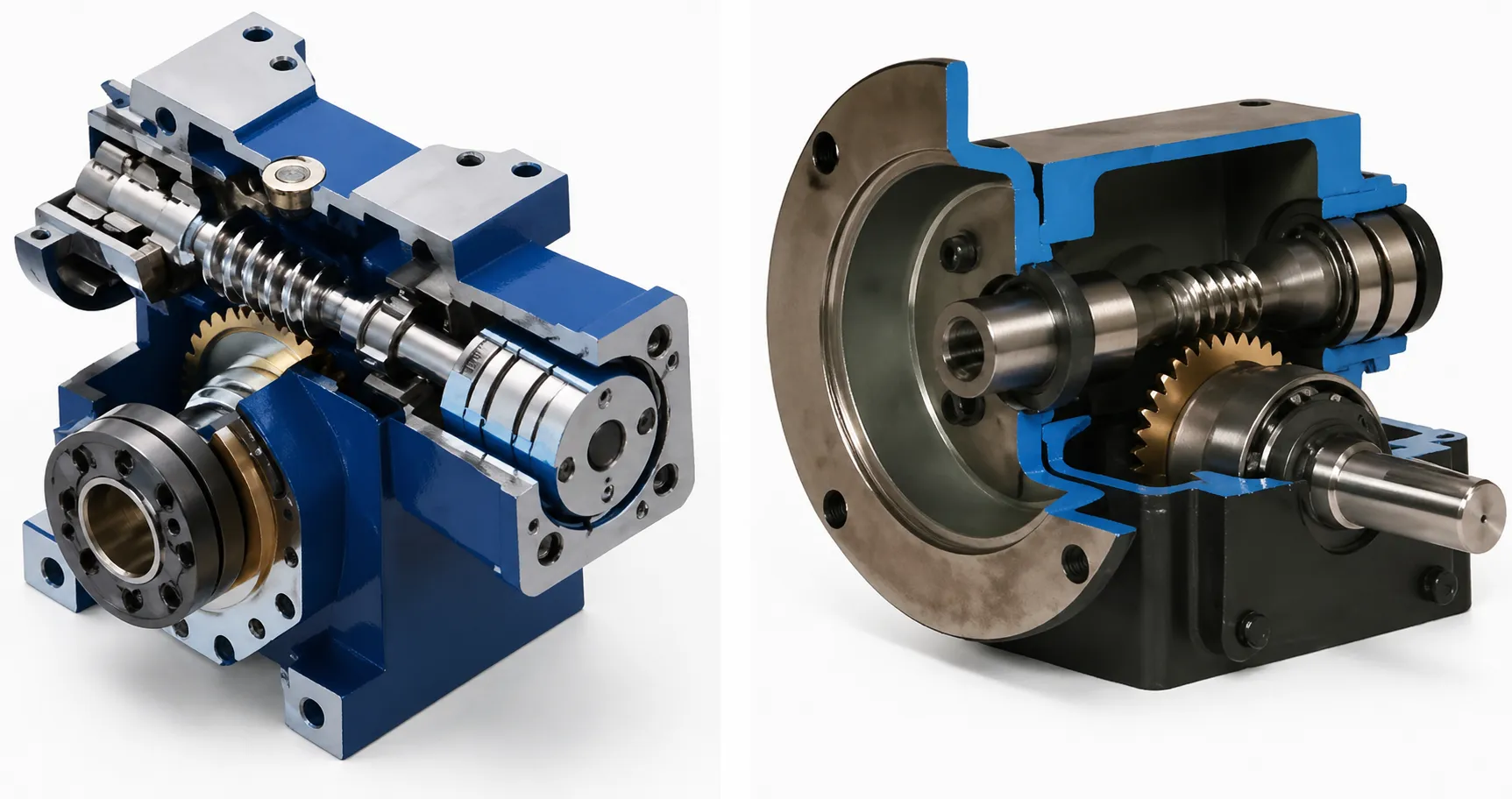
First, cast iron housing dissipates gear-mesh vibration more effectively than aluminum, typically reducing radiated noise by 3-5 dB(A) at the same frame size and load. For cooling tower duty, cast iron is the standard specification — the weight increase is inconsequential since the fan deck structure carries the static load regardless. Second, precision-ground worm shaft and lapped worm wheel surfaces reduce tooth-mesh impact noise by 4-7 dB(A) compared to standard machined-only surfaces. This is a factory-specification option, not a field modification — the worm shaft and ussikäigu reduktor wheel must be ground and lapped during manufacture. Third, synthetic PAG lubricant with high viscosity index provides viscoelastic damping in the oil film that reduces tooth-mesh impulse transmission by an additional 1-2 dB(A). The combined effect of all three measures: 8-14 dB(A) total noise reduction, typically bringing the worm gear reducer below 65 dB(A) at 1 m — within the typical cooling tower gearbox noise budget.
Wet Mist and Chemical Water Treatment Corrosion Defense
An induced-draft cooling tower worm gear reducer operates inside a continuous stream of warm, saturated air carrying entrained water particles and dissolved chemical treatment compounds. The water exiting the fill media has been treated with biocides (to prevent Legionella and algae growth), anti-scale agents (phosphonates, polycarboxylates), and corrosion inhibitors (molybdates, silicates, azoles). These compounds deposit on the external gearbox housing surface and accumulate over weeks — forming a chemical film that attacks standard industrial coatings far more aggressively than clean water or even light salt spray.
The corrosion defense for cooling tower worm gear reducer service requires four layers. First, two-pack epoxy primer applied to blast-cleaned (SA 2.5) substrate, providing adhesion and chemical barrier (100-150 μm). Second, polyurethane topcoat providing UV resistance and smooth surface that sheds water rather than trapping it (80-120 μm). Third, IP66 sealing with FKM output shaft seals that resist the 30-50 °C saturated exhaust air continuously without hardening. Fourth, sealed PTFE membrane breather that prevents the warm humid air from condensing inside the housing during thermal cycling — particularly important on towers that cycle between full-load and standby, where the housing temperature swings 20-30 °C.
For high-chloride cooling water (coastal intake water, or high cycles of concentration), the coating system should be upgraded to ISO 12944 C4-C5M specification — the same system used for marine applications. This is not a common default but is warranted where cooling water chloride exceeds 500 ppm or where the tower sits within 1 km of coastline with salt-laden intake air. The capital premium for C5M coating over standard industrial is typically 8-12% of unit cost — a fraction of the replacement cost for a housing that corrodes through within 3-5 years without adequate protection.
Top-Mounted Access and Maintenance Logistics
The induced-draft worm gear reducer sits on top of the cooling tower fan deck — typically 8-25 metres above grade level, accessible only by internal ladder, external staircase or in some cases crane. This high, confined position transforms routine maintenance into a logistical exercise. Oil changes require carrying lubricant containers up the tower. Oil sampling requires a collection kit that does not contaminate the sample with water from the surrounding mist. Visual inspection requires a technician comfortable working at height in wet conditions. And if the worm gear reducer must be replaced, a crane or gin pole must be mobilised to lower the old unit and raise the new one — a process that typically requires the cooling tower cell to be shut down for 4-12 hours.
These maintenance logistics create a strong economic incentive to specify for long maintenance intervals. Synthetic PAG lubricant with 18-24 month oil change intervals (vs 6-12 months for mineral CLP) halves the number of tower climbs for oil service over the 20-year gearbox life. Sealed PTFE breathers with 3-5 year replacement intervals reduce climb frequency further. FKM seals with 10-15 year service life mean one seal replacement at mid-life rather than three or four with NBR. The cumulative effect: a properly specified cooling tower worm gear reducer requires 3-5 maintenance tower climbs per decade, versus 10-15 for a standard industrial specification — reducing both the direct labour cost and the fall-risk exposure for maintenance technicians.
Weight is an additional consideration for top-mounted worm gear reducer installation. The accessibility constraint also affects spare parts strategy: maintaining one or two pre-staged spare units at site level eliminates the procurement lead time that would otherwise extend a tower outage from hours to weeks. Cast iron worm gear reducer units at WPA 130-WPDS 175 frame sizes weigh 45-120 kg — manageable with standard rigging but requiring two technicians for positioning on the fan deck. Frame sizes above WPDS 175 typically exceed 150 kg, requiring crane involvement for installation and replacement even with a good access staircase. Where possible, specifying the smallest adequate frame size (after thermal and noise derating) reduces installation and replacement logistics throughout the 20-year service life.
Sizing Worm Gear Reducer for Common Cooling Tower Configurations
Five cooling tower configurations account for the majority of worm gear reducer demand in HVAC and industrial cooling. Each carries distinctive power, speed, noise and environmental requirements:
◎ CONFIG 01
Small HVAC package tower (50-200 kW thermal)
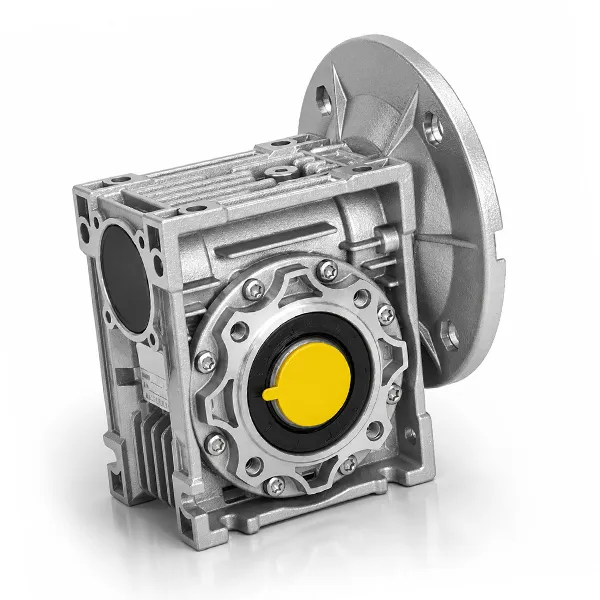
Fan motor 0.55-2.2 kW. Fan speed 200-400 rpm. Frame NMRV 075-NMRV 110. Ratio 5-10. Forced-draft common. Noise less critical (rooftop locations). Standard IP65 acceptable for sheltered FD units.
◎ CONFIG 02
Medium industrial tower (500-2,000 kW thermal)
Fan motor 4-11 kW. Fan speed 150-250 rpm. Frame WPA 110-WPA 150. Ratio 8-15. Induced-draft top-mount. IP66 + FKM seals + 2-pack coating. Noise: 65-70 dB(A) target at gearbox.
◎ CONFIG 03
Large industrial tower (2,000-10,000 kW thermal)
Fan motor 11-30 kW. Fan speed 100-200 rpm. Frame WPDS 175-WPDS 250. Ratio 10-20. Induced-draft. Full marine-grade coating. Noise-critical: precision-ground worm + lapped wheel mandatory.
◎ CONFIG 04
Power station hyperbolic tower (auxiliary fan)
Fan motor 15-45 kW. Auxiliary mechanical-draft fan on natural-draft hyperbolic towers. Frame WPDS 200+. 24/7 continuous. Heavy-duty SF 1.4+ for base-load operation.
◎ CONFIG 05
Data centre cooling tower (high-reliability)
Fan motor 4-15 kW. Induced-draft. 24/7/365 continuous. Tier III/IV data centres require N+1 redundancy on cooling — one spare drive per cell. Noise-critical (often urban locations). Rapid-replacement specification: spare worm gear reducer pre-staged at site, swap time target <4 hours. Browse our ussiülekande reduktori kataloog for cooling tower rated frame variants.
Common Cooling Tower Drive Specification Mistakes
◎ MISTAKE 01
Standard industrial coating on induced-draft tower
Single-coat alkyd enamel fails within 12-24 months in warm wet mist with chemical treatment compounds. Specify two-pack epoxy + polyurethane at 200-280 μm factory-applied as baseline for any induced-draft installation.
◎ MISTAKE 02
Aluminum housing on noise-critical installations
Aluminum radiates gear-mesh noise 3-5 dB(A) louder than cast iron at the same operating point. For any cooling tower with a noise limit below 70 dB(A) at the gearbox, cast iron housing is mandatory regardless of the weight penalty.
◎ MISTAKE 03
Open breather plug on top-mounted gearbox
The worm gear reducer on a tower top sits in 100% humidity air, 24/7. An open breather plug draws moisture into the housing with every thermal breathing cycle. Sealed PTFE membrane breather is not optional — it is essential.
◎ MISTAKE 04
Mineral CLP oil with 6-month interval on top of tower
Mineral CLP requires 6-12 month oil changes — meaning 20-40 tower climbs over 20-year life. Synthetic PAG extends to 18-24 months, halving the climb count. The lubricant premium recovers in reduced labour and fall-risk exposure within the first 3-4 years.
Cooling Tower Fan Worm Gear Reducer FAQ
Q: What is the expected service life of a cooling tower worm gear reducer?
A: A properly specified unit (cast iron housing, two-pack epoxy + polyurethane coating, IP66, FKM seals, sealed breather, synthetic PAG) typically reaches 12-18 years to first major overhaul in induced-draft service. Standard industrial specification drops this to 3-6 years. The 20-25% capital premium for cooling tower specification recovers 4-6× through avoided replacement cycles and reduced maintenance tower climbs over the 20-year cooling tower design life.
Q: Does the self-locking feature matter on cooling tower fan drives?
A: Yes — for one specific reason: wind-driven fan windmilling. When the fan motor is off (during cell shutdown or load shedding), high winds can spin the fan blades backward at speeds exceeding the design rating, potentially damaging the motor, gearbox and fan blades. A self-locking worm gear reducer at ratio ≥30 prevents this backward rotation entirely without requiring an additional mechanical brake or fan lock. For towers in high-wind locations (coastal, raised, exposed sites), this passive anti-windmill protection is a significant advantage of worm architecture over non-self-locking alternatives.
Q: How do I verify the noise specification of a cooling tower worm gear reducer?
A: Request the factory noise test certificate showing measured sound power level (Lw) at rated speed and load per ISO 8579-2. The field sound pressure level (Lp) at a given distance can then be calculated from Lw using standard acoustic propagation formulas. Specify the noise measurement conditions (load, speed, mounting) in the purchase order. For noise-critical installations, request witness testing before shipment — the cost of returning and replacing a non-compliant gearbox 20 metres up a cooling tower far exceeds the cost of a factory noise test.
Q: What maintenance schedule applies to cooling tower worm gear reducer?
A: Quarterly: visual inspection during routine tower inspection — check for oil leaks, coating damage, mounting bolt tightness, breather condition. Annually: oil sample analysis (viscosity, water content, acid number). Every 18-24 months (synthetic PAG): oil replacement. Every 5-7 years: seal condition assessment. At year 10-12: planned FKM seal replacement campaign. Integrate worm gear reducer checks into the cooling tower inspection programme rather than running a separate schedule — every tower climb should include the gearbox.
Q: Is VFD (variable frequency drive) common on cooling tower fan applications?
A: Increasingly standard — VFD-controlled cooling tower fans can reduce energy consumption by 30-50% by matching fan speed to actual cooling demand rather than running at full speed continuously. From the worm gear reducer perspective, VFD operation is beneficial: soft start reduces starting torque peaks, and variable speed operation distributes mechanical wear across a wider speed range. However, verify thermal margin at the lowest planned operating speed — at low fan speeds the motor cooling fan runs slowly, and the worm gear reducer may run at continuous load with reduced cooling. The minimum continuous operating speed is typically 30-40% of rated; below this, thermal runaway risk increases.
Q: How do I get a sized recommendation for my cooling tower fan drive?
A: Send our engineering team the cooling tower details: thermal capacity (kW), fan motor power and speed, fan diameter and speed, draft type (induced or forced), noise limit (dB(A) at gearbox or at boundary), water treatment chemistry (if known), installation height, and climate zone. We return a sized recommendation with noise estimate, coating specification, lubricant grade and lead time within 24-48 hours.
Sourcing Worm Gear Reducer for Cooling Tower Fan?
Send us fan power, speed, draft type, noise limit and water chemistry. Our Korean engineering team returns sized recommendations with noise estimate and corrosion defense specification within 24-48 hours.
Toimetaja: Cxm