Tekstiilitööstusele mõeldud ussikäigu reduktor: pideva töö spetsifikatsioon
Spinning, weaving, dyeing and finishing sub-application requirements, lint contamination defense, 24/7 continuous duty thermal sizing, noise mitigation and Korean equivalents for textile mill drives.
Textile mills stress a worm gear reducer in ways that food and packaging applications do not — round-the-clock operation, continuous lint and fiber loading on housing surfaces, ambient temperatures often 35-45 °C in spinning halls, and operator-adjacent installations that demand low noise. Generic industrial sizing methods underestimate textile-mill thermal margins by 20-35%, and seal selection for lint environments diverges from standard practice. The article below distinguishes the four major textile sub-applications (spinning, weaving, dyeing, finishing), maps lint defense strategies to each, walks the continuous-duty thermal sizing convention used in textile specifications, and summarises typical Korean cross-references.
Why Textile Mills Stress Worm Gear Reducer Differently
Most industrial worm gear reducer applications run 8-16 hours per day with maintenance windows for visual inspection. Textile mills run 22-24 hours per day, with brief maintenance windows weekly rather than daily. The first stress is therefore duration — the worm gear reducer is rarely allowed to cool to ambient temperature. The second stress is environment: spinning rooms, weaving halls and finishing zones generate continuous lint and fiber suspension that settles on housing surfaces, blocks cooling fins, and can ingress past standard seals.
The third stress is thermal — ambient temperatures in unconditioned mill halls run 35-45 °C in summer, with localised peaks near machinery exceeding 50 °C. Standard catalogue thermal ratings assume 20-25 °C ambient, so direct application of catalogue tables in textile environments produces undersized specifications and accelerated lubricant degradation. The fourth stress is noise: textile mills are heavily operator-occupied, and noise-sensitive zones require sub-72 dB(A) drives even on mid-power mid-frame units.
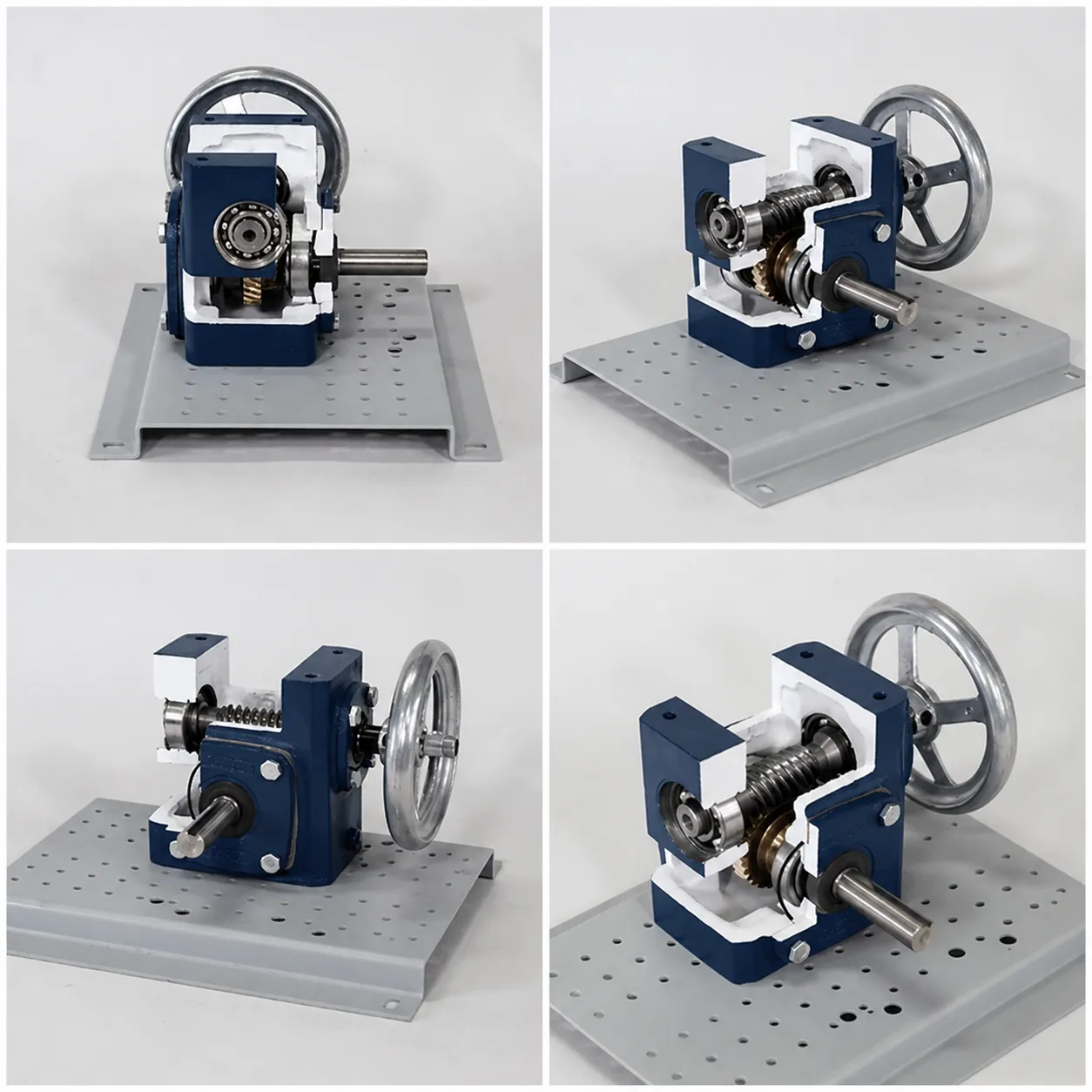
Four Textile Sub-Applications — Spinning, Weaving, Dyeing, Finishing
Textile manufacturing breaks into four major sub-application categories. Each places a different load profile on the worm gear reducer, and each has a distinctive environmental envelope.
Lint Contamination Defense — Three Strategies
Cotton, synthetic and wool lint settles on housing external surfaces and at every micro-recess in the housing. Over weeks the deposit builds up to 5-15 mm thick on horizontal surfaces, blocking cooling air movement past fins and ingressing past output shaft seals. Three complementary strategies defend a textile-duty worm gear reducer:
◆ STRATEGY 01 — HOUSING DESIGN
Smooth, sloped, no horizontal surfaces
Textile-duty worm gear reducer housings minimise upward-facing horizontal surfaces. Fin tops slope 3-5° to encourage gravity self-cleaning. Cast iron and aluminum bodies are preferred over stainless for thermal reasons; surface finish is paramount.
◆ STRATEGY 02 — SEAL SELECTION
Double-lip output shaft seals with dust deflector
Standard single-lip NBR seals fail within 6-12 months in heavy-lint environments. Textile-duty worm gear reducer specifications use double-lip FKM (Viton) with metal dust deflector or felt collar pre-filter. Replacement interval extends to 24-36 months.
◆ STRATEGY 03 — MAINTENANCE PROTOCOL
Weekly compressed-air clean of cooling fins
Even with optimal housing design, mill-floor lint accumulation requires weekly external cleaning. Compressed air at 3-5 bar, applied at 30 cm distance to fins and breather, removes 90%+ of accumulated deposit. Monthly inspection of seals and breather completes the cycle.
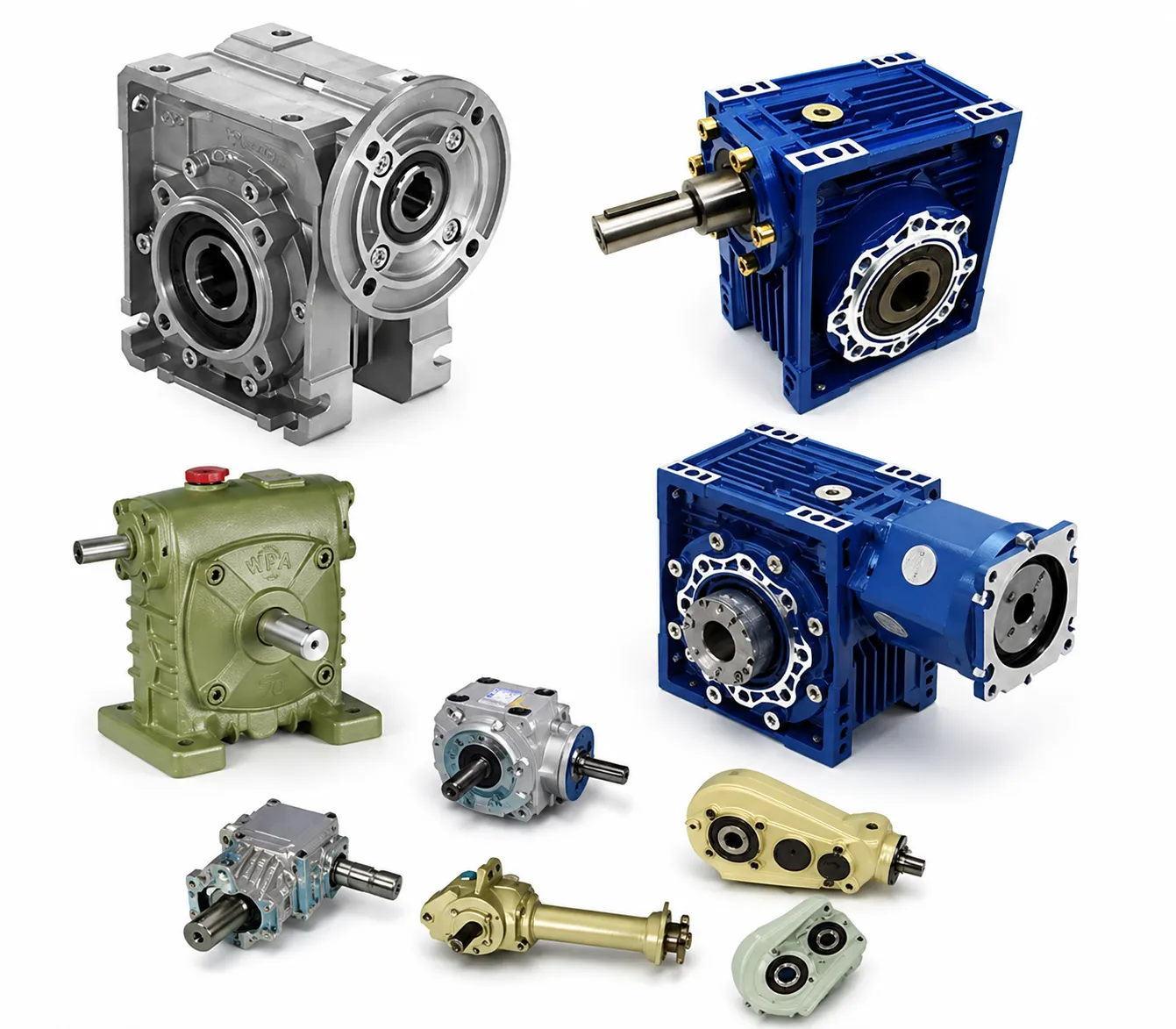
Continuous-Duty Thermal Sizing for Textile Mills
Standard catalogue thermal ratings (P_thermal in kW) are published at 20 °C ambient with 8 hours/day duty assumption. Textile applications run 22-24 hours/day at 35-45 °C ambient — both factors derate the catalogue rating. The textile-duty thermal sizing convention applies two correction factors:
f_T (ambient temperature factor):
- ▸20 °C ambient: f_T = 1.0
- ▸30 °C ambient: f_T = 0.85
- ▸40 °C ambient: f_T = 0.70
- ▸50 °C ambient: f_T = 0.55
f_D (duty cycle factor):
- ▸8 hours/day: f_D = 1.0
- ▸16 hours/day: f_D = 0.90
- ▸22+ hours/day (textile typical): f_D = 0.80
The corrected thermal rating: P_thermal_textile = P_thermal_catalogue × f_T × f_D. For a 40 °C ambient spinning hall on 22+ hour duty: P_thermal = catalogue × 0.70 × 0.80 = 0.56 × catalogue. The worm gear reducer must therefore be sized at 1/0.56 ≈ 1.8× the application power demand to avoid thermal overload. Skipping this correction is the single largest source of premature failure in textile installations.
Noise Mitigation in Operator-Adjacent Drives
Textile mill noise is dominated by loom, spindle and air-jet sources, which can exceed 95 dB(A) in active production halls. The worm gear reducer contribution is small relative to those sources, but in quieter zones (drawing frames, stenter lead-in, dyeing tank circulation) the gearbox can dominate the local sound field if specified poorly. Three approaches reduce worm gear reducer noise contribution:
First, prefer cast iron over aluminum housings — cast iron damps gear-mesh frequencies more effectively, reducing radiated noise by 3-5 dB(A). Second, specify ground-and-lapped worm-wheel mating profiles (premium grade); the noise reduction over standard machined surfaces is 4-7 dB(A) at typical mill input speeds. Third, use synthetic PAG lubricant rather than mineral CLP — viscoelastic damping in the oil film reduces tooth-mesh impulse noise by an additional 1-2 dB(A). The combined effect: a textile-duty gearbox can run 8-13 dB(A) quieter than a generic industrial equivalent at the same frame size and load.
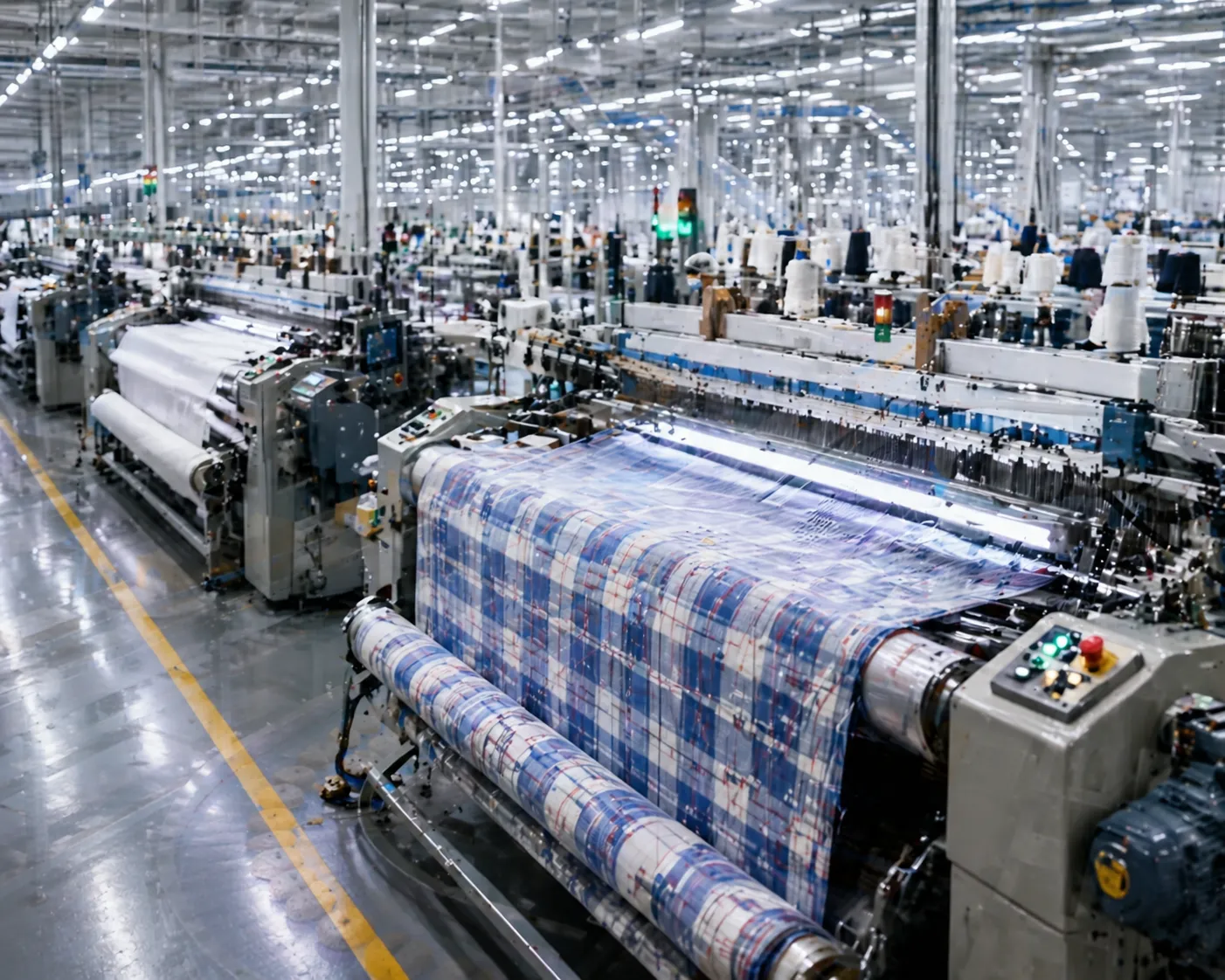
Sizing Worm Gear Reducer for Common Textile Drives
◐ TEXTILE 01
Ring frame / spinning drive
Output 2.2-5.5 kW, output speed 100-400 rpm, smooth continuous. Frame NMRV 075-WPA 110, ratio 5-15. Apply f_T 0.70 + f_D 0.80 corrections.
◐ TEXTILE 02
Loom auxiliary drive — beam let-off
Output 0.55-1.5 kW, output speed 1-10 rpm (very low), cyclic micro-shock. Frame NMRV 063-NMRV 075, ratio 100-300. SF 1.4-1.6 minimum.
◐ TEXTILE 03
Jet dyeing — fabric circulation
Output 4-7.5 kW, output speed 30-60 rpm, smooth. Frame WPA 110-WPA 130. IP66 sealing, FKM seals, anti-corrosion housing coating mandatory.
◐ TEXTILE 04
Stenter frame — fabric drying transport
Output 5.5-15 kW, output speed 60-150 rpm. High ambient (50-60 °C near oven). Frame WPA 130-WPDS 175, synthetic PAG mandatory, oversize one frame for thermal margin.
Common Textile Specification Mistakes
⚠ VIGA 01
Skipping ambient correction
Catalogue thermal rating at 20 °C does not apply at 40 °C textile-mill ambient. Skipping the f_T factor undersizes the worm gear reducer by 30%+.
⚠ VIGA 02
Single-lip seals in lint zones
Standard single-lip NBR seals fail within 6-12 months when subjected to constant lint deposit. Specify double-lip FKM with dust deflector.
⚠ VIGA 03
Mineral oil for stenter drives
Mineral CLP oxidises within 2,000-3,000 hours at 90+ °C oil-bath temperatures typical near stenter frames. Synthetic PAG mandatory for >70 °C oil temperature.
⚠ VIGA 04
Ignoring SF for loom let-off
Loom warp let-off looks like a smooth low-power application but actually delivers cyclic micro-shock from beat-up impulses. SF 1.4-1.6 minimum.
⚠ MISTAKE 05
Forgetting weekly cleaning protocol
Even a perfectly specified worm gear reducer fails within 18-30 months in lint environments without weekly external compressed-air cleaning. Build the protocol into mill maintenance schedules from day one — see our field troubleshooting guide for failure symptom diagnosis.
Worm Gear Reducer Textile Industry FAQ
Q: Why is mineral oil insufficient for stenter and finishing drives?
A: Stenter ovens raise nearby ambient air to 60-80 °C, which raises worm gear reducer oil-bath temperature to 80-100 °C continuously. Mineral CLP (paraffinic base) oxidation rate doubles for every 10 °C above 60 °C — so at 90 °C the oxidation rate is 8× the 60 °C baseline. Service life of 2,000-3,000 hours typical. Synthetic PAG resists oxidation 4-6× longer at the same temperature, extending oil-change intervals to 6,000-8,000 hours and protecting bronze wheel wear.
Q: How do I size a unit when ambient changes seasonally?
A: Size for the worst-case (summer peak) ambient. A textile mill that runs 28 °C in winter but 45 °C in summer should size to 45 °C — applying f_T = 0.65 in the thermal calculation. Sizing to the average ambient (37 °C, f_T = 0.78) works for several months but creates summer thermal failures. Capital savings from average-ambient sizing are illusory: replacement cost plus production downtime exceeds the upfront oversize delta.
Q: Can existing dyeing machine drives use generic gearboxes?
A: Generic IP54 industrial worm gear reducer typically fails within 6-18 months in dyeing environments — chemical splash and ambient humidity 60-80% combine to corrode internal bearings and shaft seals. Specifying IP66 minimum, with anti-corrosion epoxy housing coating and FKM seals, extends service life to 5-8 years. The capital premium for the upgraded specification is 25-40%, recovered within the first replacement cycle through avoided downtime.
Q: What noise level should I expect from a properly specified textile-duty worm gear reducer?
A: A textile-grade worm gear reducer at 1500 rpm input, mid-frame size (NMRV 090 / WPA 110) with cast iron housing, lapped-finish wheel, synthetic PAG fill: 60-68 dB(A) at 1 m distance. Generic industrial equivalent at the same operating point typically runs 70-78 dB(A). The 8-10 dB(A) gap is meaningful for operator-adjacent installations and contributes to OSHA / ISO 9612 compliance margins. Higher input speeds (1800 rpm+) increase noise by 4-6 dB(A); slower input speeds reduce by similar margin.
Q: How often does the gearbox require maintenance in textile environments?
A: Weekly: external compressed-air cleaning of cooling fins and breather. Monthly: visual inspection of seals, breather condition, mounting bolt tightness, oil sight glass level. Quarterly: oil sample for laboratory analysis (water, particulate, viscosity, oxidation). Annually: oil replacement (mineral) or extended (synthetic 24,000-36,000 hours). Every 5-7 years: bearing inspection / replacement schedule. The weekly cleaning is the most frequently neglected item and the most consequential for service life.
Q: Where can I get a sized recommendation for my mill drive?
A: Send our engineering team the drive parameters (output power, speed, ratio, duty cycle hours/day, ambient temperature range, sub-application type) and we return a sized recommendation with thermal margin and noise estimate within 24-48 hours. Browse our ussiülekande reduktori kataloog to see frame options before requesting the quote, or use our contact form for direct engineering consultation.
Specifying a Textile-Duty Drive?
Send us your sub-application (spinning, weaving, dyeing, finishing), drive parameters, ambient envelope and duty cycle. Our Korean engineering team returns sized recommendations with thermal correction factors applied and full lubricant + sealing specification within 24-48 hours.
Toimetaja: Cxm