Printing is among the most precision-demanding applications for mechanical drives in any manufacturing sector. A four-colour offset press must maintain colour-to-colour register within ±0.05 mm across all four impression cylinders — a positional tolerance tighter than most CNC machining operations, achieved at web speeds of 5-15 metres per second on continuous web presses or 15,000+ sheets per hour on sheetfed presses. While the main press drive (typically 15-75 kW) uses helical or planetary gearboxes for efficiency at high power, the dozens of auxiliary drives that surround each printing unit — ink fountain roller drives, dampening system oscillators, impression cylinder pressure adjusters, plate cylinder register positioners, folder drives and cross-cutter synchronisers — use worm gear reducer architecture for the compact right-angle layout, self-locking position hold, and high ratio that these positions demand.
A modern printing press operates 20-60 worm gear reducer auxiliary positions per press, and a commercial printing plant with 3-8 presses operates 100-480 positions in total. The specification challenges span precision (backlash below 6 arc-minutes on register positioners), contamination defense (ink mist, solvent vapour, paper dust), thermal management (UV curing lamp proximity at 80-120 °C), and vibration control (mesh-frequency vibration that prints as banding in halftone areas). This article walks the three major printing technologies and their drive requirements, register positioning precision, ink and dampening system drives, folder and finishing equipment, and sized recommendations for each press type.

Three Printing Technologies and Their Worm Gear Reducer Demands
Each printing technology generates a different drive profile for its auxiliary worm gear reducer positions, determined by the image transfer mechanism and the substrate handling requirements.
Offset lithography (sheetfed and web): Uses an intermediate blanket cylinder to transfer ink from plate to paper. The auxiliary worm gear reducer positions include ink fountain roller drives (metering ink supply), dampening system oscillators (distributing fountain solution), plate cylinder register motors (adjusting circumferential and lateral register), impression cylinder pressure adjusters, and delivery pile height control. Offset demands the tightest register tolerance (±0.05 mm) because the four-colour halftone process produces visible moire patterns if register exceeds ±0.1 mm. Ink viscosity is moderate (10-50 Pa.s) and ink mist is the primary contamination hazard.
Flexographic printing (packaging, labels, corrugated): Uses a flexible polymer plate on a plate cylinder with anilox roller ink metering. The auxiliary worm gear reducer positions include anilox roller drives (precise ink metering through engraved cell volume), doctor blade positioning, plate cylinder register, web tension control, and die-cutting station drives. Flexo uses low-viscosity water-based or solvent-based inks (0.05-0.5 Pa.s) that splash and mist more readily than offset inks, requiring IP65 sealing on worm gear reducer positions in the ink path. Register tolerance is ±0.1-0.2 mm (less demanding than offset due to coarser halftone screens on packaging substrates).
Gravure printing (publication, packaging, decorative): Uses an engraved chrome-plated cylinder immersed in liquid ink. The auxiliary ussikäigu reduktor positions include impression roller pressure adjusters, doctor blade angle positioners, web tension drives, and dryer damper actuators. Gravure inks are solvent-based with very low viscosity (0.02-0.1 Pa.s) and high solvent content (60-80%), creating ATEX Zone 1 explosive atmospheres in the press enclosure. Every worm gear reducer in the gravure press zone must satisfy ATEX Category 2G for solvent gas — the most stringent ATEX classification commonly encountered in printing.

Register Positioning Precision Within ±0.05 mm
Colour register — the alignment between successive colour impressions — is the defining quality parameter in multi-colour printing. The plate cylinder register motor drives an eccentric or rack mechanism that shifts the plate circumferentially (print direction) and laterally (cross direction) to align each colour impression with the preceding one. The worm gear reducer on the register motor converts servo motor rotation to the precise linear shift — typically ±5-10 mm of travel with resolution of 0.01-0.02 mm per motor step. At typical register mechanism gear ratio of 200-500 total (worm gear reducer ratio 30-60 multiplied by the eccentric or rack mechanism), each arc-minute of worm gear reducer backlash corresponds to approximately 0.005-0.015 mm of register dead zone. To maintain ±0.05 mm register accuracy, the backlash budget allocated to the worm gear reducer is 3-6 arc-minutes — the tightest backlash specification in any worm gear reducer application.
Achieving 3-6 arc-minutes requires precision-ground worm at ISO class 3-4 (not the class 5-6 sufficient for elevator and escalator service), lapped bronze worm wheel, and factory-adjusted centre distance. The self-locking characteristic at ratio ≥30 holds the register position between adjustments — critical because register corrections occur every few hundred metres of web (automated by camera-based register control systems) and the position must remain absolutely stable between corrections. Any drift in the held position produces progressive register error that the camera system must then correct, creating a control oscillation that wastes substrate and ink during the correction cycle.
Ink Roller and Dampening System Drives
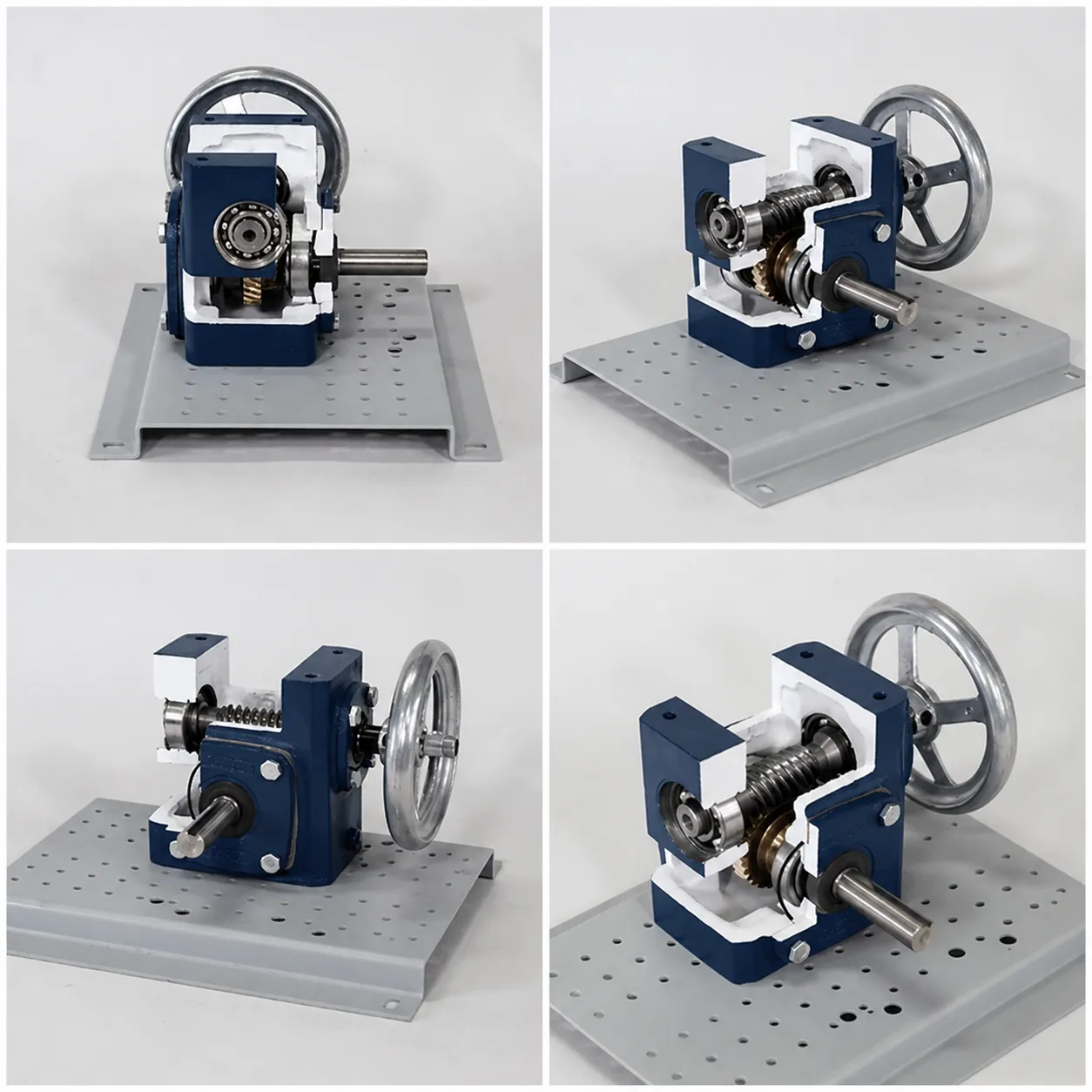
The ink fountain roller on an offset press rotates at 1-15 rpm, metering ink from the fountain reservoir to the ink train. The worm gear reducer on this position must deliver extremely smooth rotation — any speed variation produces ink density variation (banding) visible in solid and halftone areas. Precision-ground worm specification is mandatory for ink fountain drives on quality-critical commercial and packaging presses. Self-locking holds the fountain roller at zero rotation during press stops and wash-up cycles, preventing gravity-driven ink leakage from the fountain. The ink environment is contamination-heavy: ink mist, solvent vapour and dried ink particles coat every surface near the ink train. IP55 minimum sealing with FKM seals resistant to ink solvents (petroleum distillates for conventional offset, water-glycol for UV offset) protects the ussikäigu reduktor from internal contamination.
Dampening system oscillator drives on offset presses present a different challenge: continuous reciprocating motion at 20-60 strokes per minute, distributing fountain solution uniformly across the dampening roller face. This oscillating duty accumulates 1-3 million cycles per year — similar to packaging machinery indexing — and demands C3 bearings with anti-fretting treatment for oscillating service. The worm gear reducer on the oscillator converts motor rotation to linear reciprocating motion through a crank or cam mechanism, and the mesh-frequency vibration from the worm must not transmit to the dampening rollers where it would produce periodic dampening variation visible as tonal banding in the printed halftone.
UV Curing Proximity Heat and Solvent Vapour ATEX Defense
UV and LED UV curing systems are increasingly standard on offset and flexo presses, replacing conventional hot-air drying. UV curing lamps operate at 200-400 W/cm, generating substantial infrared heat that raises the ambient temperature around nearby worm gear reducer positions to 60-120 °C depending on shielding and ventilation. The thermal derating methodology follows the same framework as plastics barrel proximity and paper mill dryer section: at 80 °C ambient with continuous press operation (16-20 hours/day on commercial presses, 22-24 hours/day on newspaper presses), usable thermal power is 28-35% of catalogue — requiring 3-4× frame oversizing on UV-proximate positions.
For gravure printing presses, solvent vapour ATEX compliance is the dominant environmental specification. Toluene, MEK and ethyl acetate — the primary gravure ink solvents — form explosive atmospheres at 1.1-11.5% concentration in air. Every worm gear reducer inside the gravure press enclosure (impression roller adjusters, doctor blade positioners, web guide drives) must carry ATEX Category 2G certification with temperature class T3 or T4 depending on the specific solvent auto-ignition temperature. The ATEX worm gear reducer specification mirrors the automotive paint shop approach: maximum surface temperature verification at worst-case load and ambient, double-lip FKM seals with leak-detection drain groove, and non-sparking housing material (cast iron is acceptable; aluminum is preferred for ATEX compliance as it eliminates the ferrous-impact spark risk).
Folder, Cross-Cutter and Finishing Equipment Drives
Web presses (newspaper, commercial web offset, gravure publication) terminate in a folder that cuts, folds and delivers the printed signature. The folder contains 4-8 worm gear reducer positions: jaw cylinder timing, former board angle adjustment, chopper fold timing, delivery fan speed, and compensator roller positioning. The cross-cutter drive is the most demanding position: a rotary knife synchronised to the web speed cuts the web at precisely the correct length — ±0.5 mm cut-to-print accuracy at web speeds of 5-15 m/s. The worm gear reducer on the cross-cutter phase adjustment positions the knife cylinder timing relative to the web print repeat, and any backlash translates directly into cut position error.
Post-press finishing equipment (sheeters, die-cutters, gluers, case-makers) uses worm gear reducer drives on feed table lifts, impression cylinder adjusters, glue applicator positioners and delivery stacker mechanisms. These positions operate at moderate precision (±0.5-2 mm) and moderate cycle rates (5,000-20,000 sheets per hour), with self-locking providing position hold during format changes and machine adjustments. The finishing environment is generally cleaner and cooler than the press environment (no ink mist, no UV heat, no solvent vapour), allowing standard industrial worm gear reducer specification with IP54-IP55 and synthetic PAG at catalogue thermal rating.
Paper Dust Contamination and Digital Hybrid Press Trends
Paper dust is a significant contamination hazard in printing environments — both for print quality (dust particles cause hickeys and picking defects on the printed sheet) and for mechanical equipment reliability. Paper dust particles range from 5-500 μm and are generated at every point where the substrate is cut, folded or handled under tension. In sheeter and folder environments, paper dust concentration can exceed 2 mg/m³ continuously, coating every surface including gearbox housings, seal lips and breather openings. Double-lip FKM seals with dust exclusion groove and sealed desiccant breather are the baseline defense for any position in a printing hall where paper dust is present — which in practice means every position on a sheetfed press, every folder and sheeter position, and every post-press finishing station.
The growth of digital-offset hybrid presses (combining inkjet or electrophotographic digital heads with conventional offset units on the same press line) introduces new auxiliary drive requirements. The digital imaging section typically requires substrate pretreatment (primer application, corona treatment) and post-treatment (UV or LED curing) that add 4-8 additional motorised positions per hybrid press — each requiring a geared drive. The positioning precision for digital-to-offset register alignment is tighter than conventional offset-to-offset alignment (±0.03-0.05 mm), pushing the backlash specification on the digital section register positioners to 2-4 arc-minutes — the most demanding backlash specification encountered in commercial printing today, approaching laboratory instrument-grade precision.
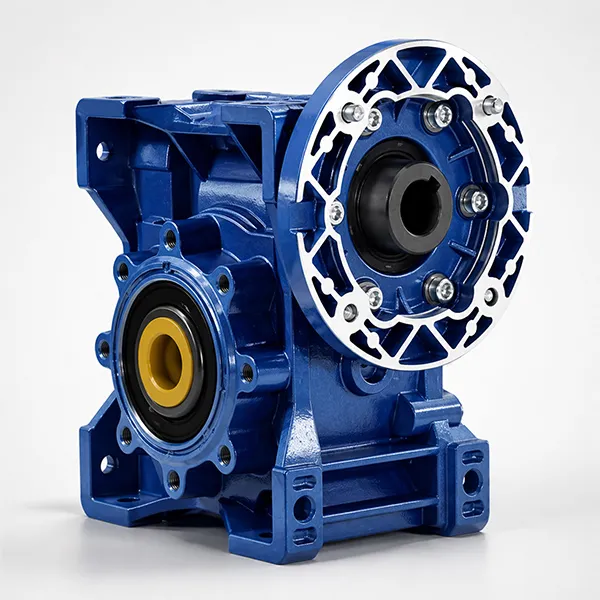
Corrugated board printing (flexo and digital) presents a different scale of drive requirement: corrugated press lines operate at 200-350 m/min with sheet sizes up to 2,800 mm wide. The auxiliary torque demands on corrugated presses are 3-5× higher than equivalent commercial press positions due to the heavier substrate and larger impression cylinder diameters. Frame sizes shift upward accordingly: NMRV 075 on commercial offset becomes WPA 130 or WPDS 175 on corrugated flexo for the equivalent function. The corrugated environment also generates more paper dust (from the flute liner surfaces) than coated commercial paper, increasing the seal and breather protection requirement.
Common Printing Drive Specification Mistakes
Catalogue backlash on register positioner
Standard 15-25 arc-min produces ±0.1-0.3 mm register dead zone — exceeding the ±0.05 mm tolerance for quality four-colour process work. Specify ISO class 3-4 precision worm gear reducer at 3-6 arc-min for register drives.
Standard NBR seals in ink mist zone
Petroleum-based offset inks and solvent-based flexo/gravure inks swell and degrade NBR within 3-6 months. FKM seals are mandatory on any worm gear reducer position within the ink mist zone of any press type.
No ATEX certification on gravure press drives
Gravure press enclosures are ATEX Zone 1 due to toluene/MEK vapour. Non-ATEX worm gear reducer in the press enclosure creates an explosion risk and violates regulatory compliance. ATEX Category 2G with verified T-class is mandatory.
No thermal derating near UV curing lamps
UV lamps at 200-400 W/cm produce 60-120 °C ambient within 1-2 metres. At 80 °C + 20 h/day press operation, usable thermal power is 28-35% of catalogue. Under-sizing produces thermal failure within 12-24 months on high-production presses.
Printing Machinery Worm Gear Reducer FAQ
Q: How many worm gear reducer positions does a typical printing press operate?
A: A four-colour sheetfed offset press operates 20-35 worm gear reducer auxiliary positions: 4-8 ink fountain drives (one per colour), 4-8 dampening oscillator drives, 4-8 register positioners, 2-4 impression cylinder adjusters, and 2-4 delivery and feeder auxiliary drives. A six-colour web offset press with inline folder operates 35-55 positions. A commercial printing plant with 3-5 presses operates 80-275 worm gear reducer positions in total. Standardising on 2-3 NMRV frame families across the press fleet reduces spare inventory to 4-6 units.
Q: What service life is expected on printing press duty?
A: Register positioners (low cycle, precision-ground): 15-20 years — the precision worm and wheel surfaces wear very slowly at the low speeds and light loads of register adjustment. Ink fountain drives (continuous low speed): 10-15 years. Dampening oscillators (high cycle reciprocating): 5-8 years before bearing replacement. Folder drives (moderate speed, moderate cycle): 8-12 years. A well-maintained printing press press worm gear reducer fleet typically outlasts the press itself — presses are replaced every 15-25 years, and the gearbox fleet serves the full press lifecycle with one mid-life bearing overhaul on the high-cycle positions.
Q: Does self-locking matter on printing presses?
A: Yes — critically for three positions. Register positioners must hold colour register between adjustments without drift — even 0.01 mm of drift between corrections degrades print quality. Ink fountain roller drives must hold at zero rotation during press wash-up to prevent ink leakage. Impression cylinder pressure adjusters must hold the nip pressure setting during the entire production run without creep. Self-locking at ratio ≥30 provides zero-drift hold on all three positions without mechanical locks or brakes.
Q: What maintenance schedule applies to printing press worm gear reducer?
A: Weekly: external cleaning of ink mist accumulation during press wash-up (the press wash-up cycle provides the access window). Monthly: visual inspection for leaks and seal condition. Every 12-18 months (synthetic PAG): oil sample on high-duty positions (dampening oscillators, folder drives). Every 24-36 months: oil replacement. Every 5-7 years: bearing vibration analysis on dampening oscillators and folder drives, backlash measurement on register positioners. All maintenance aligns with the press maintenance schedule — printing presses have weekly wash-up and monthly preventive maintenance windows that accommodate worm gear reducer inspection.
Q: How do I get a sized recommendation for my printing press?
A: Send our engineering team the press details: press type (sheetfed offset, web offset, flexo, gravure), number of colours, auxiliary drive positions per press, register tolerance requirement, ink type (conventional, UV, water-based, solvent), ATEX classification (gravure), UV lamp proximity, operating hours per day, and total press count. We return sized recommendations with precision class, ATEX compliance and fleet pricing within 24-48 hours.
Sourcing Worm Gear Reducer for Printing Press?
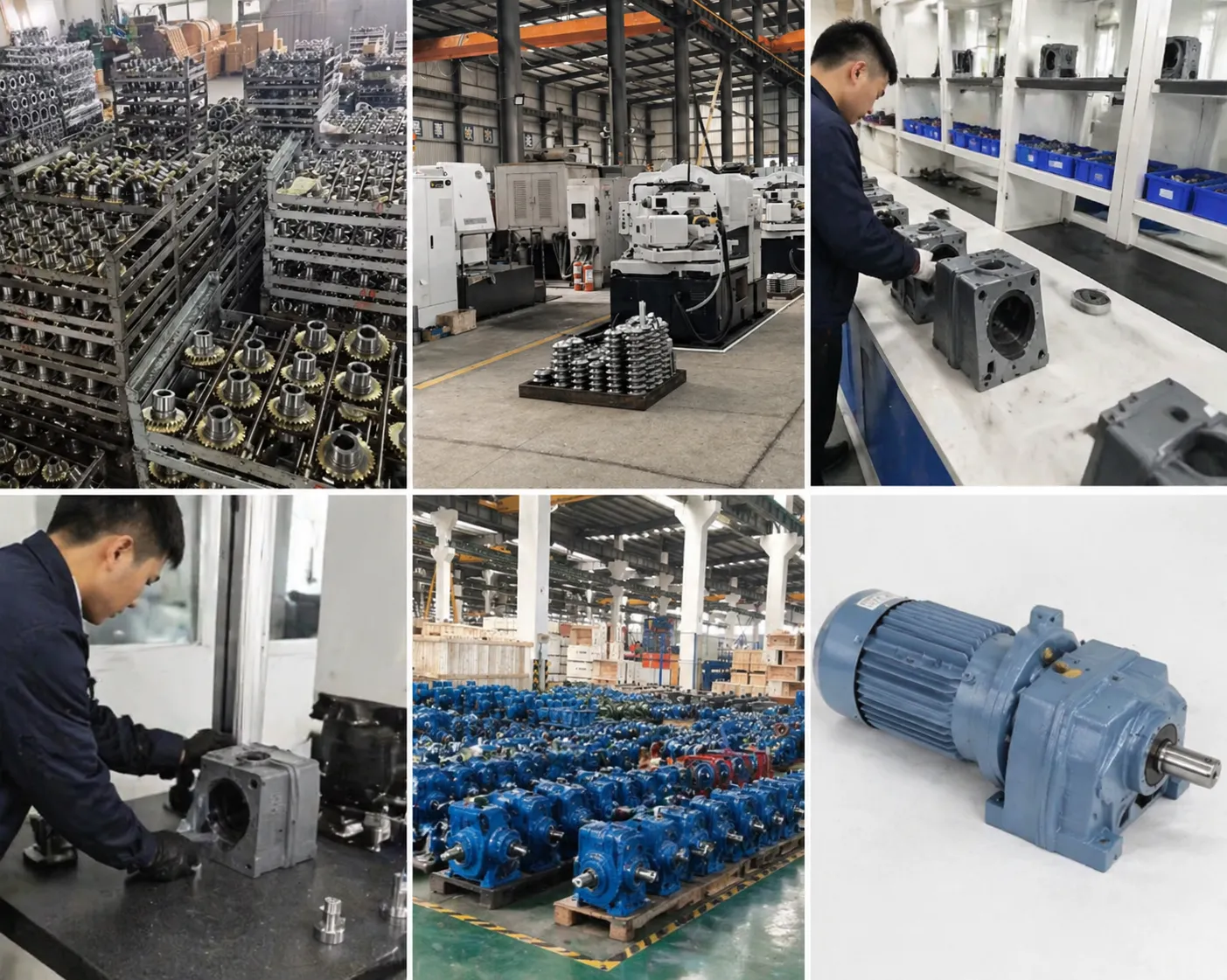
Send us press type, register tolerance, ink type and ATEX requirement. Our Korean engineering team returns sized recommendations with precision class and fleet pricing within 24-48 hours.
Toimetaja: Cxm