Worm Gear Reducer Troubleshooting: 10 Common Field Problems
Stop the drive the right way, diagnose the right cause, fix the right thing. A field-tested troubleshooting reference covering the ten problems Korean and Asian maintenance teams encounter most — each with severity rating, likely causes, field actions and escalation criteria.
A worm gear reducer that runs catalogue rated duty on synthetic PAG with 4,000-hour oil changes typically delivers 25,000 to 40,000 operating hours before any field intervention is needed. The problems below are what arises in the other cases — undersized installations, oil-change deferrals, sealing failures, dust ingress, motor mismatches, ageing seals. Each is documented with a severity rating, likely causes, immediate field actions and escalation criteria. The aim is to turn a 30-minute panic diagnosis into a 5-minute structured one. For sizing-related problems where undersizing was the original cause, our companion 6-step sizing guide walks through the calculation that should have been done up front.
How to Read the Severity — Triaging a Worm Gear Reducer Problem
Every worm gear reducer symptom in the following sections is tagged with a severity level that determines the response window. The four-level scale below is the same triage scheme Korean industrial-maintenance teams use across automotive, food, cement and chemical-process plants.
Normal operating signal. Note in maintenance log; no action required this shift.
Early-warning signal. Monitor the gearbox actively, schedule inspection within the week.
Active failure mode. Address before next shift; degradation accelerating.
Stop the drive now. Catastrophic failure imminent or hazard to personnel present.
Acoustic & Mechanical Distress Signals
A worm gear reducer in healthy operation produces a steady mid-frequency hum at 54-58 dB measured 1 metre from the housing. Deviations from that baseline — tonal whine, low-frequency rumble, knocking, or vibration that travels into the mounting frame — are the earliest signals available to a maintenance team. Catching them on the worm gear reducer before downstream symptoms develop is the difference between a planned intervention and an emergency stop.
Abnormal noise (whine, rumble or knock)
◆ LIKELY CAUSES
- ▸ Bearing wear at worm shaft or output shaft
- ▸ Loose mounting bolts (frame or motor adapter)
- ▸ Damaged or chipped worm wheel teeth
- ▸ Lubricant level low or wrong viscosity grade
◆ FIELD ACTION
- → Re-torque all visible bolts to spec
- → Check oil level via sight glass
- → Listen with stethoscope at each bearing housing
If unresolved: escalate within 24 hours — bearing failure progresses fast.
Excessive vibration
◆ LIKELY CAUSES
- ▸ Motor-to-gearbox shaft misalignment
- ▸ Worn or damaged worm shaft bearings
- ▸ Output coupling imbalance
- ▸ Foundation bolts loose
◆ FIELD ACTION
- → Verify motor alignment with dial indicator
- → Re-torque foundation bolts in star pattern
- → Vibration meter reading at bearing housings
If unresolved: bearing replacement — schedule within 48 hours.
Thermal & Lubrication Issues
A worm gear reducer running at correctly sized service factor stabilises oil-bath temperature between 55-75 °C in typical Korean factory ambient. Deviation upward toward 90 °C and beyond signals undersizing, lubricant degradation, or dust accumulation blocking cooling fins. Lubrication faults on a worm gear reducer — leakage, level drop — interact with thermal symptoms because lower oil volume dissipates heat less effectively, accelerating the temperature rise.
Overheating above 90 °C oil temperature
◆ LIKELY CAUSES
- ▸ Frame undersized for actual duty cycle
- ▸ Cooling fins blocked by dust or debris
- ▸ Mineral oil used where synthetic PAG specified
- ▸ Ambient temperature above 40 °C without derate
◆ FIELD ACTION
- → Clean cooling fins with compressed air
- → Verify oil level and grade on nameplate
- → Reduce duty cycle until investigation complete
If unresolved: thermal sizing review needed — likely upsize one frame.
Oil leakage at shaft seals or inspection cover
◆ LIKELY CAUSES
- ▸ Aged Viton lip seal (7+ years typical limit)
- ▸ Inspection cover gasket compression set
- ▸ Breather plug clogged, pressurising housing
- ▸ Output shaft surface scoring on seal contact face
◆ FIELD ACTION
- → Clean and inspect breather plug
- → Top up oil to sight glass mid-line
- → Mark leak rate (drops/hour) for trending
If unresolved: seal replacement at next planned shutdown.
Performance Drop-Off — Power Reaches Output but Falls Short
Performance issues describe a worm gear reducer that runs but does not deliver — output torque feels low, motor current draw climbs above nameplate, or reversing produces noticeable lag at the load. These are gradual worm gear reducer symptoms that develop over months as the bronze wheel teeth wear, the worm thread polishes, or the mounting drifts out of alignment.
Insufficient output torque or slipping
◆ LIKELY CAUSES
- ▸ Severe bronze wheel tooth wear
- ▸ Worm thread polished beyond effective contact
- ▸ Output shaft key sheared partially
- ▸ Application load increased beyond original spec
◆ FIELD ACTION
- → Measure motor current vs nameplate rating
- → Check load weight and resistance changes
- → Verify output shaft rotation matches input × i
If unresolved: internal inspection — re-tooth kit or full replacement.
Excessive backlash on reversing duty
◆ LIKELY CAUSES
- ▸ Bronze wheel tooth wear (gradual increase over hours)
- ▸ Worm shaft bearing axial play
- ▸ Output shaft key clearance opened up
- ▸ Coupling between gearbox and load worn
◆ FIELD ACTION
- → Measure output rotation with input locked
- → Inspect coupling and key fit
- → Trend backlash growth month-over-month
If unresolved: re-tooth kit at next maintenance window.
Internal Component Wear
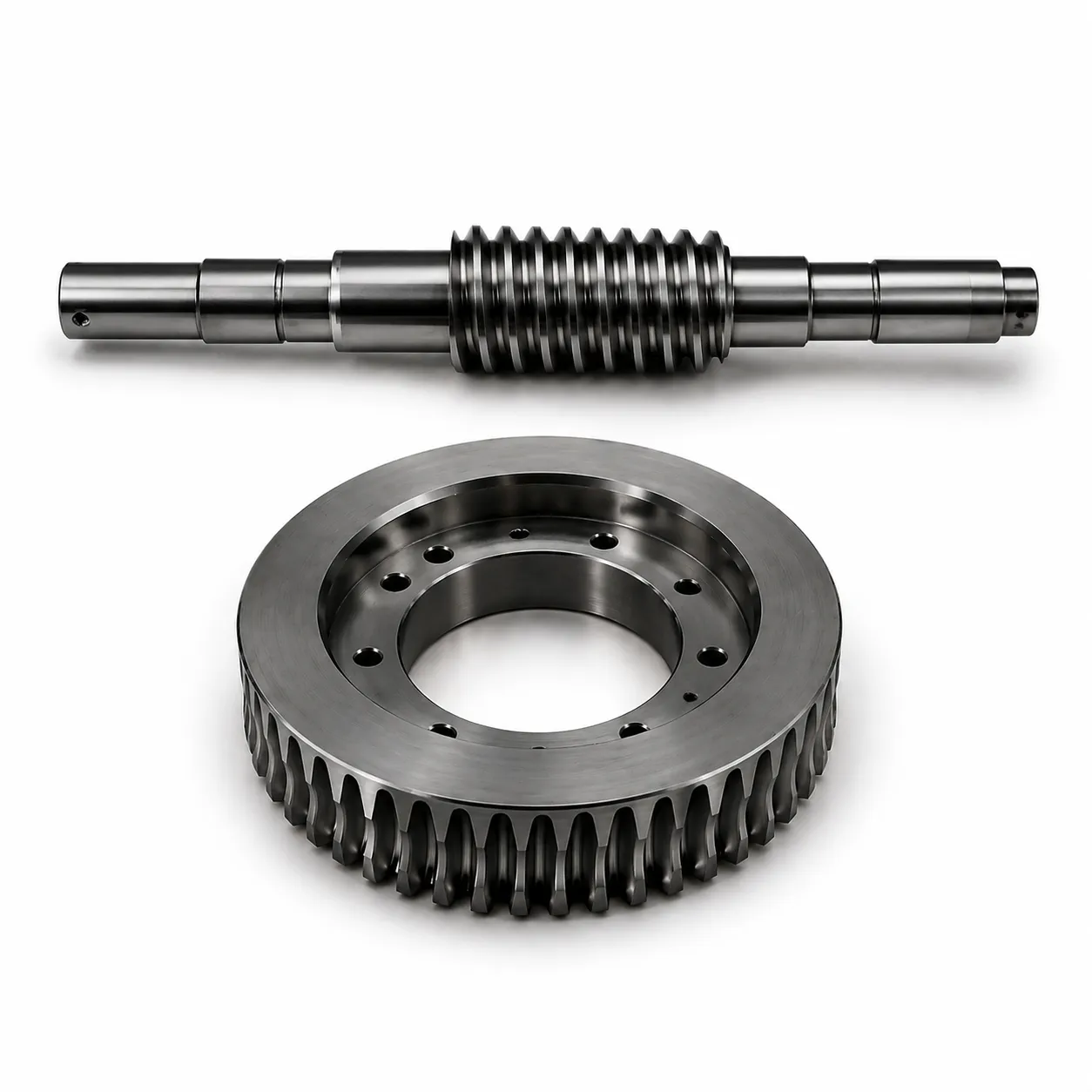
Two internal components wear measurably across a worm gear reducer’s service life — the bronze wheel teeth (the engineered wear surface) and the worm shaft thread (which polishes slowly). Recognising the worm gear reducer wear pattern and intervening at the right point prevents the wear from cascading into bearing failure or housing damage. For matched bronze-and-steel re-tooth kits sized to common frame patterns, see our reference catalogue of worm- en wormwielparen.
Premature bronze wheel wear (under 20,000 hours)
◆ LIKELY CAUSES
- ▸ Frame undersized at original sizing exercise
- ▸ Continuous over-temperature operation degrading lubricant
- ▸ Wrong oil grade reducing film thickness
- ▸ Dust ingress contaminating oil bath
◆ FIELD ACTION
- → Take oil sample for spectrographic analysis
- → Verify duty cycle vs original sizing assumptions
- → Plan re-tooth kit replacement
If unresolved: re-sizing review needed — root cause likely original spec.
Worm shaft pitting or surface spalling
◆ LIKELY CAUSES
- ▸ Inadequate case depth from heat-treatment defect
- ▸ Severe over-load events accumulating fatigue
- ▸ Lubricant film breakdown under sustained heat
- ▸ Hard particle contamination from bronze wheel
◆ FIELD ACTION
- → Stop drive — pitting accelerates rapidly
- → Drain oil for analysis (look for steel particles)
- → Quote complete worm-and-wheel set replacement
If unresolved: housing damage within weeks — replace the worm gear reducer.
Catastrophic Failures — When the Drive Stops
When a worm gear reducer stops producing motion at the load — either fails to start, or stops mid-operation with broken output — the failure mode is binary and usually irreversible without component replacement. The two scenarios below cover the production-stopping worm gear reducer failures Korean and Asian maintenance teams escalate to engineering review most often.
Gearbox will not start (mechanical or electrical)
◆ LIKELY CAUSES
- ▸ Internal seizure (bearing, bronze wheel jam)
- ▸ Application load exceeds motor break-loose torque
- ▸ Motor electrical fault or supply phase loss
- ▸ Brake (if fitted) failed to release
◆ FIELD ACTION
- → Confirm electrical supply on all phases
- → Disconnect motor and rotate input shaft by hand
- → Check brake release voltage if present
If unresolved: internal seizure means full unit replacement.
Output shaft breakage
◆ LIKELY CAUSES
- ▸ Sustained overload beyond catalogue overload rating
- ▸ Application start torque exceeds shaft fatigue limit
- ▸ Cyclic shock loading creating fatigue crack
- ▸ Side load from misalignment over years
◆ FIELD ACTION
- → Stop and lock-out the entire drive
- → Photograph the fracture surface for analysis
- → Review original sizing — frame likely undersized
If unresolved: replacement plus root-cause sizing review mandatory.
Quick Symptom-Cause Matrix
For maintenance teams arriving on a hot worm gear reducer without time to read each symptom card, the matrix below cross-references the ten symptoms against the seven most common root causes. A check mark indicates that root cause typically produces that symptom; multiple check marks suggest the root cause to investigate first.
| Symptom \ Cause | Under- sized |
Wrong oil grade |
Mis- alignment |
Bearing wear |
Wheel wear |
Seal aging |
Over- load |
|---|---|---|---|---|---|---|---|
| Abnormal noise | — | ✓ | ✓ | ✓✓ | ✓ | — | — |
| Oververhitting | ✓✓ | ✓ | — | — | — | — | ✓ |
| Olielekkage | — | — | — | — | — | ✓✓ | — |
| Trilling | — | — | ✓✓ | ✓ | — | — | — |
| Low torque/slip | ✓ | — | — | — | ✓✓ | — | ✓ |
| Excessive backlash | — | — | — | ✓ | ✓✓ | — | — |
| Wheel wear | ✓✓ | ✓ | — | — | — | — | ✓ |
| Worm pitting | ✓ | ✓✓ | — | — | — | — | ✓ |
| Won’t start | — | — | — | ✓✓ | — | — | ✓ |
| Asbreuk | ✓ | — | ✓ | — | — | — | ✓✓ |
Highlighted cells (✓✓) indicate the dominant root cause for that symptom — investigate first. For aged-out units beyond economical re-tooth, browse our replacement worm gear reducer catalogue matched to common existing footprints.
When to Field-Fix vs When to Call a Service Engineer
Not every worm gear reducer problem needs an engineer on-site. The four-question filter below decides whether the maintenance team can resolve the worm gear reducer issue in-house or whether the problem warrants escalation. Run the questions in order; the first hard answer settles the decision.
Is the symptom tagged CRITICAL on the severity scale?
If yes → stop the drive, escalate immediately. Do not attempt field repair on critical-severity symptoms (worm shaft pitting, output shaft breakage, total no-start).
Has the symptom recurred within 48 hours of the previous fix?
If yes → root cause not addressed. Field repair is treating symptoms; engineer review needed to identify underlying cause (commonly undersizing or misalignment).
Does the diagnosis require opening the housing?
If yes → factory or authorised workshop. Internal inspection requires precision measurement of bronze wheel tooth profile, worm shaft TIR and bearing clearance — outside typical maintenance team capability.
Is the unit beyond economical re-tooth (over 50,000 hours or significant housing damage)?
If yes → replace rather than repair. Re-tooth kit makes sense up to about 50,000 hours service or third re-tooth cycle, whichever comes first; beyond that, full replacement returns the maintenance budget to value faster.
Troubleshooting FAQ
Q: My worm gear reducer ran fine for years and suddenly started overheating — what changed?
A: Three things commonly trigger sudden onset overheating on a previously healthy unit. First, the application duty changed (longer hours, higher loads, more starts) without a corresponding sizing review. Second, the cooling fins accumulated dust over time and finally crossed the threshold where heat dissipation could no longer keep up. Third, the lubricant degraded slowly and finally lost film thickness adequate for the mesh. Investigate in that order — duty audit first, then fin cleaning, then oil sample.
Q: How can I tell if abnormal noise is bearing wear vs gear mesh damage?
A: On a worm gear reducer, frequency tells you the source. Bearing wear produces low-frequency rumble that gets worse with rotation speed and is typically loudest at the bearing housing. Gear mesh damage produces tonal whine or click at gear-mesh frequency (motor speed × wheel teeth count, divided by 60 to get Hz) and is loudest near the centre of the worm gear reducer housing. A stethoscope localising the loudest spot usually settles it within 30 seconds.
Q: Is a slow oil leak (1-2 drops per hour) something I can ignore?
A: Short term yes, long term no. A 1-2 drops-per-hour leak loses around 0.5 litres per month — negligible against a 5-litre oil bath but problematic over 6-month intervals. Top up the worm gear reducer oil to spec as part of the monthly inspection routine and plan seal replacement at the next planned shutdown. Letting the leak progress past 5 drops/hour starts depleting the bath fast enough to compromise lubrication, which then triggers the more serious mesh-wear and bearing-wear cascade.
Q: What does a healthy worm gear reducer oil sample look like?
A: Clear amber colour with no visible suspended particles when held against light. Synthetic PAG appears slightly darker amber than mineral CLP. Spectrographic analysis from a healthy worm gear reducer shows iron below 50 ppm and copper below 100 ppm. A sudden jump above those thresholds — iron above 200 ppm or copper above 500 ppm — indicates active wear and warrants internal inspection within the next maintenance window.
Q: When does it make sense to repair vs replace a worm gear reducer?
A: For a worm gear reducer, repair (re-tooth kit) is economical when the housing, bearings and worm shaft are all serviceable and only the bronze wheel has reached wear limit. This typically applies through the first three re-tooth cycles or about 50,000 cumulative hours. Beyond that, the housing has typically accumulated enough thermal-cycle stress, and the worm shaft enough surface fatigue, that a full unit replacement returns better value. Korean buyers running multi-unit fleets often replace at about 80,000 hours regardless of apparent condition — the predictability matters more than the marginal life remaining.
Q: My drive trips on motor overload — is the gearbox the cause?
A: Possibly, but check the application first. Sustained motor overload on a worm gear reducer usually means the load demands more torque than the motor can deliver — frequently because the application has accumulated drag (jammed conveyor belt, fouled mixer impeller, stuck application bearing) rather than gearbox damage. Disconnect the motor and rotate the input shaft by hand: if it spins freely, the gearbox is fine and the problem is downstream. If it binds, internal seizure has begun and the worm gear reducer needs immediate engineering review.
Need Field Service Support on a Worm Gear Reducer Problem?
Send a description of the symptom — sound, temperature, vibration reading, fluid loss rate or whatever data the maintenance team has captured — plus the worm gear reducer nameplate. Our Korean engineering team returns a diagnostic recommendation including likely root cause and field action within 12 to 24 hours.
Editor: Korea Ever-Power Engineering Team