Agriculture consumes an enormous diversity of rotating drives — seed metering discs turning at precisely 12-30 rpm, irrigation pivot towers traversing at 0.5-2 rpm, grain augers running at 200-500 rpm, feed mixer paddles at 15-40 rpm, fruit sorting conveyors at 0.3-1.5 m/s, manure spreader beaters at 300-600 rpm, and greenhouse ventilation fans at 100-300 rpm. The worm gear reducer serves a substantial fraction of these applications because it delivers the high-ratio speed reduction (motor or PTO speed down to implement speed) in a compact right-angle layout that fits within the constrained mechanical envelope of agricultural equipment, while providing self-locking to hold position when the drive motor or PTO shaft stops.
What makes agricultural worm gear reducer specification unique is the operating pattern: seasonal use with extended storage, extreme outdoor exposure (dust, mud, rain, UV, temperature cycling from -20 to +45 °C), and maintenance by farm operators rather than industrial technicians. A factory gearbox runs 8,760 hours per year under controlled conditions with scheduled maintenance; an agricultural worm gear reducer may run 600-1,500 hours per season, then sit idle for 6-9 months in an open-sided shed, exposed to condensation, temperature cycling and rodent nesting. The specification must address both the operating duty and the storage survival equally. This article walks the four agricultural drive categories, outdoor environment defense, seasonal storage protection, PTO conversion considerations, and sized recommendations for common agricultural equipment.
Four Agricultural Drive Categories
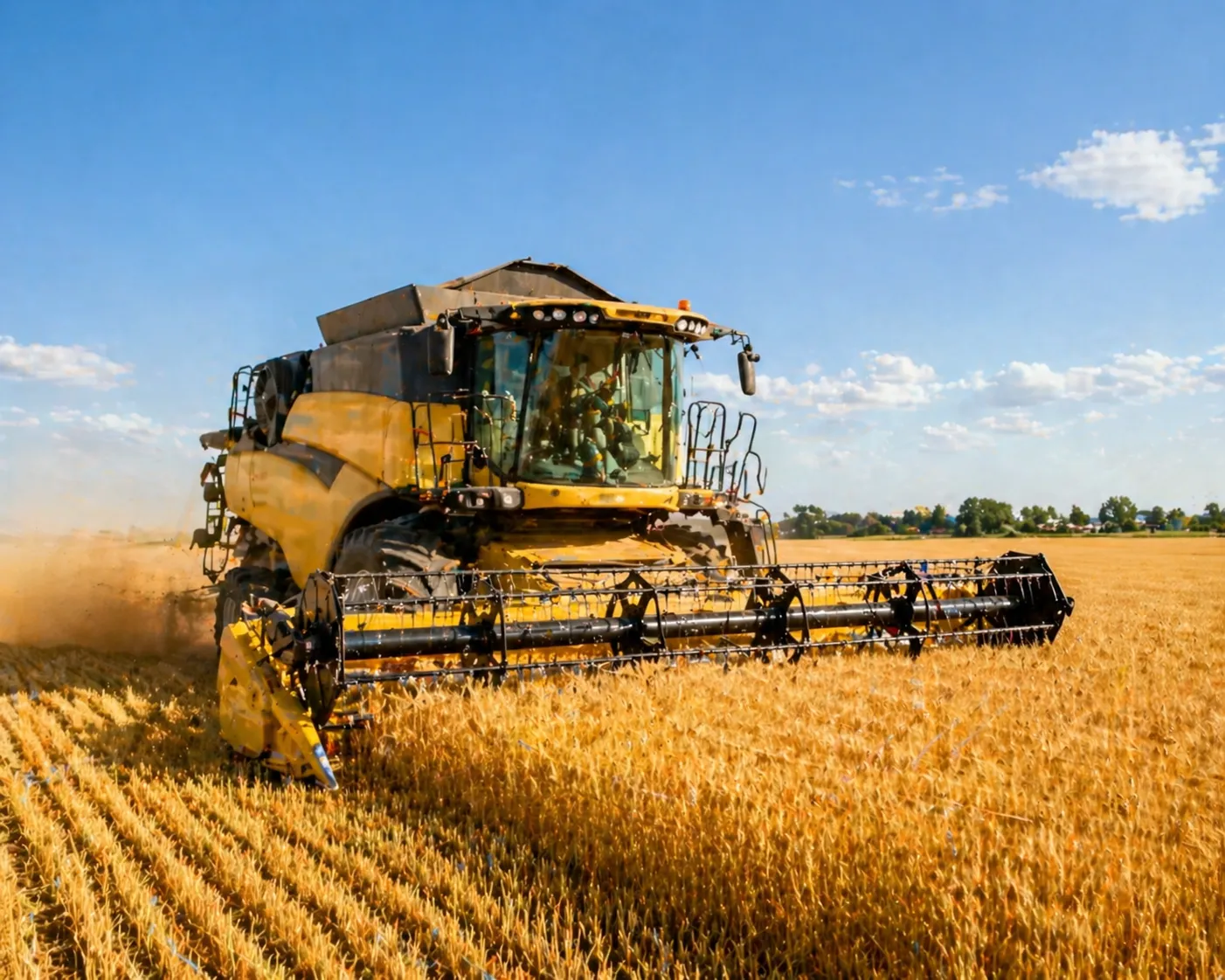
Agricultural worm gear reducer demand concentrates in four drive categories, each with distinctive seasonal patterns, load profiles and environmental exposures.
Outdoor Field Environment Defense
Agricultural worm gear reducer units face a wider environmental range than any other single application category. A centre-pivot irrigation drive sits fully exposed in an open field for 12 months of the year — direct sun, rain, snow, dust storms, temperature cycling from -20 °C winter to +45 °C summer, and UV radiation that degrades standard NBR seals and alkyd enamel coatings within 2-3 seasons. A grain auger drive operates in dense grain dust that clogs breathers and abrades seals. A manure scraper drive sits in a livestock building atmosphere saturated with ammonia, hydrogen sulfide and moisture — conditions comparable to wastewater treatment facilities.
The baseline outdoor agricultural specification for a worm gear reducer covers: IP65 sealing (dust-tight plus low-pressure water jet protection), UV-resistant polyurethane topcoat over epoxy primer (200-250 μm total film thickness), FKM output shaft seals rated for -25 to +200 °C continuous, and sealed PTFE membrane breather. For livestock building installations where ammonia exceeds 25 ppm ambient, upgrade the coating to two-pack epoxy with polyurethane topcoat identical to wastewater specification — ammonia attacks standard industrial paint at concentrations common in poultry and pig housing. For irrigation drives in coastal agricultural regions, marine-grade C4-C5 coating system is warranted where salt-laden wind is a year-round factor.
Seasonal Storage and Restart Protection
The seasonal usage pattern of most agricultural equipment introduces a failure mode absent from continuous industrial service: storage degradation. A worm gear reducer that runs 600 hours during spring planting season then sits idle for 9 months in an open-sided machinery shed undergoes 250-280 day/night thermal cycles during storage. Each cycle draws moist air into the housing through the breather (unless sealed), deposits condensation on internal bearing races and the червячно колело surface, and creates a thin corrosion layer that accumulates through the storage season. By the time the equipment restarts the following spring, the bearings may show visible rust pitting and the oil may contain 2,000-5,000 ppm water — well above the 200 ppm threshold for accelerated bearing damage.
Three measures protect the worm gear reducer during seasonal storage. First, top up the oil to full capacity before storage — the larger oil volume provides better corrosion inhibitor coverage on internal surfaces. Second, run the drive for 5-10 minutes monthly during storage (if practical) to redistribute oil film and displace condensation. Third, specify synthetic PAG lubricant with enhanced corrosion inhibitor package rather than mineral CLP — PAG forms a more persistent protective film on metal surfaces during extended standstill, and its higher water tolerance (500-800 ppm vs 200 ppm for mineral) provides a larger margin against condensation accumulation. For equipment that cannot be run during storage, a vapour-phase corrosion inhibitor (VCI) sachet placed inside the housing through the breather port provides additional protection during the idle season.
PTO-to-Stationary Conversion and Input Speed Considerations
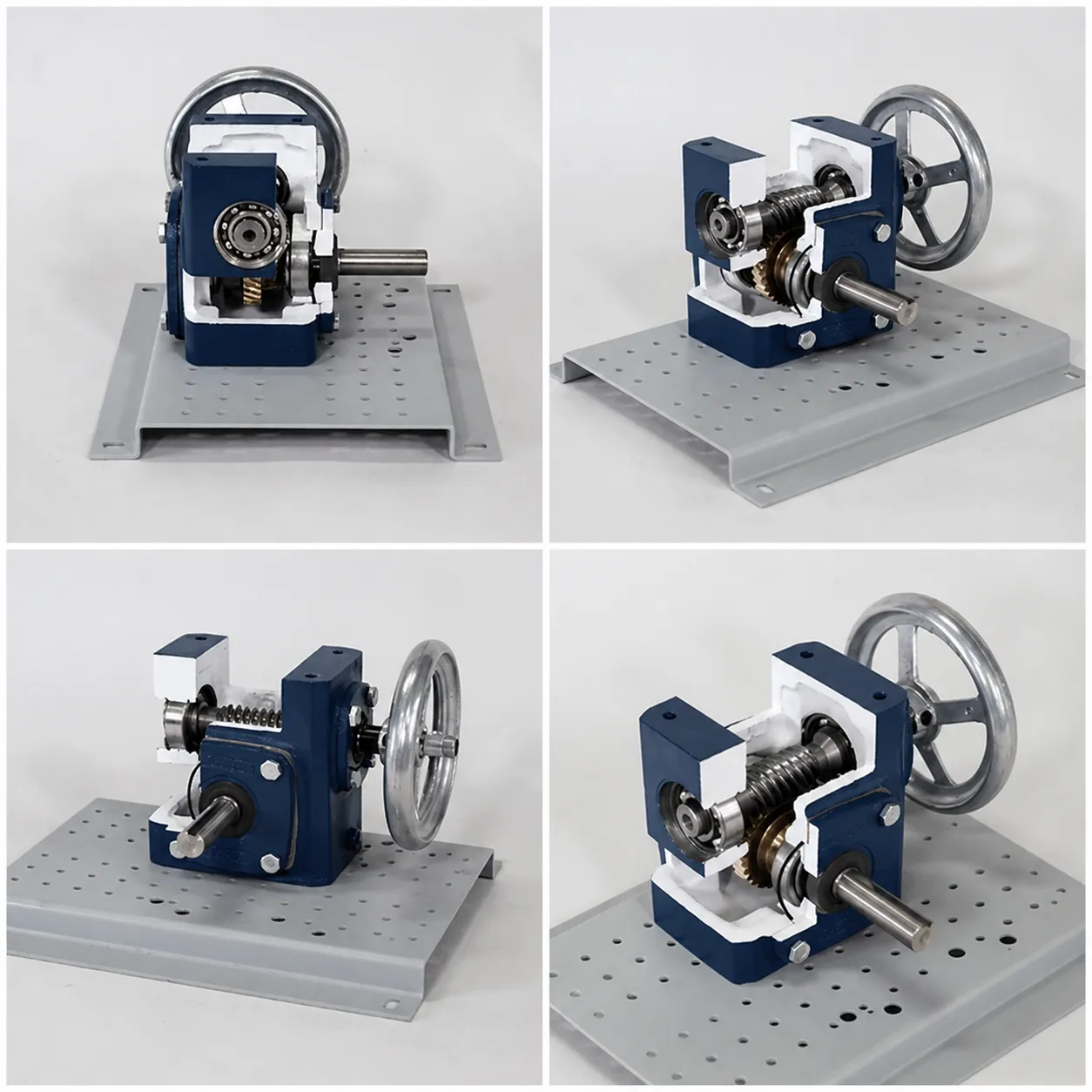
Many agricultural worm gear reducer applications receive input power from a tractor PTO (power take-off) shaft rather than a fixed electric motor. Standard PTO output speed is 540 rpm or 1,000 rpm depending on the tractor class — both significantly lower than the 1,450-1,750 rpm of standard industrial electric motors. This lower input speed has two consequences for worm gear reducer specification.
First, the required ratio is lower — a seed metering disc at 20 rpm driven from 540 rpm PTO needs ratio 27, versus ratio 73 from a 1,450 rpm motor. The lower ratio brings many PTO-driven applications below the self-locking threshold of 30 — which means PTO-driven implements that require holding torque (seed metering, irrigation valve positioning) may need external brakes or higher-ratio gearbox configurations to maintain self-locking capability. Second, the lower input speed generates less heat through worm mesh friction, substantially reducing the thermal demand. PTO-driven worm gear reducer units at 540 rpm input can often be one frame size smaller than the equivalent electric-motor-driven application at the same output torque — a significant advantage for weight-constrained mobile agricultural equipment where every kilogram affects implement manoeuvrability and tractor fuel consumption.
For stationary agricultural equipment (grain dryers, feed processing, barn ventilation) powered by fixed electric motors at 1,450-1,750 rpm, standard industrial worm gear reducer sizing applies — the same thermal derating, service factor and environmental protection methodologies used in factory installations. The distinction is that even stationary agricultural worm gear reducer installations are typically located in partially exposed environments (open-sided barns, machinery sheds, outdoor grain storage facilities) rather than the controlled conditions of a factory floor, requiring the outdoor environmental defense specification as baseline.
Sizing for Common Agricultural Drives
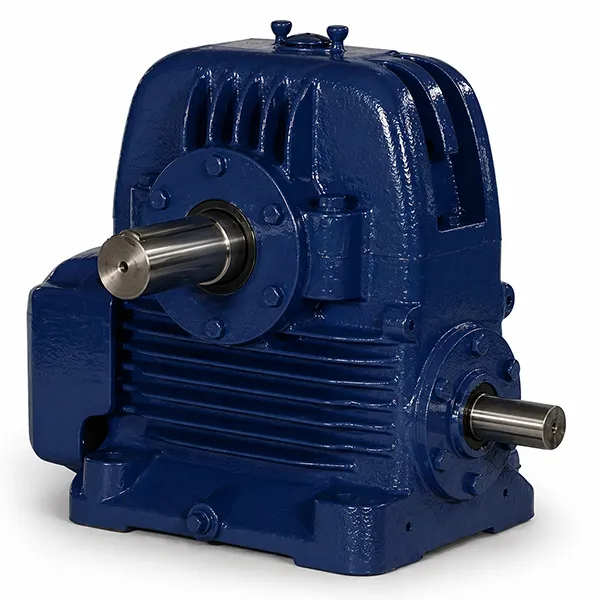
Five agricultural drive configurations account for the majority of червячен редуктор demand in farming and food production:
◎ AGRI 01
Precision seed metering drive
PTO or electric 0.25-1.5 kW. Output 12-30 rpm. Frame NMRV 050-NMRV 075. Ratio 30-120. Self-locking for headland turn hold. Backlash 8-15 arc-min for seed spacing accuracy. IP65 for field dust.
◎ AGRI 02
Centre-pivot irrigation tower
Electric 0.37-0.75 kW per tower. Output 0.5-2 rpm. Frame NMRV 075-NMRV 090. Ratio 200-1,000 (two-stage for extreme ratios). Fully outdoor — UV, rain, frost. Self-locking for wind-hold. Synthetic PAG for -20 to +45 °C range.
◎ AGRI 03
Grain auger / elevator drive
PTO or electric 2.2-11 kW. Output 200-500 rpm. Frame WPA 110-WPDS 175. Ratio 5-10. SF 1.4-1.6 for auger plug-start shock. Grain dust defense: sealed breather mandatory. Self-locking for incline augers.
◎ AGRI 04
TMR feed mixer
PTO 15-55 kW. Paddle 15-40 rpm. Frame WPDS 175-WPDS 250. Ratio 15-40. SF 1.6-2.0 (heavy mixing torque with fibre and grain). Year-round daily use — continuous-duty thermal sizing. Cast iron housing for thermal capacity.
◎ AGRI 05
Greenhouse ventilation / climate control
Electric 0.37-2.2 kW. Fan 100-300 rpm, vent actuator 1-5 rpm. Frame NMRV 063-NMRV 090. Ratio 10-60. High humidity — IP65 + FKM seals. Moderate noise for worker comfort. Self-locking on vent actuators to hold position against wind.
Common Agricultural Drive Specification Mistakes
◎ MISTAKE 01
No storage preparation before seasonal shutdown
Six to nine months of idle storage without protection introduces condensation corrosion that exceeds the damage from the entire operating season. Fill oil to full, run briefly monthly, or specify PAG with enhanced corrosion inhibitors.
◎ MISTAKE 02
NBR seals on year-round outdoor equipment
Standard NBR seals harden and crack within 2-3 seasons under UV and thermal cycling (-20 to +45 °C). FKM seals cost $3-8 more per unit and last the full 10-15 year equipment life. The most cost-effective upgrade in agricultural worm gear reducer specification.
◎ MISTAKE 03
Ignoring PTO input speed difference
PTO at 540 rpm produces a different ratio than electric motor at 1,450 rpm for the same output speed. Failing to recalculate may push the ratio below self-locking threshold (30) on PTO-driven implements that require holding torque.
◎ MISTAKE 04
Sizing feed mixer to running torque only
TMR mixers can load to 200-300% of running torque when fibre or frozen feed blocks are loaded into the chamber. SF 1.6-2.0 is mandatory — sizing at SF 1.0 produces gearbox failure within the first heavy-loading season.
Maintenance by Farm Operators — Practical Considerations
Agricultural worm gear reducer units are maintained by farm operators and mechanics rather than industrial maintenance technicians — a reality that fundamentally shapes the specification approach. Farm operators are skilled with machinery but typically lack vibration analysis equipment, oil sampling kits and precision alignment tools common in industrial maintenance shops. The worm gear reducer specification must therefore favour simplicity and forgiveness: oil sight glasses for visual level checking (rather than dipsticks that may not be checked), drain plugs positioned for easy access without removing guards, and colour-coded housing markings for oil grade identification.
The maintenance schedule should align with natural agricultural timing. Pre-season (before planting/harvest): check oil level, inspect seals for cracking, verify mounting bolt tightness, replace breather if clogged with dust from previous season. Post-season (after harvest): top oil to full for storage protection, clean external housing to remove accumulated crop residue, inspect for coating damage, and apply touch-up paint if bare metal is exposed. Mid-season check is recommended for equipment running more than 500 hours per season: visual leak check and oil level only. This two-event annual maintenance programme — pre-season and post-season — is realistic for farm operations and sufficient for 10+ year worm gear reducer service life with proper specification.
Oil change intervals for agricultural worm gear reducer follow operating hours rather than calendar time: every 2,000-3,000 hours for synthetic PAG, or every 1,000-1,500 hours for mineral CLP. For seasonal equipment accumulating 600-1,500 hours per year, this means a PAG oil change every 2-4 years — a practical interval that aligns with major equipment overhaul cycles rather than requiring a dedicated mid-season oil change. Mineral CLP may require annual changes at 1,000+ hours per season, making the synthetic PAG premium worthwhile on operating convenience alone — in addition to the superior temperature range and corrosion protection benefits.
Agricultural Machinery Worm Gear Reducer FAQ
Q: How long should an agricultural worm gear reducer last?
A: With proper outdoor specification (IP65, FKM seals, UV-resistant coating, synthetic PAG) and seasonal storage protection: 10-15 years or 8,000-15,000 cumulative operating hours, whichever comes first. Without storage protection, condensation corrosion during idle months typically causes bearing or seal failure within 3-5 seasons regardless of operating-hour accumulation — making storage protection as important as operating-hour specification.
Q: Can a standard industrial worm gear reducer be used on a tractor PTO?
A: Yes — with proper input coupling. Standard PTO shaft has a 6-spline or 21-spline profile at 35 mm (540 rpm) or 35/45 mm (1,000 rpm). The worm gear reducer input shaft accepts a standard IEC motor flange or bare shaft input. An intermediate coupling (spline-to-shaft adapter or cardan joint) bridges the connection. The cardan joint also absorbs angular misalignment between the tractor PTO and the implement-mounted gearbox during field operation. Verify that the input shaft torque rating exceeds the PTO output torque — PTO torque ratings can be substantially higher than the equivalent electric motor size suggests.
Q: Is the worm gear reducer suitable for vineyard or orchard equipment where space is very limited?
A: Yes — and this is one of the strongest arguments for worm architecture in specialty agriculture. The right-angle layout and compact frame dimensions of NMRV 050-075 fit within the narrow working envelope of vineyard inter-row equipment, orchard shaker drives and berry harvester mechanisms where helical or planetary alternatives are physically too large. The weight of the aluminum NMRV frame (3-8 kg at these sizes) is also advantageous on boom-mounted and canopy-level equipment where mass affects balance and operator fatigue.
Q: What lubricant is recommended for agricultural worm gear reducer?
A: Synthetic PAG with enhanced corrosion inhibitor package is the standard recommendation for any agricultural worm gear reducer with seasonal storage exposure. The three key properties: wide temperature range (VI >180, -30 to +120 °C operational), water tolerance (500-800 ppm without emulsion formation), and corrosion inhibitor persistence during extended standstill. ISO VG 220 for temperate climates, ISO VG 150 for cold-climate operations where winter temperatures regularly drop below -15 °C. For food-contact agricultural applications (fruit/vegetable sorting, dairy equipment), specify NSF H1 rated synthetic PAG.
Q: How do I get a sized recommendation for my agricultural equipment?
A: Send our engineering team the equipment details: application type (seeding, irrigation, harvesting, feed processing), power source (PTO 540/1,000 rpm or electric motor), output speed and torque, annual operating hours, storage conditions (indoor sheltered, open-sided shed, or fully exposed), climate zone with temperature range (min/max), and any special requirements (food-grade lubricant, ammonia-resistant coating, precision backlash for seed metering). We return a sized recommendation with environmental specification, seasonal storage protection guidance, lubricant grade and lead time within 24-48 hours. For fleet orders (irrigation pivots, multi-unit feed processing lines), competitive volume pricing and coordinated delivery scheduling are available for consolidated orders of 10+ units.
Sourcing Worm Gear Reducer for Agricultural Equipment?
Send us equipment type, power source, output requirements and operating environment. Our Korean engineering team returns sized recommendations with outdoor defense specification and seasonal storage guidance within 24-48 hours.
Редактор: Cxm