Packaging machinery operates in a fundamentally different duty pattern from most industrial applications. Where a conveyor runs continuously and a crane lifts intermittently, a packaging machine indexes — it starts, runs a precise angular distance, stops, dwells while a filling head, labeller or sealer performs its operation, then starts again. A typical flow-wrapper or case packer executes 60-200 indexing cycles per minute, accumulating 3-12 million start-stop cycles per month. This cycle count compresses bearing and gear mesh fatigue in ways that standard continuous-duty worm gear reducer sizing cannot predict, and demands a specification approach calibrated to indexing endurance rather than steady-state torque.
The second critical packaging-machine requirement is positional precision. A labeller that places a label 2 mm off-centre on every bottle produces visible brand defects; a case packer that mis-indexes by 3° jams on the next cycle. This precision demand translates directly into a backlash budget on the worm gear reducer — typically 4-15 arc-minutes depending on sub-application, versus 15-30 arc-minutes acceptable in general industrial duty. The article below walks the four packaging sub-applications, the indexing cycle endurance calculation, the backlash specification approach, intermittent-duty thermal analysis (which differs from continuous), and sized recommendations for common packaging drives.
Why Packaging Drives Fail Differently — The Indexing Stress Pattern
A continuous-duty worm gear reducer reaches thermal and mechanical equilibrium after the first 30-60 minutes of operation. An indexing-duty packaging drive never reaches equilibrium — it cycles between acceleration (high torque, high tooth-mesh stress), dwell (zero rotation, static load on bearings), deceleration (reverse torque through mesh), and idle (zero load, brief thermal recovery). Each transition generates a distinct damage mechanism: acceleration loads the drive-side tooth flank, deceleration loads the coast-side flank, dwell causes boundary-lubrication standstill marking on bearing raceways, and the rapid thermal cycling between loaded and idle phases fatigues seal materials faster than sustained temperature.
The compounding effect is severe. A packaging drive running 200 cycles per minute for 16 hours per day accumulates 192,000 start-stop events daily — 57.6 million per year. Standard industrial worm gear reducer bearings rated to L10 of 20,000 hours at continuous duty may reach L10 in 6,000-8,000 hours under this indexing pattern because the standstill-marking damage mechanism operates independently of the rotational fatigue mechanism. The remediation is not simply “bigger” — it requires bearings specifically rated for indexing service (typically C3 internal clearance with modified cage geometry), lubricant formulated for boundary-film retention during dwell, and a worm gear reducer frame sized to the indexing thermal profile rather than continuous-duty catalogue ratings.
Four Packaging Sub-Applications — Filling, Labelling, Sealing, Cartoning
Packaging machinery worm gear reducer demand concentrates in four sub-applications, each with a distinctive cycle rate, precision requirement and load profile.

Indexing Cycle Count and Bearing Endurance Calculation
The indexing cycle count determines the worm gear reducer bearing specification more than any other parameter. Standard L10 bearing life calculations assume continuous rotation; indexing duty adds a standstill-marking damage coefficient that is independent of the load-based L10 formula.
INDEXING CYCLE COUNT FORMULA
N_annual = CPM × 60 × H_shift × D_year
CPM (cycles per minute)
Machine rated output: typically 60-200 for filling, 100-600 for labelling, 30-150 for sealing, 20-80 for cartoning.
H_shift × D_year
Typical: 16 h/day × 250 days/year = 4,000 h/year. High-output food/pharma: 22 h/day × 300 days = 6,600 h/year.
Worked example: A rotary filler at 120 CPM, 16 h/day, 250 days/year: N_annual = 120 × 60 × 16 × 250 = 28.8 million cycles/year. Over a 7-year target service life: 201.6 million total cycles. Standard industrial bearings rated at 20 million cycles to L10 fail at year 0.7 — within the first year. Indexing-rated C3 bearings with anti-fretting grease typically sustain 150-300 million cycles to L10, covering the full service life target.
The practical consequence: packaging worm gear reducer must specify indexing-rated bearings (C3 clearance, polyamide or brass cage, anti-fretting pre-load) rather than standard catalogue bearings. The per-unit cost premium for indexing-rated bearings is typically 15-25% — a fraction of the downtime cost when a standard bearing fails after 8-14 months in a high-speed packaging line.
Backlash Budget for Precision Packaging Positioning
Backlash in a worm and wheel mesh is the angular play between drive-side and coast-side tooth flanks. In continuous-duty drives this play is inconsequential — the load always presses the same tooth flank. In indexing-duty packaging machines the direction of tooth loading reverses on every deceleration phase, and the backlash gap must be traversed before the coast-side flank picks up load. This creates a positional uncertainty at each cycle reversal equal to the backlash angle at the output shaft.
Standard catalogue worm gear reducer backlash runs 15-30 arc-minutes. At a typical packaging turret radius of 200 mm, 30 arc-minutes of backlash translates to a circumferential positional error of 200 × tan(0.5°) ≈ 1.7 mm. For cartoning and case packing (tolerance ±3-5 mm) this is acceptable. For rotary filling (tolerance ±0.5 mm) and labelling (tolerance ±0.5 mm) it is unacceptable — the positional error exceeds the full tolerance budget.
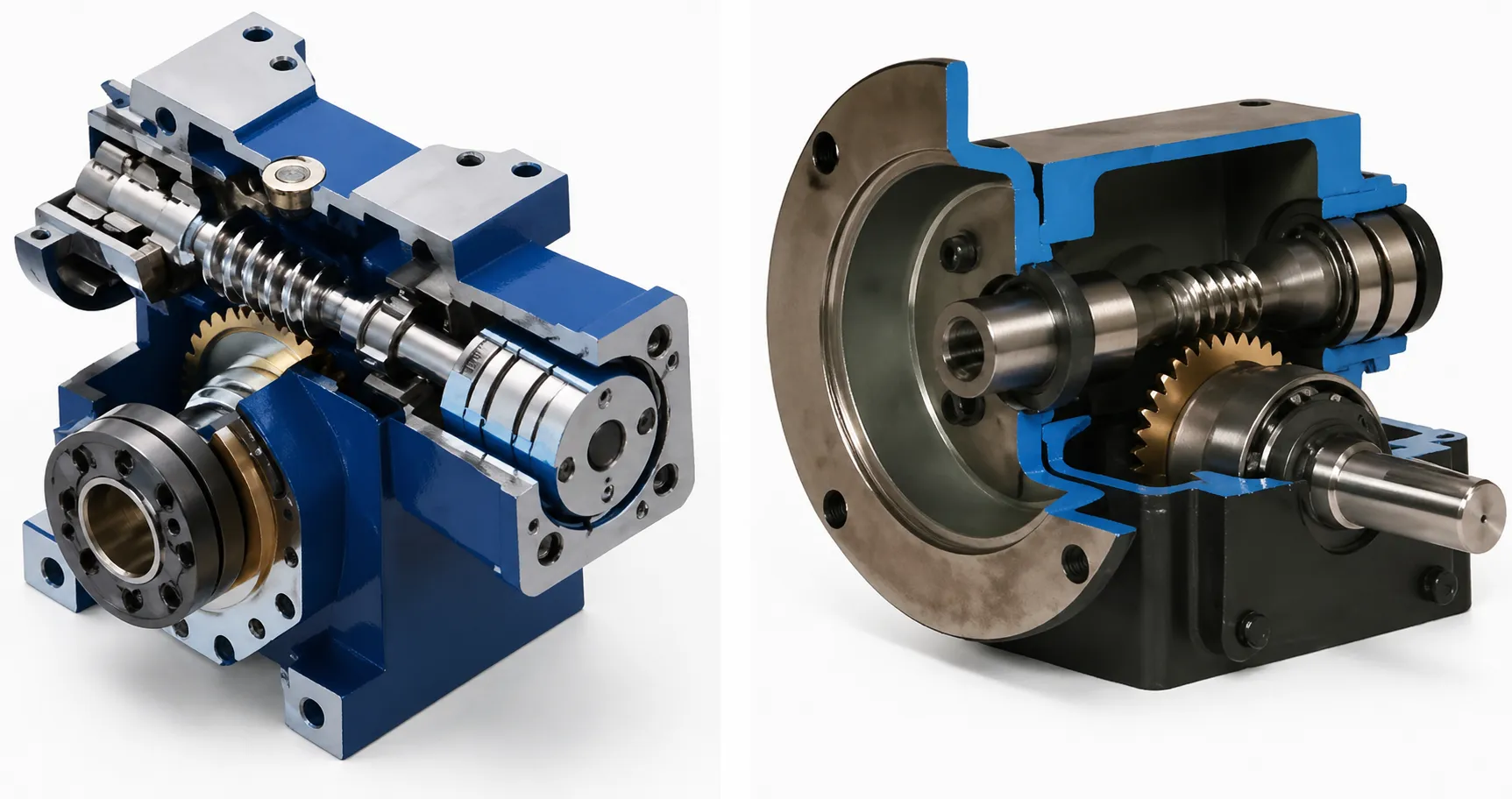
Achieving 4-8 arc-minute backlash requires three modifications beyond standard catalogue. First, the worm shaft is precision-ground (Class 5 or better) rather than standard-hobbed (Class 7-8). Second, the bronze worm wheel is generated on a precision pitch line with controlled tooth profile modification. Third, the centre distance between worm and wheel is set with a precision shim pack during assembly, verified with a backlash gauge, and documented on the unit test certificate. The capital premium for precision-backlash specification runs 40-80% over catalogue standard at the same frame size — justified only when the application backlash budget cannot accommodate standard tolerance.
Intermittent-Duty Thermal Profile — Different From Continuous
Packaging worm gear reducer thermal behaviour is counterintuitive: the indexing duty pattern generates less total heat per hour than continuous duty at the same power, but concentrates that heat into brief high-intensity pulses followed by zero-power dwell. The result is a thermal profile that never reaches steady state — oil-bath temperature oscillates 5-15 °C around a mean that is typically 10-20 °C lower than the continuous-duty equivalent at the same nominal power.
The practical consequence: packaging worm gear reducer units can often be one frame size smaller than continuous-duty equivalents at the same motor power, because the thermal demand is lower. However, the mechanical demand (cycle-count bearing fatigue) may require a larger frame anyway — so the sizing decision must check both thermal and mechanical limits independently and use whichever produces the larger frame size. In most high-speed filling and labelling applications, the mechanical (cycle count) limit dominates; in lower-speed cartoning and sealing, the thermal limit may dominate. Never assume one limit covers both.
Hygiene and Wash-Down Considerations for Food Packaging Lines
A significant proportion of worm gear reducer packaging demand serves food, beverage and pharmaceutical lines where the gearbox operates in a wash-down environment. The requirements overlap with but differ from dedicated food processing: the worm gear reducer on a packaging line typically sits downstream of the primary processing zone — handling sealed bottles, capped containers or wrapped trays rather than open product — but still faces periodic wash-down with caustic detergent and sanitiser at 60-80 °C.
The practical specification consequence: IP66 sealing is adequate for most packaging-zone worm gear reducer installations (vs IP69K required in direct-product food processing zones). NSF H1 lubricant is recommended but not always mandatory — confirm with the plant HACCP coordinator whether the packaging zone falls under “incidental contact” or “no contact” classification. Housing material can remain standard aluminum or cast iron with epoxy coating rather than stainless 316L, since direct caustic exposure is less frequent than in upstream processing. FKM (Viton) output shaft seals are still recommended over standard NBR to resist the elevated temperatures during wash-down cycles — NBR degrades within 12-24 months under repeated 60-80 °C exposure even when the baseline operating temperature is moderate.
For pharmaceutical blister packaging and sterile fill-finish lines, the worm gear reducer specification tightens further: clean-room-compatible external surfaces (smooth, crevice-free housing), food-grade lubricant with pharmaceutical declaration of composition, and documentation traceability to satisfy GMP audit requirements. The capital premium for pharmaceutical-grade worm gear reducer is typically 30-50% over standard packaging specification — a modest investment relative to the regulatory consequences of a contamination event on a pharmaceutical production line. The indexing precision and cycle-count endurance requirements remain identical to food packaging equivalents; only the environmental compliance layer changes.
Sizing for Common Packaging Machine Drives
Five common packaging machine drives account for the majority of worm gear reducer demand in the packaging industry. Each carries distinctive cycle rate, precision and torque requirements:
◎ DRIVE 01
Rotary filler turret indexing
Motor 0.55-2.2 kW. 60-300 CPM. Frame NMRV 063-NMRV 090. Ratio 40-100. Backlash 4-8 arc-min (precision-ground). Indexing-rated C3 bearings mandatory.
◎ DRIVE 02
Labeller container orientation
Motor 0.37-1.5 kW. 100-400 CPM. Frame NMRV 050-NMRV 075. Ratio 30-80. Backlash 6-10 arc-min. Compact size priority — aluminum housing preferred for weight.
◎ DRIVE 03
Flow-wrapper film transport
Motor 0.55-1.5 kW. 80-200 CPM. Frame NMRV 063-NMRV 075. Ratio 20-50. Backlash 8-12 arc-min. Continuous film tension — smoother profile than pure indexing.
◎ DRIVE 04
Cartoner product infeed
Motor 0.75-3 kW. 30-80 CPM. Frame NMRV 075-WPA 110. Ratio 30-80. Backlash 15-25 arc-min (catalogue standard acceptable). Higher torque per cycle than filling/labelling.
◎ DRIVE 05
Case packer / palletiser positioning
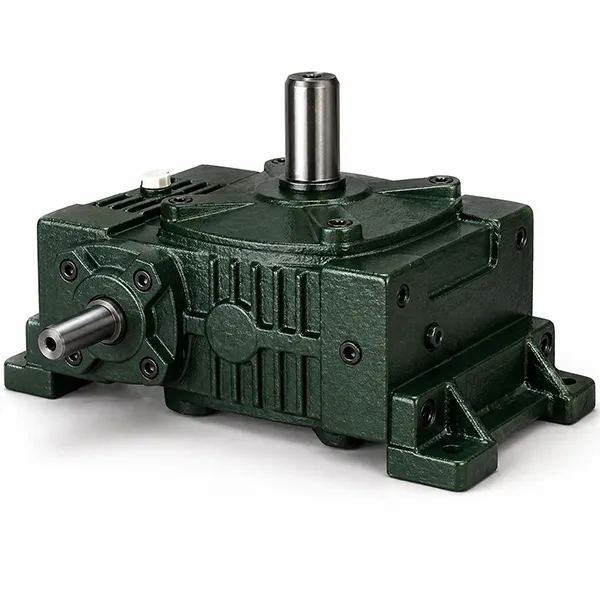
Motor 1.5-5.5 kW. 10-40 CPM. Frame WPA 110-WPA 150. Ratio 30-100. Backlash 15-30 arc-min. Highest torque per cycle in packaging — self-locking useful for held positions during packing dwell. Browse our Katalog für Schneckengetriebe for indexing-rated frame variants.
Common Packaging Drive Specification Mistakes
◎ MISTAKE 01
Standard bearings on high-cycle indexing drives
Standard P0 bearings fail from standstill-marking damage within 8-14 months at 100+ CPM. Specify indexing-rated C3 bearings with anti-fretting cage — the 15-25% bearing cost premium recovers within the first avoided line stoppage.
◎ MISTAKE 02
Catalogue backlash on precision filling/labelling
Standard 15-30 arc-min backlash produces 1-3 mm positional error at typical turret radius. For ±0.5 mm precision, specify precision-ground worm gear reducer at 4-8 arc-min backlash.
◎ MISTAKE 03
Sizing to continuous-duty thermal rating
Indexing duty generates less total heat than continuous — but the mechanical cycle-count limit may require a larger frame anyway. Always check both thermal and mechanical limits independently; do not assume one covers both.
◎ MISTAKE 04
Mineral oil without dwell-retention additives
Standard mineral CLP drains from mesh and bearings during dwell phases. Synthetic PAG with EP/AW additive package retains a protective boundary film during standstill, reducing start-of-cycle metal-to-metal contact by 60-80%.
Packaging Machinery Worm Gear Reducer FAQ
Q: How does worm architecture compare to servo-planetary for packaging indexing?
A: Servo-planetary drives offer near-zero backlash (1-3 arc-min) and higher efficiency (92-96%) but at 3-5× the capital cost per axis. For high-precision filling turrets running at 200+ CPM where positional accuracy is paramount, servo-planetary is typically warranted. For labelling, sealing and cartoning where 6-15 arc-min backlash is acceptable, worm gear reducer delivers equivalent functional performance at 30-50% capital cost per axis. The break-even threshold is roughly at 4-6 arc-min backlash: below 4 arc-min, servo-planetary wins; above 6 arc-min, worm architecture wins on TCO.
Q: What lubricant is recommended for packaging indexing drives?
A: Synthetic PAG with EP (extreme pressure) and AW (anti-wear) additive package is the standard recommendation for packaging worm gear reducer. The key property is boundary-film retention during dwell: synthetic PAG maintains a protective mono-molecular film on gear mesh and bearing surfaces even during extended standstill, reducing the metal-to-metal contact phase when rotation resumes. For food-contact packaging lines, specify NSF H1 rated synthetic PAG to cover incidental contact compliance. ISO VG 220 or VG 320 depending on ambient temperature and cycle rate.
Q: How often should a packaging line worm gear reducer be serviced?
A: Monthly: visual inspection for oil leaks, abnormal noise, mounting bolt tightness. Quarterly: oil sample for laboratory analysis — viscosity, water content, wear metal content (copper for bronze wheel, iron for worm shaft and bearings). Every 12-18 months (mineral) or 24-36 months (synthetic PAG): oil replacement. Every 3-5 years: bearing condition assessment via vibration analysis. On high-speed fillers (200+ CPM), compress the bearing assessment to annual — the cycle count accumulates faster than calendar time suggests.
Q: Does the self-locking feature matter on packaging drives?
A: Yes — for two specific scenarios. First, vertical packaging machines (vertical form-fill-seal, vertical cartoners) require the worm gear reducer to hold the film feed or product column against gravity during dwell. Self-locking at ratio ≥30 provides this hold without an additional brake. Second, case packer flap-folding mechanisms require the folding arm to hold position during the glue-set dwell — self-locking prevents the arm from relaxing under spring-back force. For horizontal machines where gravity does not act on the packaging axis, self-locking is a convenience rather than a requirement.
Q: Can I retrofit precision-ground backlash onto an existing standard worm gear reducer?
A: No — precision backlash is an assembly-level specification, not a field modification. The worm shaft must be ground during manufacture, the bronze wheel must be generated on a precision pitch, and the centre distance must be set during controlled assembly with measuring equipment. Attempting to reduce backlash in the field by shimming the centre distance without matching tooth profile produces premature mesh wear and can actually increase backlash within months. Precision-backlash units must be ordered as a factory-specified variant.
Q: How do I get a sized recommendation for my packaging machine drive?
A: Send our engineering team the machine details: sub-application (filler, labeller, sealer, cartoner, case packer), cycles per minute, required positional precision (mm or arc-min), motor power, operating hours per day, and any special environment (food/pharma wash-down, clean-room). We return a sized recommendation with indexing-rated bearing specification, backlash class, lubricant grade and lead time within 24-48 hours.
Sourcing Worm Gear Reducer for Packaging Machinery?
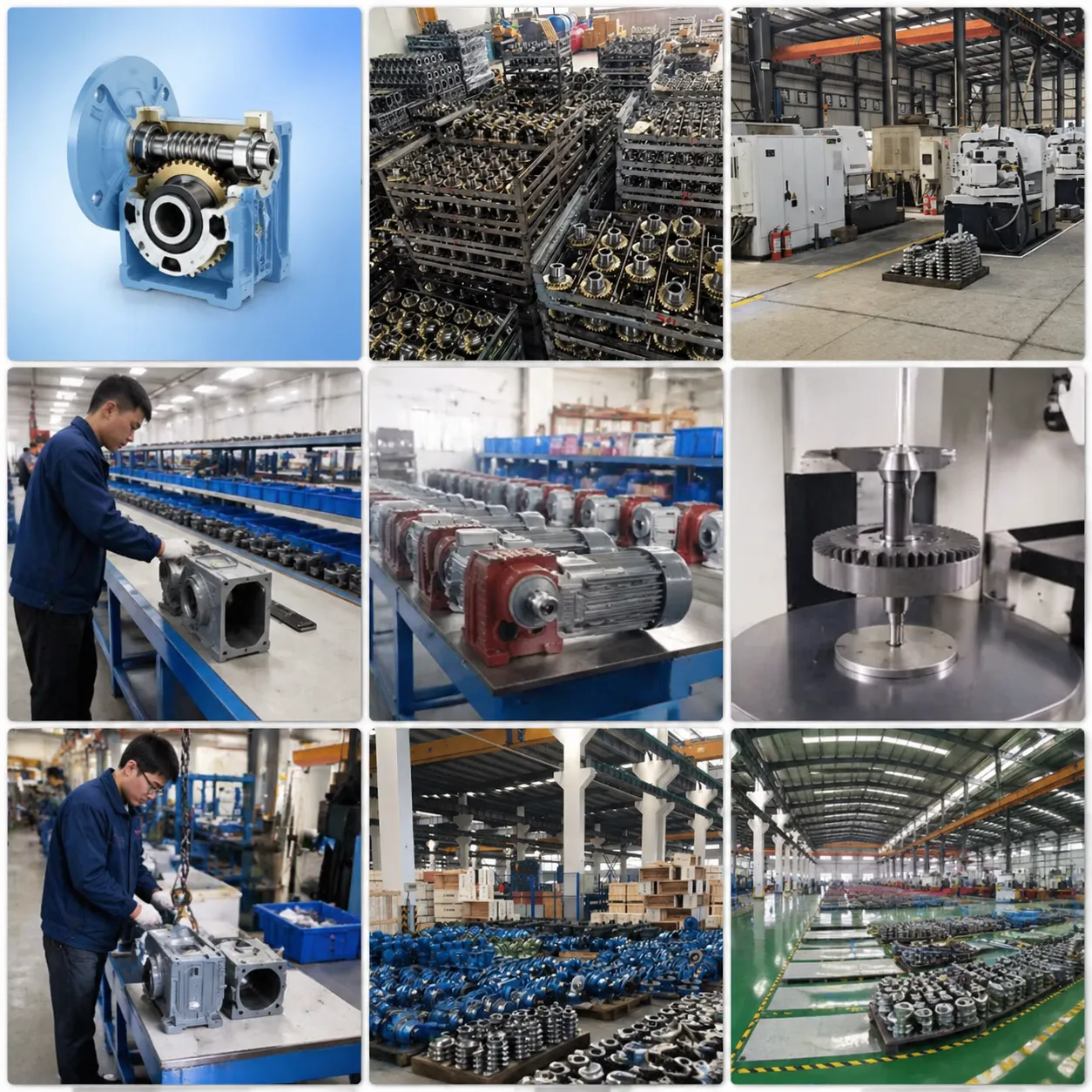
Send us cycles per minute, precision requirement, machine type and operating hours. Our Korean engineering team returns sized recommendations with indexing-rated bearing and backlash specification within 24-48 hours.
Herausgeber: Cxm