Industrial-Grade Worm Gear Reducers Engineered in Ansan, Korea
NMRV, WP, right-angle and helical-worm specifications shipped to 50+ countries. Direct-from-factory pricing, ISO 9001 quality, 24-48 hour technical response from our Sandan-ro engineering team.
What Is a Worm Gear Reducer?
Definition, working principle, the major variants we manufacture, and the four properties that distinguish worm-and-wheel drives from helical, bevel and planetary alternatives.
01Definition
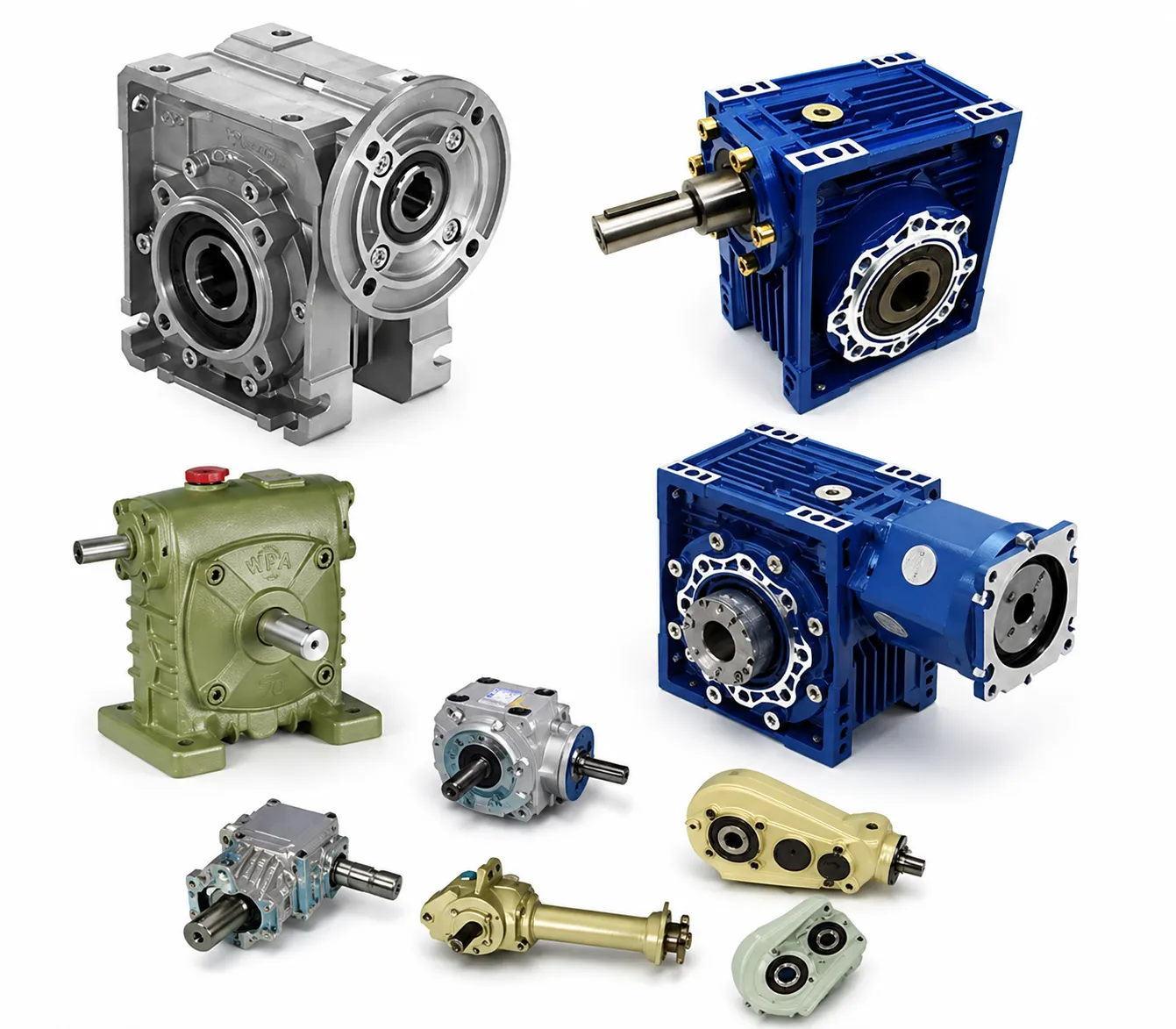
A worm gear reducer is a right-angle gearbox that uses a hardened-steel worm shaft meshing with a bronze worm wheel to deliver large speed reduction in a single stage. Input and output shafts are perpendicular (90° offset), and the high-ratio mesh — typically i = 5 through i = 100 — is achieved within a footprint smaller than equivalent helical or bevel arrangements.
02Working Principle
The worm shaft rotates and slides against the bronze wheel teeth in a screw-and-nut style of contact. Each full revolution of the worm shaft advances the wheel by one (or two, three, four) tooth depending on the number of thread starts. This sliding contact enables the high reduction ratio in a single mesh — but it also means lubricant film, bronze grade and worm shaft surface hardness directly determine service life.
Self-Locking Capability
At low lead angles (≤ 5°), the wheel cannot back-drive the worm — eliminating separate brakes on lifts and hoists.
High Reduction Per Stage
Single-mesh ratios of 100:1 are routine — equivalent to two or three helical stages in a much smaller envelope.
Quiet, Smooth Output
Sliding contact damps mesh impact noise — typically 5-10 dB(A) quieter than helical-only equivalents under load.
Compact Right-Angle Layout
Input and output shafts at 90° within a single housing — no separate bevel stage required for layout flexibility.
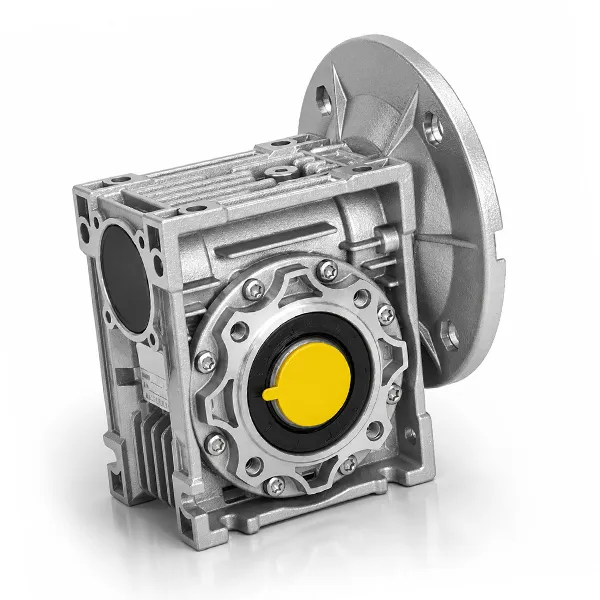
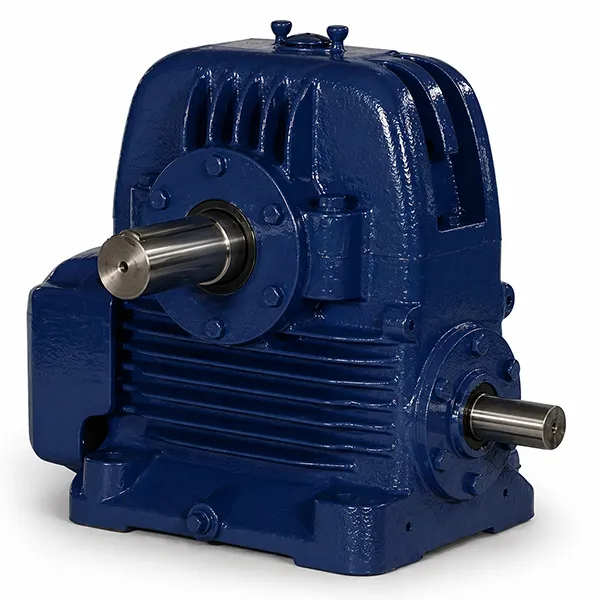
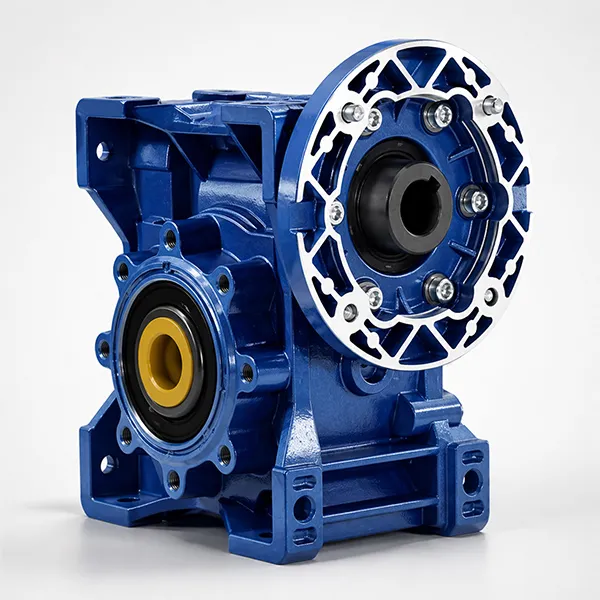
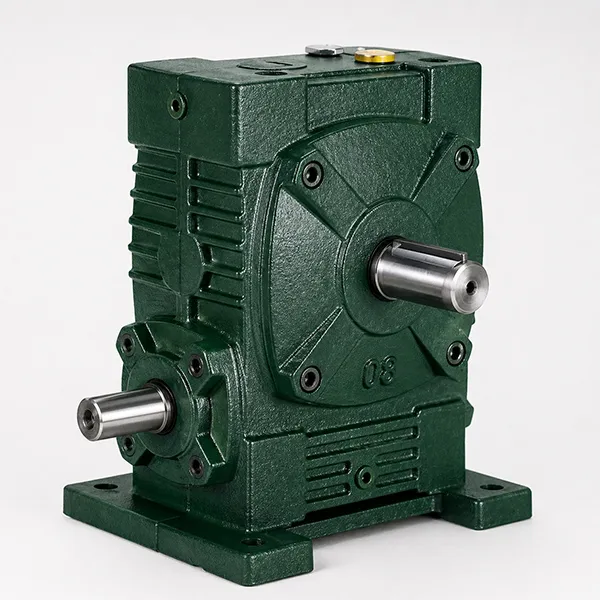
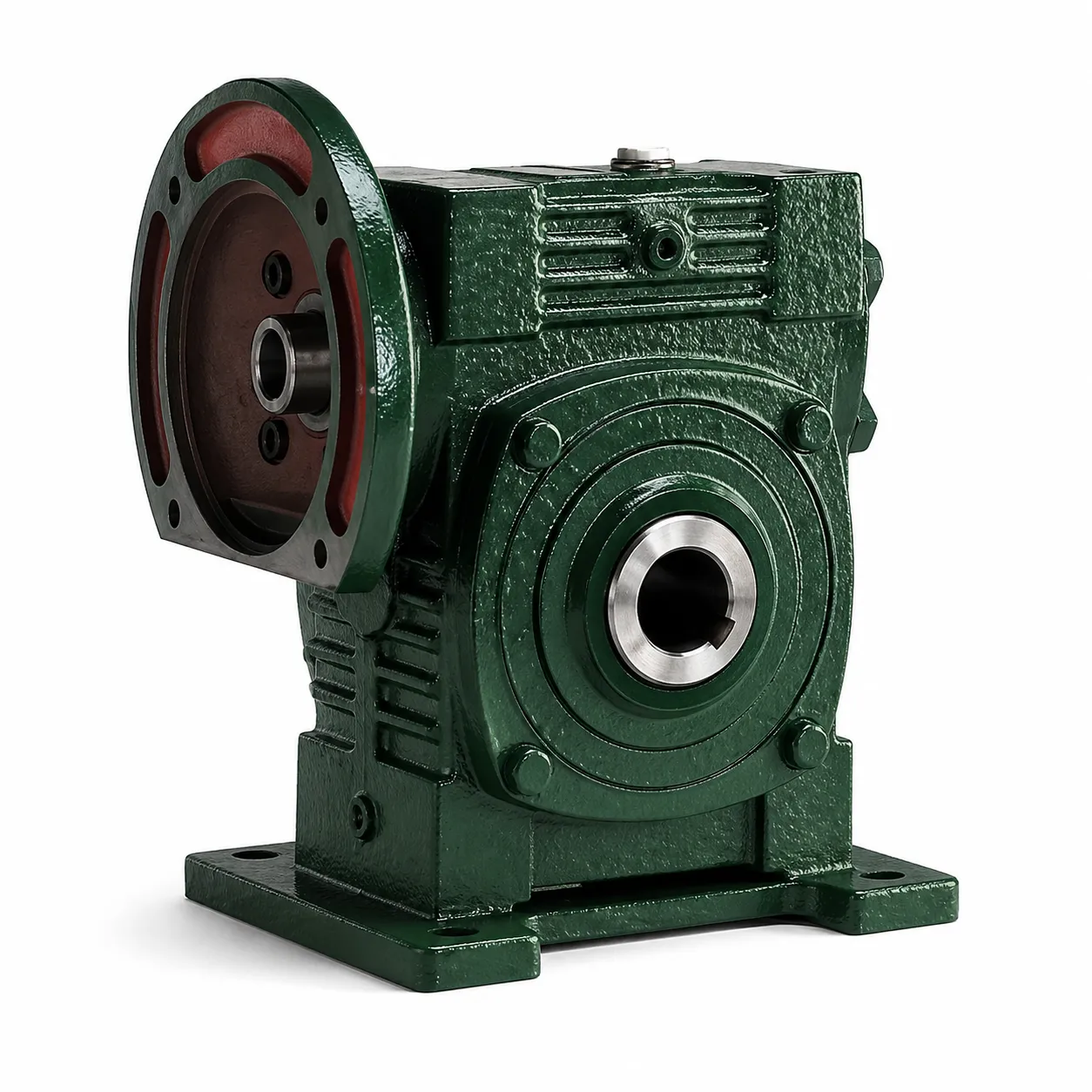
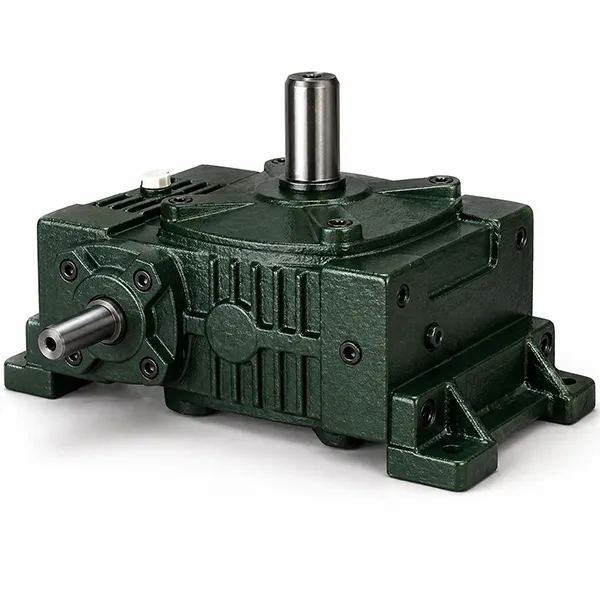
Newly Listed Worm Gear Reducer Specifications
Recently added catalogue entries — verify dimensions, ratios and torque ratings against your application before requesting a formal quote.
Inside Every Worm Gear Reducer
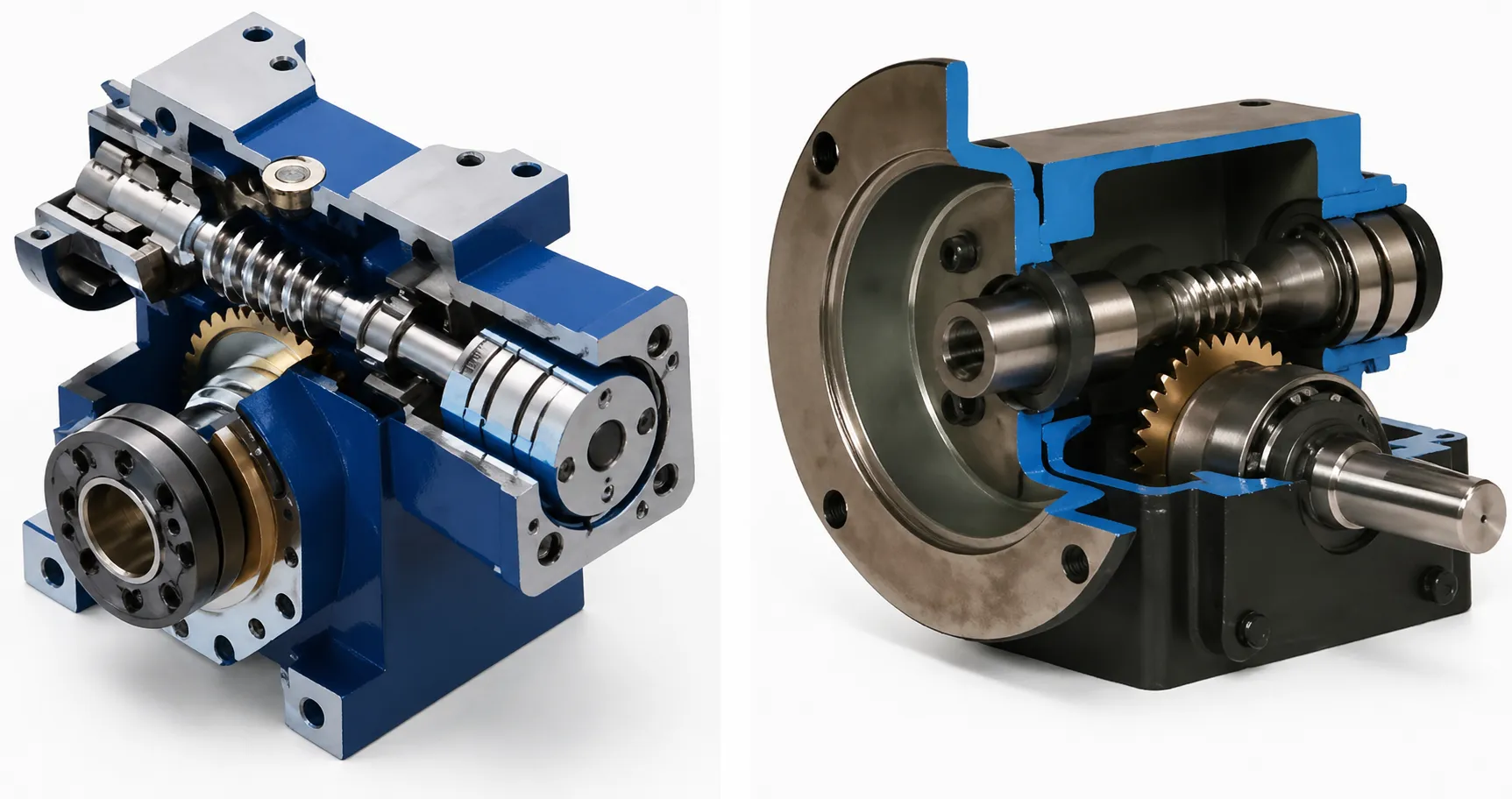
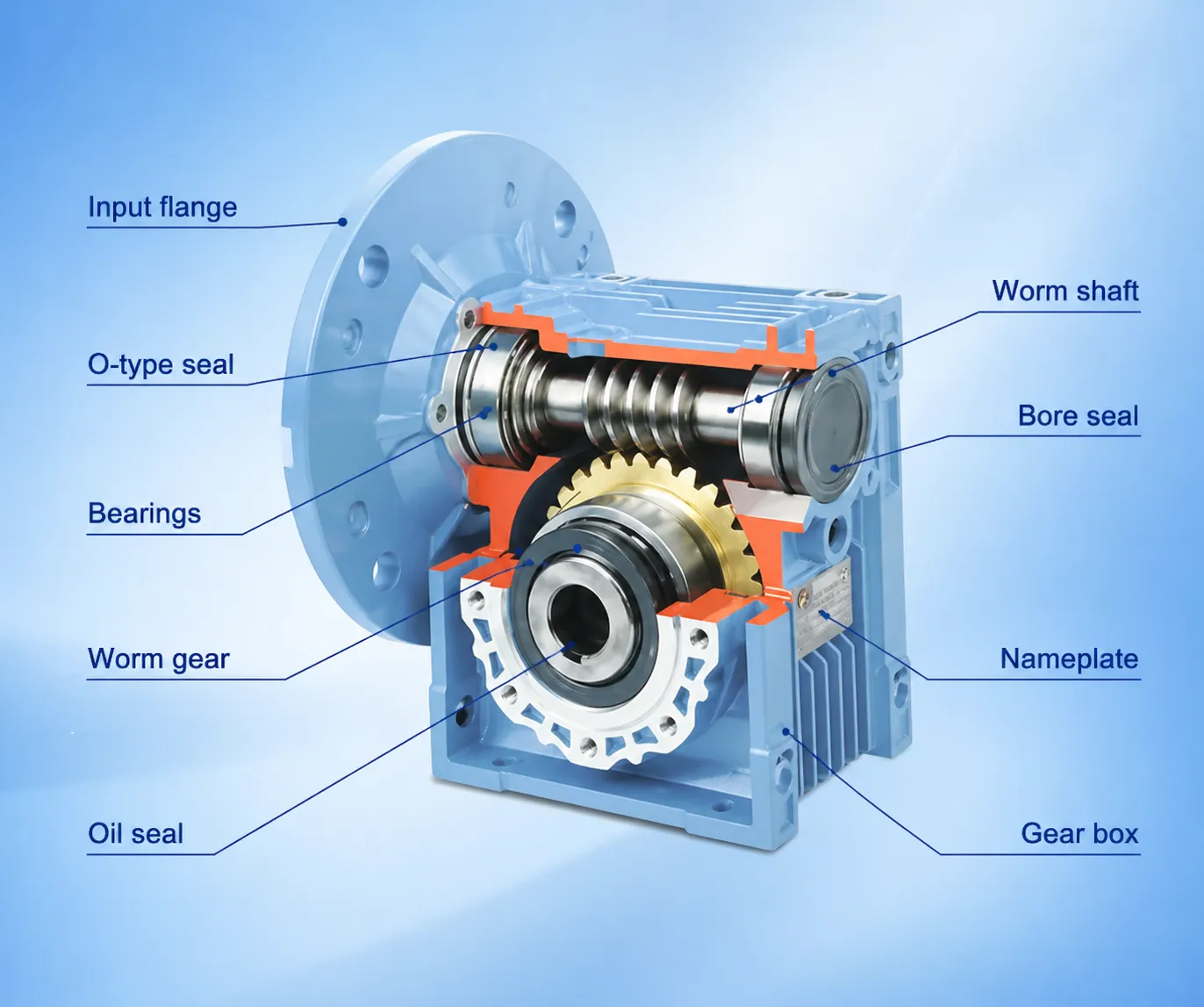
Six functional sub-assemblies behind every worm gear reducer specification — viewed from both cutaway and exploded structure perspectives.
-
1
Worm Shaft (Hardened Steel)
20CrMnTi or 20MnCr5 case-hardened to HRC 58-62 with induction or carburise-and-quench process. Single, double or quadruple thread starts depending on ratio specification.
-
2
Bronze Worm Wheel
Cast tin bronze (CuSn12) or aluminum bronze (CuAl10Fe5Ni5) for premium specs. Self-lubricating sliding contact pairs with the steel worm.
-
3
Housing — Aluminum or Cast Iron
ADC12 die-cast aluminum for NMRV light-duty frames; HT200/HT250 grey cast iron for WP heavy-duty service. UNICASE monoblock construction available on premium orders.
-
4
Tapered Roller Bearings
SKF/NSK/NTN bearings on input and output shafts. Pre-loaded for axial-radial combined loading and matched-set alignment.
-
5
Oil Seals (NBR / FPM)
Double-lip NBR seals for general industrial duty; fluoroelastomer FPM/Viton for high-temperature or aggressive lubricant exposure.
-
6
Lubricant — Synthetic PAG or Mineral CLP
ISO VG 220 standard fill. PAG synthetic for continuous-duty (8,000 h interval); mineral CLP for cost-balanced light-duty (4,000 h interval).
Korean & Asian Industries We Power
Worm gear reducer specifications deployed across eight primary industrial sectors — each with its own duty profile, environmental challenges and lubricant requirements.

Food & Beverage Processing
Conveyor lines, dough mixers, bottle fillers, and CIP washdown areas. Specified with NSF H1 food-grade lubricant and FPM seals to survive caustic cleaning cycles and 60 °C wash-down water.
Explore Application
Textile & Printing
Loom drives, dyeing line conveyors, and printing press indexing where output speed must remain rock-stable. The smooth sliding mesh delivers low-vibration output critical for print registration accuracy.
Explore Application
Mechanical Transmission
General industrial machinery main reducers, packaging line indexers, palletisers and material handling systems. Stock catalogue NMRV and WP specifications cover 80% of these applications without modification.
Explore Application
Marine Engineering
Deck winches, anchor windlasses, hatch covers and lifeboat davits where the self-locking property holds load without external brakes. Salt-spray-rated FPM seals and corrosion-protected housings standard.
Explore Application
Electricity & Energy
Solar tracker drives, wind turbine yaw and pitch systems, biomass boiler stokers and grate conveyors. Long-duration outdoor service at -25 °C to +60 °C ambient with PAG synthetic lubricant for extended drain intervals.
Explore Application
Construction & Mining
Aggregate feeders, vibrating screen drives, slewing platforms and tunnel boring conveyors. Built for shock-loading peaks 2-3× catalogue and constant dust ingress — heavy cast iron WP frames with reinforced bearings.
Explore Application
Automobiles & Transport
Assembly line conveyors, paint shop indexing, vehicle test rigs and EV charging station turntables. High-cycle precision applications where backlash and thermal stability matter — premium UNICASE housing options recommended.
Explore Application
Agricultural Machinery
Rotary tillers, mowers, grain augers, irrigation pumps and silage feeders. Wide ambient temperature service (-30 °C winter to +50 °C summer) and intermittent-duty load profiles common across Korean and Southeast Asian farming operations.
Explore ApplicationProduction Range & Engineering Parameters
Complete envelope of frame sizes, ratios, torque, power and shaft configurations available across our worm gear reducer catalogue.
| Parameter | Range / Options | Notes |
|---|---|---|
| Centre Distance (a) | 25, 30, 40, 50, 63, 75, 90, 110, 130, 150 mm | NMRV / RV pattern; WP & SCWS extend to 250+ mm |
| Single-Stage Ratio (i) | 5 / 7.5 / 10 / 15 / 20 / 25 / 30 / 40 / 50 / 60 / 80 / 100 | Single-start to 4-start worm threads |
| 2-Stage Helical-Worm Ratio | i = 100 ... 3,631 | Combined pre-stage helical + worm output |
| Power Range | 0.06 – 22 kW (single stage); up to 75 kW (helical-worm) | 3-phase IEC motor mount standard |
| Output Torque | 21 – 7,500 N·m (single stage); to 18,000 N·m (helical-worm) | SF 1.0 catalogue; derate per duty class |
| Output Speed | 14 – 280 rpm @ 1,400 rpm input | VFD-compatible 200–1,800 rpm input range |
| Mechanical Efficiency (η) | 58 – 92 % (depends on ratio & lubricant) | PAG synthetic adds +3-5 pp vs mineral CLP |
| Housing Material | ADC12 aluminum die-cast / HT200 grey cast iron / HT250 premium | UNICASE monoblock available on request |
| Worm Wheel Material | CuSn12 tin bronze / CuAl10Fe5Ni5 aluminum bronze / CuSn10P phosphor bronze | Bronze grade matched to duty class |
| Worm Shaft | 20CrMnTi / 20MnCr5 case-hardened HRC 58-62 | Carburise + quench; ground after heat treat |
| Lubricant | ISO VG 220 PAG synthetic / Mineral CLP / NSF H1 food-grade | Factory-fill or dry-shipped per customer |
| Mounting Configurations | B3 foot / B5 flange / B14 face / VS hollow shaft / shaft-mounted | Universal mounting kit shipped with each unit |
| Service Factor (SF) | 1.0 catalogue baseline; sized 1.25 – 2.5 per AGMA / ISO | Quoted SF on every engineering response |
| Standards Compliance | ISO 9001:2015 · DIN 51517-3 · AGMA 6034 | CE / RoHS / REACH on request |
Six Reasons Korean & Asian OEMs Choose Us
Beyond catalogue specifications — the engineering, manufacturing and service capabilities that justify a long-term supplier relationship.
Direct-from-Factory Pricing
Vertical integration from gear cutting and heat treatment through final assembly. No distributor mark-up between our Sandan-ro plant and your delivery dock.
Engineering Response in 48h
Quote requests answered with sized worm gear reducer specification, frame & ratio recommendation, and CAD drawing within two business days.
OEM & ODM Custom Manufacturing
Beyond catalogue: custom shaft profiles, special bronze grades, food-grade NSF H1 specs, ATEX-rated explosion-proof, marine-grade salt-spray protection.
ISO 9001 Quality System
Every worm gear reducer carries individual test certificate covering torque verification, no-load run test, oil leak test and dimensional inspection.
Asian Logistics Hub Optimised
Direct shipping from Busan and Incheon to Korea, Japan, Vietnam, Indonesia, Thailand. Container consolidation for cost-optimised LCL deliveries.
Cross-Reference Replacement
Legacy nameplates, partial codes, photos — we cross-reference Sumitomo, Bonfiglioli, Nord, Mitsubishi, Fenner specs to a modern equivalent.
Four Steps to the Right Worm Gear Reducer Spec
A streamlined sizing process that delivers a verified worm gear reducer specification — the same workflow our engineering team applies to every quote.
Define Driven Load
Application power, target output speed (or ratio), driven equipment type — conveyor, mixer, lift, indexer, agitator. Note any shock-loading characteristics.
Apply Service Factor
Composite SF from driver type, load class, daily hours and ambient temperature. Multiply application power × SF to get required catalogue rating.
Verify Thermal & Mechanical
Check both P_mech and P_th against operating conditions. For continuous duty, P_th typically binds first — add forced cooling or step up frame size.
Specify Mounting & Accessories
Foot / flange / hollow shaft mounting, IEC motor frame, output flange standard, lubricant specification (PAG or mineral), accessory pack (brake, encoder).
From Raw Stock to Tested Drive — Under One Roof
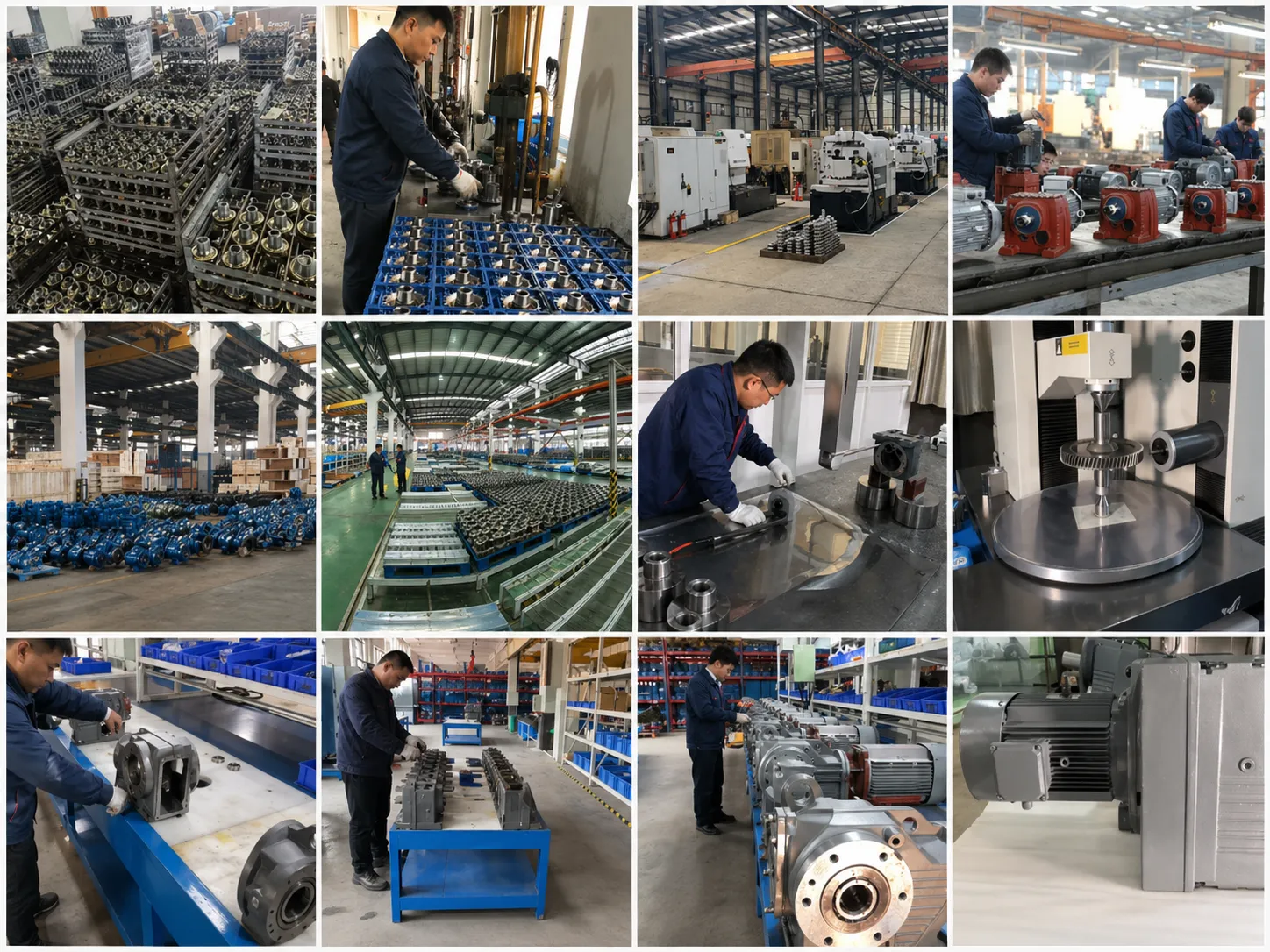
Vertical manufacturing integration across CNC gear cutting, induction hardening, precision grinding, and final test rigs — all within a single Ansan campus that processes over 12,000 worm gear reducer units monthly.
- ✓Gear Cutting: 5-axis CNC hobbing centres for worm threads + bronze wheel teeth, ±5 µm pitch tolerance
- ✓Heat Treatment: Induction + carburise-and-quench lines for HRC 58-62 worm shaft hardening
- ✓Quality Lab: Klingelnberg gear test rigs, CMM coordinate measuring, oil-leak vacuum chambers
- ✓Assembly: Climate-controlled clean assembly lines, individual unit run-test before crating
- ✓Logistics: Bonded warehouse next to Incheon port, direct sea-freight container consolidation
What Korean & Asian Engineers Say
Excerpted feedback from technical buyers across packaging, food, marine, energy, automotive and construction sectors.
Switching to Korea Ever-Power's NMRV 110 spec dropped our packaging-line oil change frequency from 4× to 2× per year. The PAG synthetic specification saved more than the price premium in maintenance labour alone.
Cross-reference response was 36 hours from sending the legacy Fenner nameplate photo. The matching WP-147 unit fitted the existing footprint without modification — exactly what we needed for a brownfield retrofit.
Salt-spray-rated finish has held up through two monsoon seasons on our deck winches. The marine-grade specification is well-thought-out — sealed breathers, FPM seals, the works.
Our solar tracker installation across 18 sites in central Java has logged over 14,000 operating hours per drive without a single field failure. The PAG synthetic and FPM seals handle the tropical humidity better than our previous European supplier.
The food-grade NSF H1 lubricant specification was delivered with full documentation chain — we passed our HACCP audit on first review. Lead time was three weeks faster than the European alternative we previously sourced.
We standardised on Korea Ever-Power for our paint-shop conveyor indexers because the engineering team actually pushed back on our spec — pointed out that we were oversizing by 40% and recommended a smaller frame. Saved capital and reduced footprint.
Latest Worm Gear Reducer Articles
Technical deep-dives written by our Korean engineering team — sizing, materials, lubrication, troubleshooting, brand cross-reference.
What Is a Worm Gear Reducer? Definition, Working Principle & Selection Basics
Comprehensive primer covering definition, working principle, types, applications and selection guidance for engineers new to worm-and-wheel drives.
02 EngineeringHow Does a Worm Gear Reducer Work? Force Flow & Sliding Contact Physics
Mesh kinematics, sliding velocity calculation, force flow through the bronze wheel, and why efficiency depends so heavily on lubricant film thickness.
03 SizingHow to Size a Worm Gear Reducer — A 6-Step Engineering Workflow
Step-by-step sizing process from application power and output speed through service factor application, thermal verification and final spec confirmation.
04 LubricationPAG vs Mineral CLP Lubricant — Which to Choose & the 5-Year TCO
Side-by-side chemistry comparison, oxidation resistance data, and a five-year total cost of ownership calculation showing where each lubricant family wins.
05 SelectionCatalogue Code Decoder: NMRV, WP, SK and SCWS Conventions
Decoder tables that translate frame size, ratio, output type and accessory pack codes from the four major worm gear reducer naming conventions.
06 ReplacementCross-Reference Replacement: Sumitomo, Bonfiglioli, Nord & Fenner
A 4-step cross-reference workflow with worked example showing how a Fenner WP nameplate translates to a modern Korea Ever-Power equivalent.
Ready to Spec Your Next Worm Gear Reducer?
Send the application — power, ratio, ambient, hours. Our Sandan-ro engineering team returns a verified specification, frame & ratio recommendation, and pricing within 24-48 hours.