Одноступенчатый и двухступенчатый червячный редуктор: в каких случаях один из них предпочтительнее другого.
A side-by-side configuration comparison covering ratio reach, efficiency uplift, cost premium, footprint and the application scenarios where each delivers better engineering value.
Korean and Asian buyers specifying a worm gear reducer above i = 60 keep running into the same configuration question: stay with a single-stage worm and accept the efficiency penalty, or step up to a 2-stage helical-worm hybrid and pay the cost-and-footprint premium for higher η? The answer depends on duty cycle, ratio target, energy tariff, and footprint constraint — and the engineering numbers settle the choice cleanly once they are laid out. The article below walks through the configuration trade-offs, the application scenarios where each wins, and a three-question decision filter for the procurement engineer. For the underlying efficiency curves that explain why the 2-stage configuration delivers more η at high overall ratio, see our companion efficiency curves analysis.
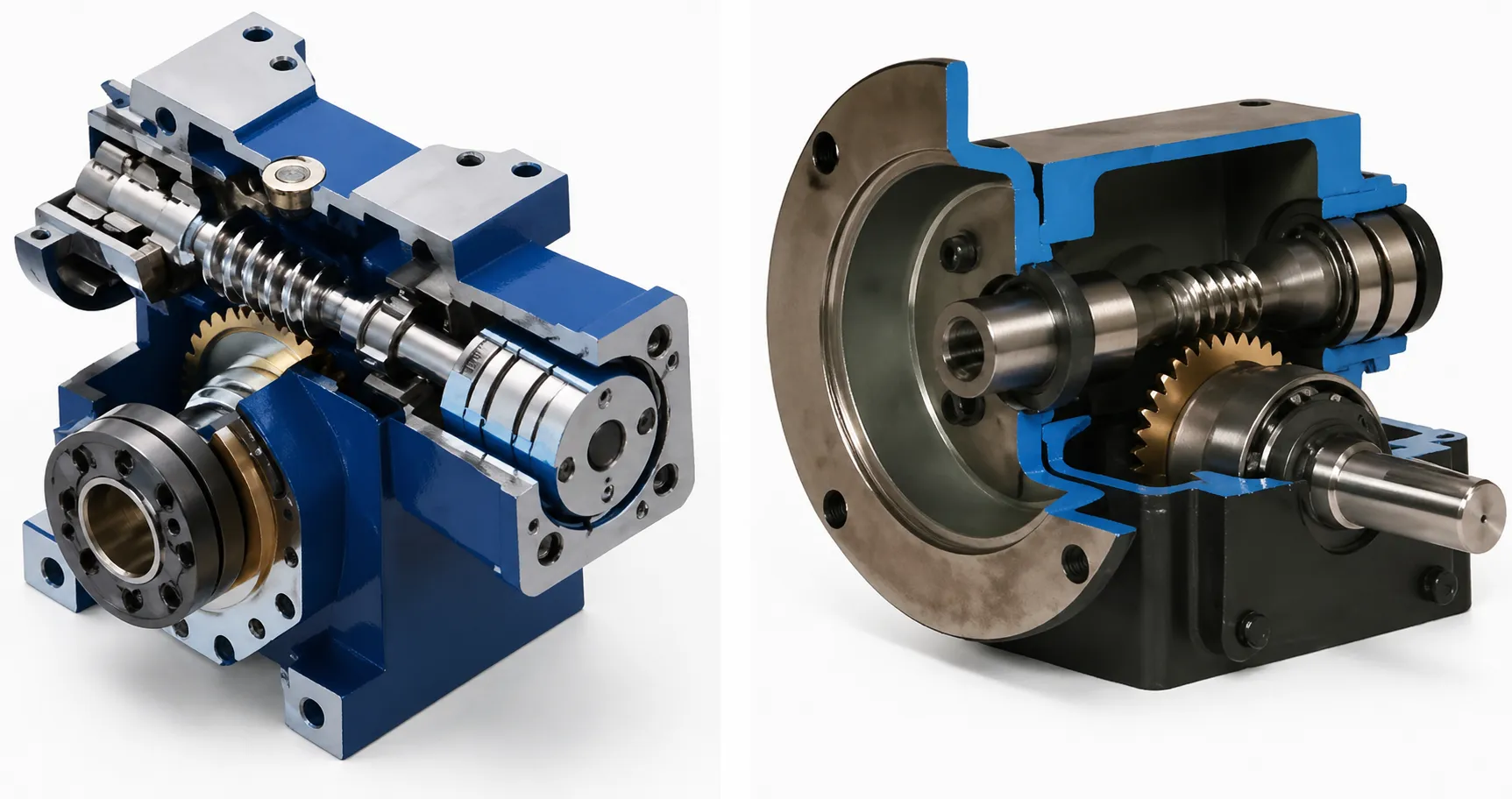
1-Stage Worm Gear Reducer
Motor → Worm shaft → Bronze wheel → Output
- ▸ Ratio range: i = 5 to 100
- ▸ Efficiency: 70-85%
- ▸ Frame length: baseline 1.0×
- ▸ Unit cost: baseline 1.0×
2-Stage Helical-Worm
Motor → Helical pair → Worm shaft → Bronze wheel → Output
- ▸ Ratio range: i = 9 to 3,631
- ▸ Efficiency: 85-92%
- ▸ Frame length: 1.25-1.35×
- ▸ Unit cost: 1.3-1.5×
The Two-Stage Helical-Worm in One Picture
A 2-stage helical-worm worm gear reducer is exactly what the name describes — a helical gear pair acting as the primary reduction stage, feeding a worm-and-wheel pair acting as the secondary reduction stage, both stages enclosed in a single housing. The motor turns the helical pinion at full motor speed; the helical wheel hands off to the worm shaft at reduced speed; the worm drives the bronze wheel at the final output speed. Examples include the Nord SK 13 series, the SEW S series, the Bonfiglioli VF-EP series, and the Sumitomo Cyclo-HE family.
The architectural advantage lies in division of labour. The helical pair handles the high-speed end of the reduction at 96-97% efficiency. The worm pair handles the high-ratio end at 80-85% efficiency on a smaller ratio than a comparable single-stage worm gear reducer would carry. Combined efficiency is roughly 85-92%, materially higher than a pure-worm single-stage at the same overall ratio.
The same architecture also extends ratio reach far beyond what a single-stage worm gear reducer can deliver. Single-stage worm gear reducer caps at i = 100 before efficiency collapses; the helical-worm hybrid runs cleanly to i = 3,631 in the largest catalogue frames. For applications needing slow output speeds with high torque, the architectural choice is essentially binary: 2-stage helical-worm, or 3-stage helical (which costs more again and loses the right-angle output and self-locking benefits worm geometry brings).
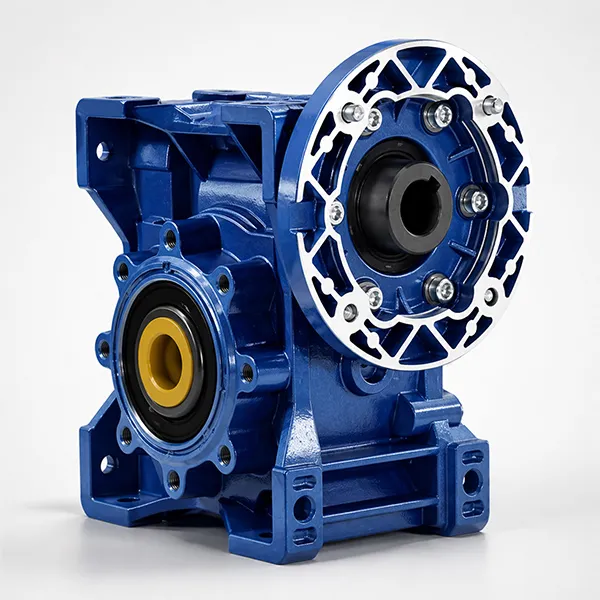
Why Add a Helical Primary Stage at All?
Four engineering motivations push designers from a 1-stage worm gear reducer toward the 2-stage hybrid. Each has a measurable benefit, and most real-world specifications driving the upgrade involve two or three of the four operating together.
- АHigher overall ratio reach — push beyond the i = 100 single-stage ceiling without going to a 3-stage pure-helical configuration that loses worm advantages.
- BBetter efficiency at high ratio — combined η of 85-92% vs single-stage 60-70% at i > 60. The energy-cost gap on continuous-duty drives recovers the unit-cost premium quickly.
- CHigher input speed acceptance — the helical primary handles 3,000+ rpm motor input, where a single-stage worm gear reducer struggles above 1,500 rpm because of sliding-velocity heat.
- ДCompact frame at high ratio — single-stage at i = 100 needs a large bronze wheel; 2-stage at the same i = 100 splits the reduction so the worm wheel stays small. Compact worm gear reducer housing for the same overall ratio.
Ratio Reach: Single-Stage Cap and 2-Stage Extension
The ratio range each configuration covers determines which one is even an option for a given application. The visualisation below shows the practical range each delivers, with the overlap zone where either configuration is viable and the engineer’s choice depends on efficiency or cost factors.
PRACTICAL RATIO RANGE (LOG SCALE INDICATIVE)
1-Stage Worm Gear Reducer
2-Stage Helical-Worm
Overlap zone (i = 9-100): both configurations work — choice depends on efficiency, cost and footprint preference.
Below i = 9, only single-stage worm gear reducer is sensible — the helical primary cannot reduce by less than its own minimum ratio. Above i = 100, only 2-stage helical-worm worm gear reducer delivers acceptable efficiency. The middle band i = 30-100 is where the cost-vs-efficiency calculation actually matters and the rest of this article focuses.
Efficiency Uplift Quantified
The efficiency advantage of the 2-stage configuration grows as overall ratio rises. The paired comparison below shows typical η values at three reference ratios, on synthetic PAG ISO VG 220 at 70 °C oil temperature.
EFFICIENCY η AT THREE REFERENCE OVERALL RATIOS
i = 30
1-Stage
2-Stage
Δη = +13 percentage points
i = 60
1-Stage
2-Stage
Δη = +21 percentage points
i = 100
1-Stage
2-Stage
Δη = +26 percentage points
The pattern is clear: for a червячный редуктор, the higher the overall ratio, the larger the efficiency advantage of the 2-stage. At i = 30 the gap is 13 points; at i = 100 the gap is 26 points. For continuous-duty drives operating at high ratio, the 2-stage configuration delivers measurable lifetime energy savings — typically USD 20,000-40,000 over 10 years on a 7.5 kW continuous-duty drive at Korean industrial tariffs.
Cost and Footprint Trade-Off
The 2-stage worm gear reducer configuration delivers higher efficiency and ratio reach at the cost of a 30-50% unit-cost premium and a 25-35% longer housing footprint. Both penalties are smaller than they sound when set against the comparison alternative of a 3-stage pure-helical drive (which costs 1.8-2.2× the single-stage worm gear reducer baseline and adds an external bevel coupling for right-angle output).
| Параметр | 1-Stage | 2-Stage Helical-Worm | Δ |
|---|---|---|---|
| Unit cost (relative) | 1.0× | 1.3-1.5× | +30-50% |
| Housing length | 1.0× | 1.25-1.35× | +25-35% |
| Weight | 1.0× | 1.4-1.6× | +40-60% |
| Efficiency at i = 60 | 65% | 86% | +21pp |
| Max useful ratio | 100 | 3,631 | 36× |
| Самоблокировка при i ≥ 30 | Yes | Yes (worm stage) | tied |
| Right-angle output | Yes | Yes | tied |
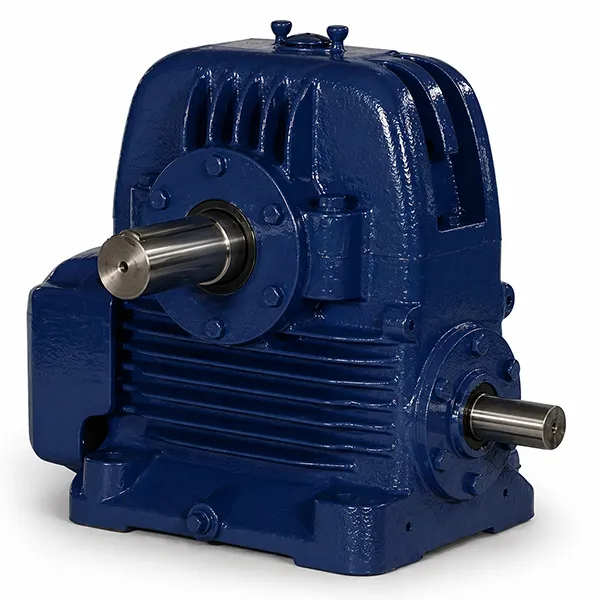
Application Pick — Five Scenarios for Each Configuration
Ten common Korean and Asian worm gear reducer application classes and the typical configuration each picks. The split below shows where 1-stage worm gear reducer remains the engineering default and where the 2-stage hybrid becomes the better choice. For agricultural drive applications where shock loading favours the 2-stage configuration, see related sizing notes for agricultural gearbox sizing.
▸ 1-STAGE WINS
Conveyor head pulley i = 30, intermittent duty
8-hour duty makes efficiency cost negligible; capital cost dominates.
Construction screw jack i = 50
Intermittent lift duty; self-locking primary, energy cost minor.
Packaging line indexer i = 25, 16h duty
Footprint constraint; compact single-stage frame fits machine.
Solar tracker i = 60
Very low operating speed; energy cost effectively zero.
Light-duty agitator i = 40
Low power input; cost-saving outweighs efficiency benefit.
▸ 2-STAGE WINS
Wastewater clarifier scraper i = 1,800
Single-stage cannot reach this ratio; helical-worm is the catalogue default.
Cement raw-mill feed i = 200, 24h duty
Continuous high-power operation; energy savings recover premium.
Bucket elevator i = 150, 24h duty
Heavy load + continuous duty + self-locking on stop.
Agricultural feed mixer i = 120
PTO shock loading benefits from helical primary stage’s smoother torque.
Continuous mixer 11 kW i = 80
High power × 8,000 h/yr; energy savings recover unit cost premium in < 18 months.
The Decision Filter — Three Questions
For procurement engineers stepping through the decision quickly, the three questions below resolve the configuration choice in 60 seconds. Run them in order; the first hard answer settles the choice and the others refine the specification.
What is the target overall ratio?
If i > 100 → 2-stage helical-worm (only option). If i < 9 → 1-stage worm (only option). If 9-100 → continue to Q2.
What are the annual operating hours?
If > 6,000 h/year → 2-stage typically wins on lifetime cost (energy savings recover unit premium). If < 4,000 h/year → 1-stage wins on capital. Between 4,000-6,000 → continue to Q3.
Is footprint or input speed constrained?
If footprint is tight (<25% extra length acceptable) → 1-stage. If motor input speed is > 2,000 rpm or VFD over-speed is part of the duty → 2-stage helical primary handles the input speed cleanly.
1-Stage vs 2-Stage Helical-Worm FAQ
Q: Does a 2-stage helical-worm worm gear reducer keep the self-locking property?
A: Yes, when the worm secondary stage carries enough ratio. Self-locking depends on the worm-stage ratio alone, not the combined ratio. A 2-stage with helical i = 4 and worm i = 30 (combined 120) self-locks because the worm stage exceeds the i ≥ 30 threshold. A 2-stage with helical i = 30 and worm i = 4 (also combined 120) does not self-lock because the worm stage is below threshold. Standard catalogue 2-stage configurations are arranged with the worm carrying the high-ratio reduction precisely to preserve self-locking.
Q: Can a 2-stage helical-worm replace a 3-stage pure-helical drive at the same ratio?
A: Often yes, with cost and footprint advantages. A 2-stage helical-worm at i = 200 runs at 86% efficiency vs a 3-stage helical at 91%; the 5-point efficiency penalty is real but small. The 2-stage helical-worm costs 1.4× the single-stage worm gear reducer baseline; the 3-stage helical costs 1.8-2.0×. The helical-worm also delivers right-angle output natively where the 3-stage helical needs an external bevel coupling. For applications above i = 100, the 2-stage hybrid usually wins on total installed cost.
Q: Does the 2-stage configuration accept higher motor input speeds than 1-stage?
A: Yes, substantially. A 1-stage worm gear reducer is typically limited to 1,500 rpm input because higher speeds drive sliding velocity at the worm-bronze contact above its frictional-heat dissipation envelope. A 2-stage helical-worm’s helical primary stage handles 3,000+ rpm input cleanly, then reduces to a safe speed for the worm secondary. This matters for VFD-driven drives where over-speed operation pushes motor speed above 2,000 rpm during peak load.
Q: Are spare parts more expensive on 2-stage helical-worm units?
A: Slightly. The helical primary stage adds two additional gear meshes and bearings to the parts inventory, raising total replacement-part value by roughly 20-30% over the equivalent single-stage worm gear reducer. The bronze wheel and worm shaft (the wear-prone parts in any worm geometry) are essentially the same parts as the single-stage equivalent, so re-tooth kit pricing is comparable. Spares planning should budget the higher replacement-part value when comparing total cost of ownership.
Q: How do common manufacturer codes designate 2-stage helical-worm vs 1-stage?
A: Common worm gear reducer patterns: Nord SK 11/12/13 series (SK 11 single-stage, SK 13 2-stage helical-worm). Bonfiglioli VF (single) vs VF-EP (2-stage). SEW S series suffix code indicates stage count. Sumitomo Cyclo HE (helical-worm). Korea Ever-Power frames carry explicit “1-stage” or “2-stage helical-worm” descriptions in the model code. When sourcing replacements for a legacy unit, verify the stage count from the existing nameplate before quoting.
Q: Does a 2-stage helical-worm worm gear reducer run quieter than 1-stage?
A: Slightly louder, in fact. The 2-stage worm gear reducer helical primary stage adds a tonal whine at gear-mesh frequency to the existing worm-stage signature; combined acoustic level rises 2-4 dB over the single-stage equivalent. Both configurations remain quieter than equivalent helical-only or planetary drives, since the worm secondary stage carries most of the load reduction at low sliding velocity. For acoustic-sensitive installations (theatre stage drives, hospital equipment), the 1-stage configuration retains a small acoustic advantage.
Need Help Choosing Between 1-Stage and 2-Stage Configuration?
Send the worm gear reducer application — power, target ratio, hours per year, footprint constraint, ambient. Our Korean engineering team returns a configuration recommendation with frame, ratio, lifetime energy cost comparison and unit-cost quotation within 24-48 hours.
Редактор: Cxm