Корпус червячного редуктора UNICASE: преимущества моноблочного литья.
A precision-engineering deep-dive on single-cast monoblock housings — stiffness gains, bearing-seat alignment, vibration improvements and the cost-benefit math that decides when UNICASE pays back its premium.
UNICASE — the term coined by Sumitomo and adopted broadly across precision worm gear reducer manufacturing — describes a housing cast in one piece, with input bearing seat, output bearing seat, gear-mesh chamber and mounting feet integrated into a single casting machined as a unit. The conventional alternative is a split housing assembled from two or three separate castings bolted together at the parting line. The structural difference between the two designs runs deeper than the manufacturing detail suggests, and shapes stiffness, alignment precision, vibration signature, and service-life economics in the resulting worm gear reducer. The article below quantifies the engineering trade-offs and identifies where UNICASE specification justifies its 12-25% cost premium.
1 casting / 0 parting lines
All bearing seats machined in one set-up
- ▸ Bearing alignment: ±15-25 µm
- ▸ Frame stiffness: baseline 1.0×
- ▸ Vibration emission: lowest
- ▸ Unit cost: 1.12-1.25× split design
2-3 castings / parting line(s)
Bearings machined in separate set-ups
- ▸ Bearing alignment: ±40-80 µm
- ▸ Frame stiffness: 0.55-0.75× baseline
- ▸ Vibration emission: higher
- ▸ Unit cost: baseline 1.0×
What Is UNICASE — and Why It Differs from Split Housings
A UNICASE worm gear reducer housing is cast as one unbroken piece, then machined on a CNC fixture that holds the entire envelope while every bearing seat, oil-seal bore, mounting face and inspection port is cut in a single set-up. The geometric outcome is that all functional surfaces share a common reference frame to within the CNC machine’s repeatability — typically ±5-10 µm. A split housing achieves the same bearing seats by casting two halves, machining each in its own set-up, then bolting them together. The bolted joint introduces alignment error from three independent sources: each casting’s set-up reference, the parting-line gasket compression, and the bolt-torque distribution.
The traditional split design was the engineering norm until the 1980s because it simplified casting (smaller parts, fewer cores) and allowed easy access for assembly. UNICASE became practical as CNC machining centres grew large enough to fixture full worm gear reducer housings in one setup, and as casting cores became precise enough to deliver sound monoblock castings without the parting-plane shortcut. Today the trade-off is no longer technical capability — both processes work — but cost-vs-performance optimisation across application classes.
Sumitomo, SEW, Bonfiglioli and Korea Ever-Power all offer UNICASE worm gear reducer designs alongside conventional split housings on overlapping frame size ranges. The price premium varies between manufacturers and frames but consistently sits in the 12-25% band over the comparable split-housing specification. Whether the premium pays back depends on duty class, alignment-sensitivity of the driven equipment, and the noise/vibration constraint envelope of the application.
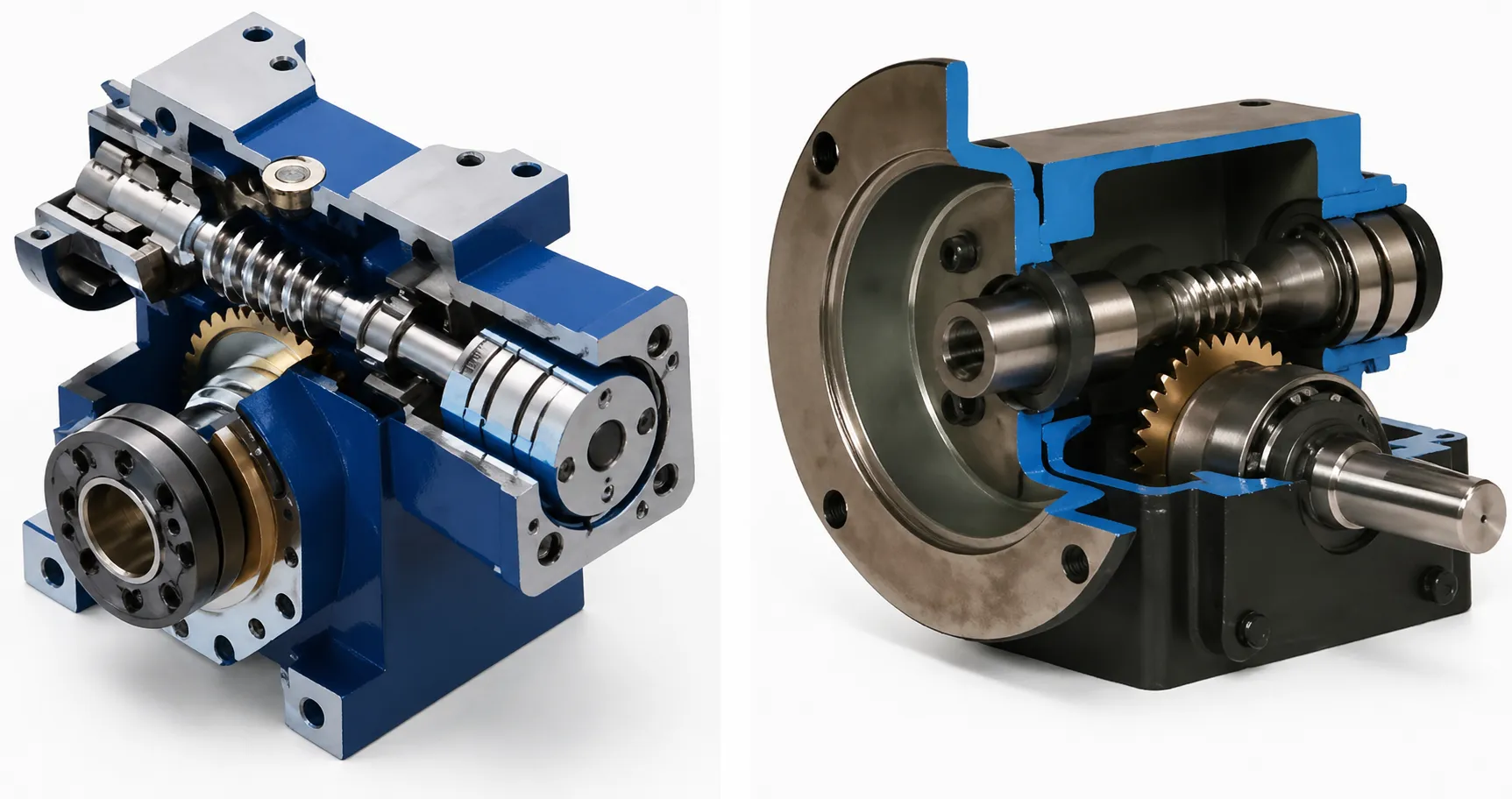
The Split-Housing Problem — Alignment and Stiffness Loss
Split-housing assemblies suffer two engineering compromises that monoblock designs eliminate by construction. The first is bearing-seat alignment. With each housing half machined in its own CNC set-up, the bearing bore on the upper half cannot reference the bearing bore on the lower half except through the parting-plane datum — and that datum carries the gasket compression tolerance and bolt-torque variability into the assembled measurement. Field-measured concentricity between input and output bearing seats on a typical mid-frame split-housing worm gear reducer falls in the ±40-80 µm range; on a UNICASE equivalent it sits at ±15-25 µm.
The 30-50 µm difference matters because the worm gear reducer mesh expects the worm-shaft axis to be perpendicular to the wheel-shaft axis to within 100 µm at typical pitch diameters. A 60 µm bearing-alignment error consumes more than half the available alignment budget before any installation factor. The remaining margin must absorb thermal expansion, base-plate flatness, coupling parallelism and other field tolerances. UNICASE essentially returns the in-housing alignment budget to the manufacturer, leaving more headroom for installation factors.
The second compromise is frame stiffness. A bolted parting-line joint deflects under gear-mesh reaction forces because the gasket compresses and bolts stretch elastically. Monoblock castings have no such joint — the same load case produces 30-45% less deflection at the bearing seats, which keeps gear-mesh contact pattern centred and reduces dynamic excitation across the operating envelope.
UNICASE Manufacturing — Single-Cast Monoblock Approach
UNICASE production starts at the foundry. The mould must form the entire housing as one unit — including the internal cavity that becomes the gear-mesh chamber — using a sand core or a lost-foam pattern that is removed after casting. The casting cools as one piece, develops residual stresses uniformly across the assembled envelope rather than concentrating at parting-plane interfaces, and arrives at the machine shop as a single workpiece. Quality verification on UNICASE worm gear reducer castings at the foundry uses dye-penetrant inspection on critical surfaces and ultrasonic inspection through the bearing-seat regions to detect internal defects.
Machining proceeds on a 4- or 5-axis horizontal CNC centre with the housing fixed to a rotating table. The set-up rotates through positions for each bearing bore, oil seal cavity, mounting face and dowel hole — all referenced to the same datum frame. Machining repeatability across positions is typically ±5-10 µm on modern centres, which sets the lower bound of the UNICASE alignment specification. Post-machining inspection confirms concentricity, parallelism and squareness before the housing is washed, painted or anodised, and shipped to assembly.
The cost premium over split-housing manufacturing comes from three sources: more complex casting (larger pattern, sand core for internal cavity, higher reject rate at foundry), longer machining set-ups (full 5-axis pass vs simpler 3-axis cuts), and tighter inspection requirements. Worm gear reducer manufacturing yield typically runs 90-95% on UNICASE vs 96-98% on split housings, with the rejected castings carrying through to the higher unit cost.
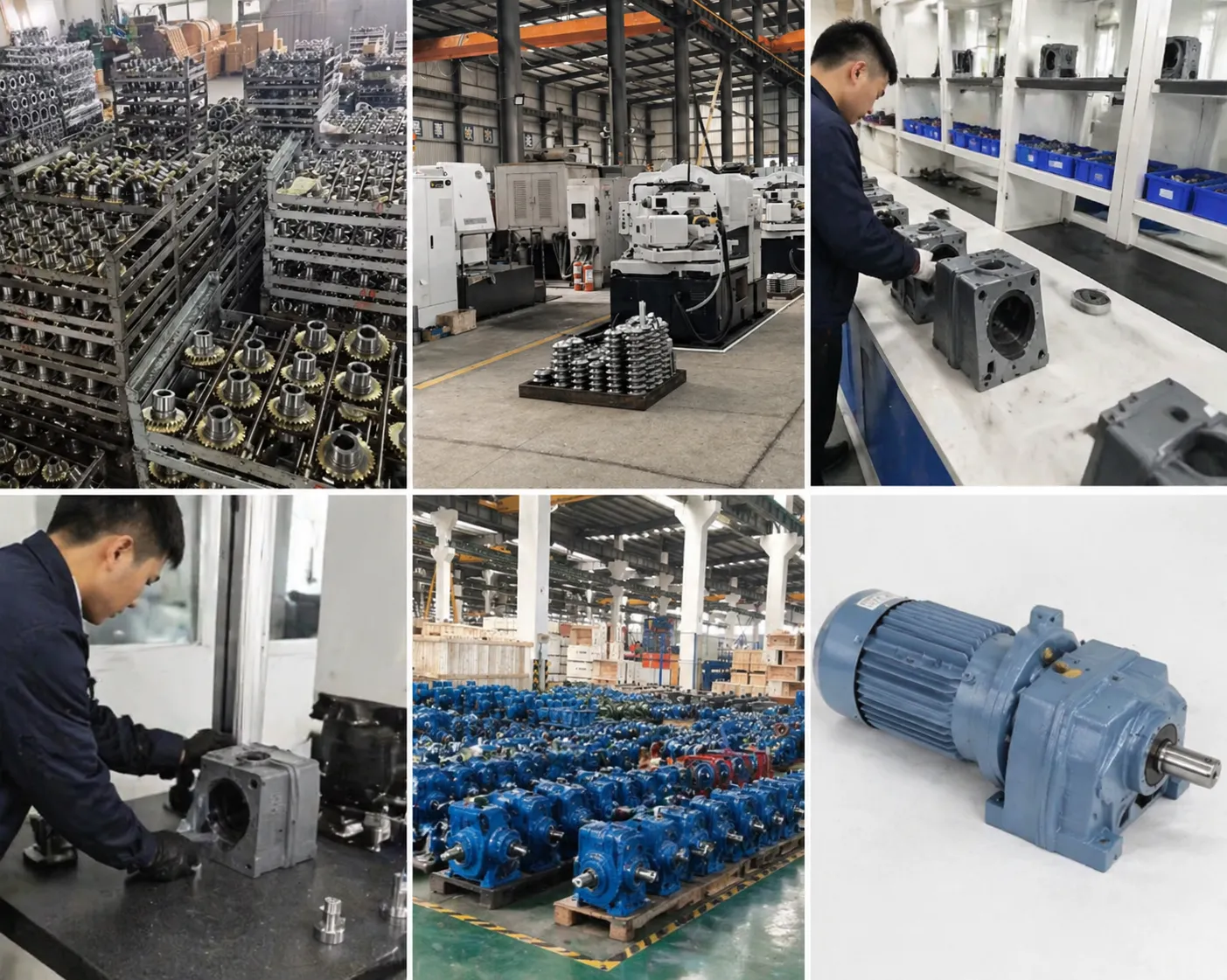
Stiffness Benefit Quantified — Deflection at Rated Load
The stiffness advantage of UNICASE shows up most clearly in the bearing-seat deflection under gear-mesh reaction load. The visualisation below shows typical FEM-predicted and bench-measured worm gear reducer deflections at the output-bearing seat for an equivalent-frame worm gear reducer in both housing architectures, at 100% catalogue rated load.
OUTPUT BEARING-SEAT DEFLECTION (µm AT RATED LOAD)
Frame size 075 (small/mid)
UNICASE
Split Housing
Δ = 10 µm (45% lower deflection)
Frame size 150 (medium)
UNICASE
Split Housing
Δ = 16 µm (42% lower deflection)
Frame size 250 (large)
UNICASE
Split Housing
Δ = 27 µm (44% lower deflection)
The 40-45% deflection reduction is consistent across frame sizes — the parting-line joint stiffness loss scales roughly with frame size, so UNICASE’s structural advantage holds across the range. For applications where output shaft position-accuracy matters (machine tool drives, indexing tables, robotic axes), the lower deflection translates directly to better positioning repeatability under load variation.
Bearing-Seat Alignment Precision
The bearing-seat alignment achievable on each design depends on three error sources: machine-tool repeatability, set-up reference quality, and joint-induced misalignment. UNICASE eliminates the third source entirely; the other two contribute equally to both architectures. The summary below shows typical alignment performance on a mid-frame worm gear reducer with detailed breakdown of each contributor. For matched bearing-aligned worm-and-wheel kits that benefit most from UNICASE precision, see our worm and worm wheel pair reference.
CONCENTRICITY ERROR BUDGET (µm, INPUT-OUTPUT BEARINGS)
UNICASE total budget: ±20 µm typical
Split Housing total budget: ±60 µm typical
The joint-compression contribution dominates the split-housing error budget — eliminate the joint and the alignment improves by 3-4× without changing any other manufacturing step.
For worm gear reducer applications driving precision rotary tables, machine tool spindles, or robotic axes, the 40 µm tighter alignment translates directly to better gear-mesh contact pattern, lower noise emission, and longer bearing service life. Worm gear reducer bearings running at the rated catalogue load with 60 µm misalignment see L10 life shortened by 30-50% compared with the 20 µm UNICASE alignment.
Vibration and Acoustic Improvements
The two worm gear reducer improvements above — better bearing alignment and higher frame stiffness — combine to reduce vibration emission across the operating speed range. Field-measured vibration on a UNICASE worm gear reducer at rated load typically runs 4-7 dB below an equivalent split-housing unit at the same operating point, with the largest gap concentrated at gear-mesh fundamental frequency where the alignment-and-stiffness combination matters most.
The acoustic benefit is usually less perceptually striking than the gap between aluminum and cast iron housings (which runs 10-16 dB), but it stacks on top of housing-material choice. A UNICASE cast-iron worm gear reducer combines both improvements and delivers field noise floors 14-23 dB below an aluminum split-housing unit of equivalent power and ratio. For installations near personnel exposure limits or in acoustic-sensitive environments, the combination matters.
A secondary benefit shows up as longer bolt retention. Worm gear reducer vibration excitation slowly works mounting bolts loose; lower vibration extends the bolt re-torque interval. UNICASE units typically run 8,000-12,000 hours between scheduled re-torque on heavy-industrial duty, where split-housing equivalents need 4,000-6,000 hour intervals to maintain the same mounting integrity.
Cost Trade-Off — When UNICASE Pays Back
Whether the 12-25% UNICASE premium pays back depends on three application factors: alignment-sensitivity of the driven equipment, vibration constraint envelope, and duty cycle. The worked example below shows the cost-payback math for a typical Korean precision-manufacturing worm gear reducer specification — a 5.5 kW frame 110 driving a machine tool indexing table at 8,000 hours per year.
10-YEAR PAYBACK CALCULATION (PRECISION INDEXING DUTY)
Initial cost premium
Split housing: USD 1,400 | UNICASE: USD 1,720
Premium = USD 320
Maintenance savings (10 yr)
Bolt re-torque (8,000 vs 5,000 h): -USD 320
Bearing replacement (L10 +35%): -USD 180
Coupling alignment service (extended): -USD 220
Total maintenance savings: USD 720
Quality benefit (production indexing)
Reduced position-error scrap rate (0.3% saved on USD 250k/yr throughput):
Annual savings = USD 750/yr
10-year benefit: USD 7,500
Net 10-year position
Premium: -USD 320
Maintenance + quality benefits: +USD 8,220
Net benefit: USD 7,900 over 10 years | Payback: ~5 months
For precision-application worm gear reducer specifications, the UNICASE premium pays back rapidly. For non-critical-duty worm gear reducer applications (general conveyors, light mixers, packaging indexers without tight position requirements), the maintenance savings alone may not recover the premium — the quality benefit drives the economics, and where it doesn’t apply the split housing remains cost-optimal.
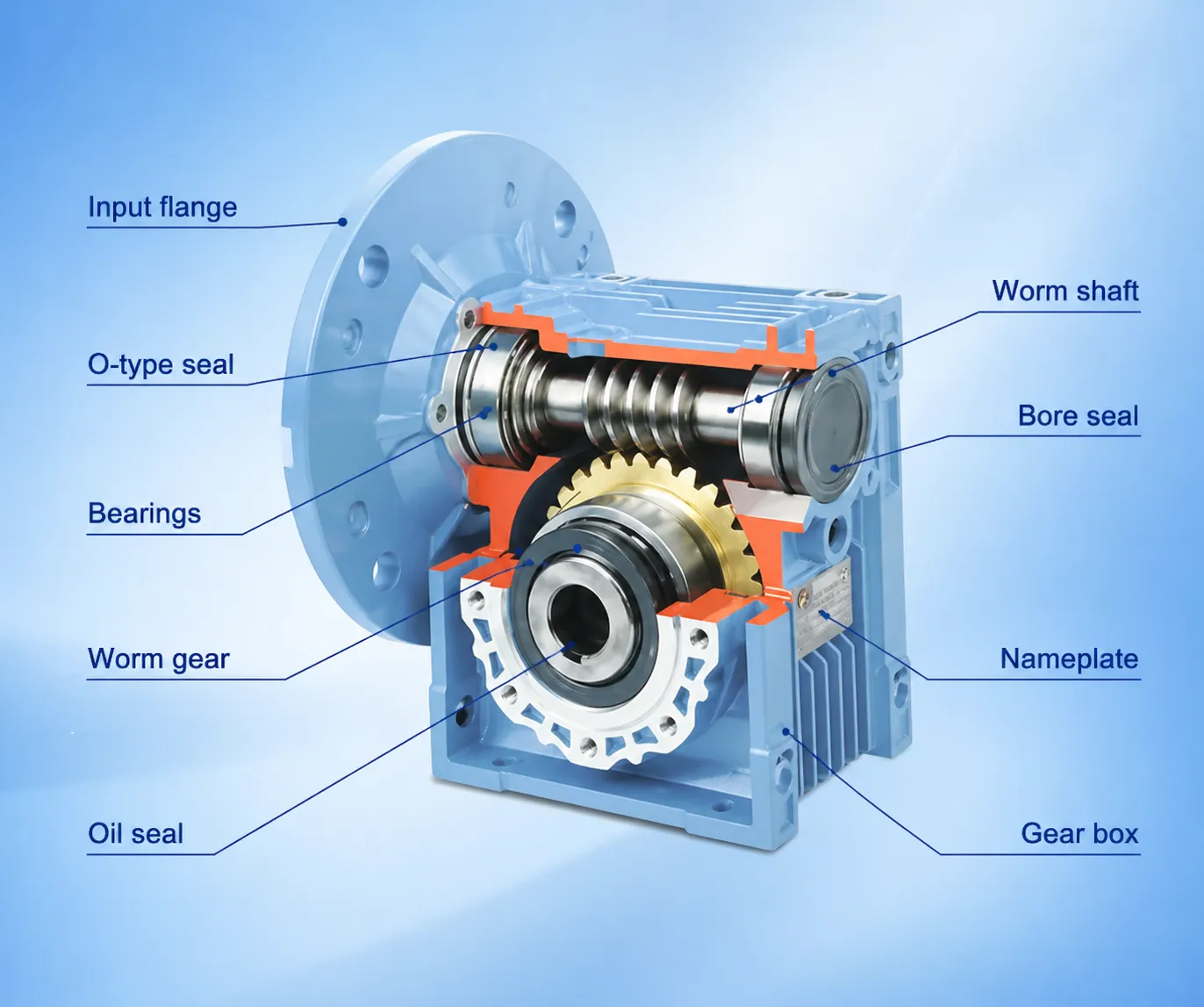
Application Scenarios for UNICASE Specification
Eight Korean and Asian application classes where UNICASE worm gear reducer specification is typically justified by the engineering-and-economics combination above. Browse the broader каталог червячных редукторов for sized UNICASE frames matching these application categories.
Machine tool indexing table
Position repeatability requires <30 µm bearing alignment.
Robotic 4-axis joint drive
Precision arm positioning under variable payload.
Theatre stage drive
Acoustic emission below 60 dB at 3 m operating point.
Semiconductor wafer handling
Cleanroom + precision motion combined requirement.
Servo-driven packaging line
High dynamic loading; backlash and stiffness critical.
Continuous mining auxiliary
24-hour duty; service-life extension justifies premium.
Marine winch hoist
Shock loading + harsh environment combined.
Test rig motorisation
Repeatability requirements drive UNICASE selection.
UNICASE Worm Gear Reducer FAQ
Q: Is UNICASE only available in cast iron, or does aluminum-housed UNICASE exist?
A: Both materials offer UNICASE construction. Aluminum die-cast UNICASE worm gear reducer delivers the alignment-and-stiffness benefits of monoblock construction at lighter weight, suitable for precision packaging and indexing applications. Cast iron UNICASE adds the thermal and damping benefits of grey iron on top, suitable for continuous-duty and acoustic-sensitive industrial drives. The premium over equivalent split-housing units is similar in both materials (12-25% range).
Q: Can a UNICASE worm gear reducer be repaired in the field, or must it return to factory?
A: Most field service operations work identically on UNICASE and split-housing units. Bearing replacement, oil seal change, lubricant exchange, and bronze wheel re-tooth all proceed through the same access ports. The exception is gear-mesh re-shimming if the bronze wheel substitution requires axial position adjustment — split housings sometimes allow this through gasket shim stacking at the parting line, while UNICASE depends on internal shim provision. Korean Ever-Power and other ISO 9001 manufacturers ship UNICASE units with internal shim packs precisely to support field re-shimming on substitution kits.
Q: How do UNICASE benefits compare to specifying a higher bearing precision class on a split housing?
A: Upgrading bearing precision (P5 vs P6, or P4 vs P5) reduces the bearings’ internal radial run-out by 5-10 µm but does not affect the bearing-seat alignment in the housing — the dominant error source on split designs. The combination “P5 bearings in UNICASE housing” delivers consistently better gear-mesh performance than “P4 bearings in split housing” because the housing alignment dominates. For precision specifications, prioritise UNICASE first, then bearing-precision upgrade as a secondary lever.
Q: Does UNICASE construction limit the range of catalogue ratios available in a worm gear reducer frame?
A: No. UNICASE manufacturing accepts the same range of internal gear meshes as split-housing alternatives — i = 5 to 100 on single-stage, i = 9 to 3,631 on 2-stage helical-worm. The internal cavity geometry is set by the casting core and machined post-cast, identical in both architectures. The choice between UNICASE and split is independent of the ratio specification.
Q: Are there frame sizes where UNICASE is not offered?
A: Very large worm gear reducer frame sizes (350 mm and above) are usually only offered as split housings because the casting equipment to cast monoblocks at that size is rare and the cost premium grows steeper. Very small frames (25-40 mm) sometimes only ship as UNICASE because the small size makes split-housing CNC fixturing difficult. The mid-range frames (50-300 mm) typically offer both architectures and let the application drive the choice.
Q: Is UNICASE a Sumitomo trademark or a generic engineering term?
A: UNICASE was originally Sumitomo’s trade name for its monoblock housing line, and it remains Sumitomo’s branded designation. Other manufacturers use different names — Bonfiglioli’s “Monolithic Housing”, SEW’s “One-Cast Housing”, Korea Ever-Power’s “Unified Cast Frame” — for the same engineering concept. The technical content is essentially equivalent across brands; the choice of supplier depends on frame fit, lead time and price. For specifications referencing “UNICASE” generically, any monoblock-housing worm gear reducer satisfies the requirement.
Need a UNICASE Worm Gear Reducer for Your Precision Application?
Send the application — power, ratio, alignment-sensitivity, acoustic class, duty cycle. Our Korean engineering team returns a UNICASE configuration recommendation with frame, ratio, alignment certificate format and 10-year payback calculation within 24-48 hours.
Редактор: Cxm