Worm Gear Reducer for Construction Mining: Heavy-Shock Specification
Three major equipment categories, heavy-shock service factor calculation, dust ingress defense, vibration damping for rough-terrain mounting and sized recommendations for concrete batching, mine conveyor and drilling-rig auxiliary drives.
Construction sites and mining operations stress a worm gear reducer in patterns that no general-purpose industrial sizing method covers. Continuous heavy shock from material handling, abrasive dust ingression that dwarfs anything inside a factory, vibration transmitted from rough-terrain mounting platforms, and routine partial-load operation between full-power demands all combine to compress catalogue service life by 50-70%. Generic industrial worm gearbox specifications applied to a mine conveyor head pulley typically last 18-24 months; properly specified equivalents last 7-12 years. The article below distinguishes the three major equipment categories, walks the heavy-shock service factor calculation, maps dust ingress defense layers, and sizes typical applications.
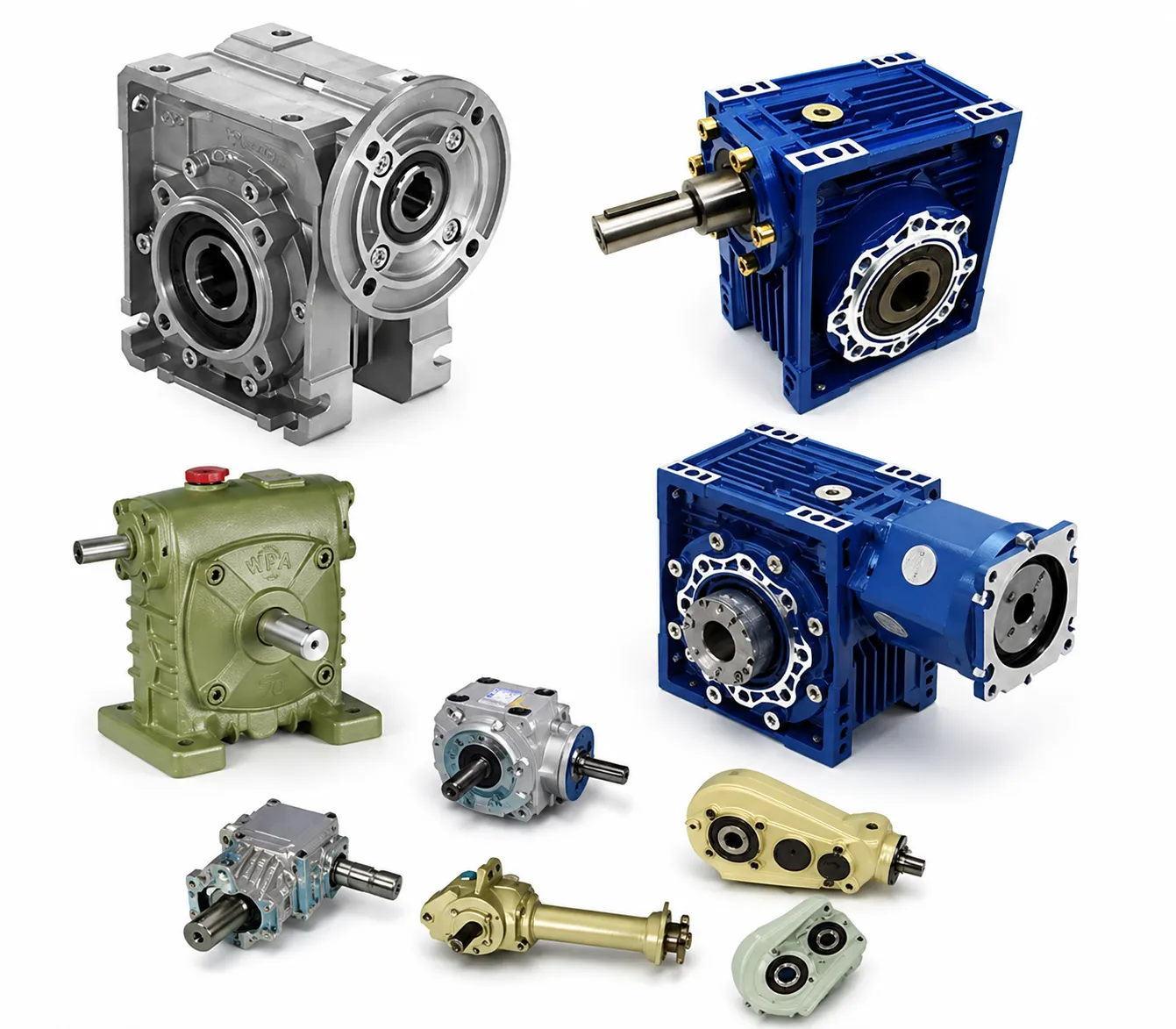
Why Construction and Mining Stress Worm Gear Reducer Differently
Standard industrial sizing assumes a relatively benign environment — clean indoor air, rigid concrete-foundation mounting, smooth load profiles with occasional shock peaks. Construction and mining environments invert all three assumptions. The worm gearbox is mounted to a steel skid that flexes under the weight of a 60-tonne haul truck loading; ambient air carries 5-15 mg/m³ silica dust; the load profile alternates between zero-load idle and 200% catalogue overload during a bucket-strike on a hard rock face.
The compounding effect across these three stressors — abrasive ingress, structural vibration, repeated overload — is why a worm gearbox specified to standard industrial criteria fails so quickly in mining and heavy construction service. Specifying for any one stressor while ignoring the others delivers no improvement in service life; the surviving stressor causes the failure. The remediation requires a layered approach: heavy SF on torque, sealed bearings against dust, and reinforced housing against vibration.
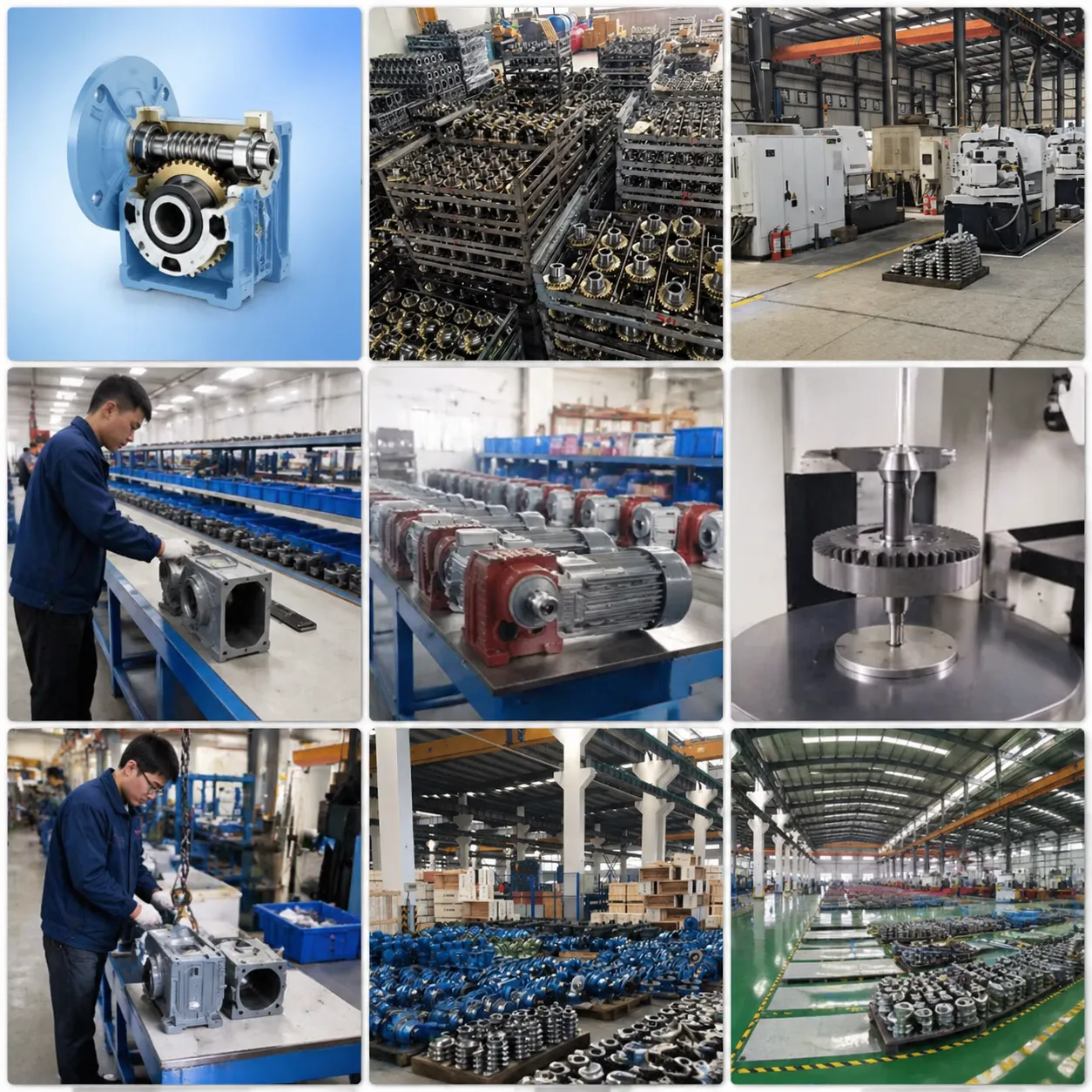
Three Major Equipment Categories
Construction and mining worm gearbox demand concentrates in three equipment categories. Each category presents a distinctive failure-mode pattern.
Heavy-Shock Service Factor Calculation
Standard catalogue SF tables top out at 1.4-1.5 for “heavy shock” in industrial classifications. Mining and construction shock loads regularly exceed this envelope. The compound SF formula recognises that shock contributes from three independent sources, each multiplicative:
SF_compound = SF_base × K_starts × K_overload
SF_base: 1.0 (smooth) to 1.4 (heavy shock) per ISO/AGMA classification.
K_starts: 1.0 if <100 starts/hour, 1.15 if 100-300, 1.30 if >300 starts/hour. Mining belt drives with anti-runback brakes typically run 200-400 starts/hour.
K_overload: 1.0 if no overload, 1.15 if occasional 150% peaks, 1.30 if regular 200%+ peaks. Bucket loaders and crusher feed conveyors regularly hit 200%.
Example: a mine head-pulley drive with heavy shock (SF_base 1.4), 250 starts/hour (K_starts 1.15), regular 200% peaks (K_overload 1.30) yields SF_compound = 1.4 × 1.15 × 1.30 = 2.10. The worm gearbox must be specified to a torque rating 2.10× the calculated nominal — substantially above any standard industrial specification.

Dust Ingress Defense Strategy
Cement, silica, coal and aggregate dust suspended in mining and construction air settles on housing surfaces and ingresses past worn output shaft seals. Once inside the oil bath, abrasive particles act as continuous lapping compound on bronze worm wheel and steel worm shaft, eroding tooth profile within months. Three defense layers compound:
| Layer | Defense Element | Particle Size Stopped |
|---|---|---|
| Outer barrier | Felt collar pre-filter on output shaft | > 50 μm coarse particulate |
| Primary seal | Triple-lip FKM with stainless dust deflector | > 5 μm respirable + abrasive |
| Pressure equalisation | Filtered breather (1 μm rated, hydrophobic) | > 1 μm fine dust + moisture vapour |
Skipping any single layer in the chain compromises the others. A high-grade FKM seal still allows ingress if the breather is open; a perfect breather still allows ingress if the output shaft seal is single-lip NBR. Specifying the dust defense as a system rather than individual components is essential.
Vibration Damping for Rough-Terrain Mounting
Mobile crushers, mobile screens and mobile concrete batching plants mount the worm gearbox on a steel skid that flexes under the dynamic loads of feed material and motion. Hull-style continuous vibration is rare; the more common pattern is impulse loading at 1-3 Hz from feed-strike events, with spike acceleration to 1.5-3 g. Standard rigid-mount worm gearbox bolts loosen within 2,000-4,000 operating hours under this regime.
Three counter-measures address the impulse pattern. Anti-vibration mount pads (typically 50-90 Shore A natural rubber or polyurethane) decouple the worm gearbox housing from the skid frame, attenuating impulse peaks by 60-80%. Self-locking nuts (Nyloc or split-ring) on all mounting bolts prevent the rotational creep that causes loosening. Quarterly bolt-torque inspection (vs annual on stationary installations) catches the residual loosening before it leads to mount failure. Together these measures extend service life from the 2,000-4,000 hour baseline to 15,000-25,000 hours.
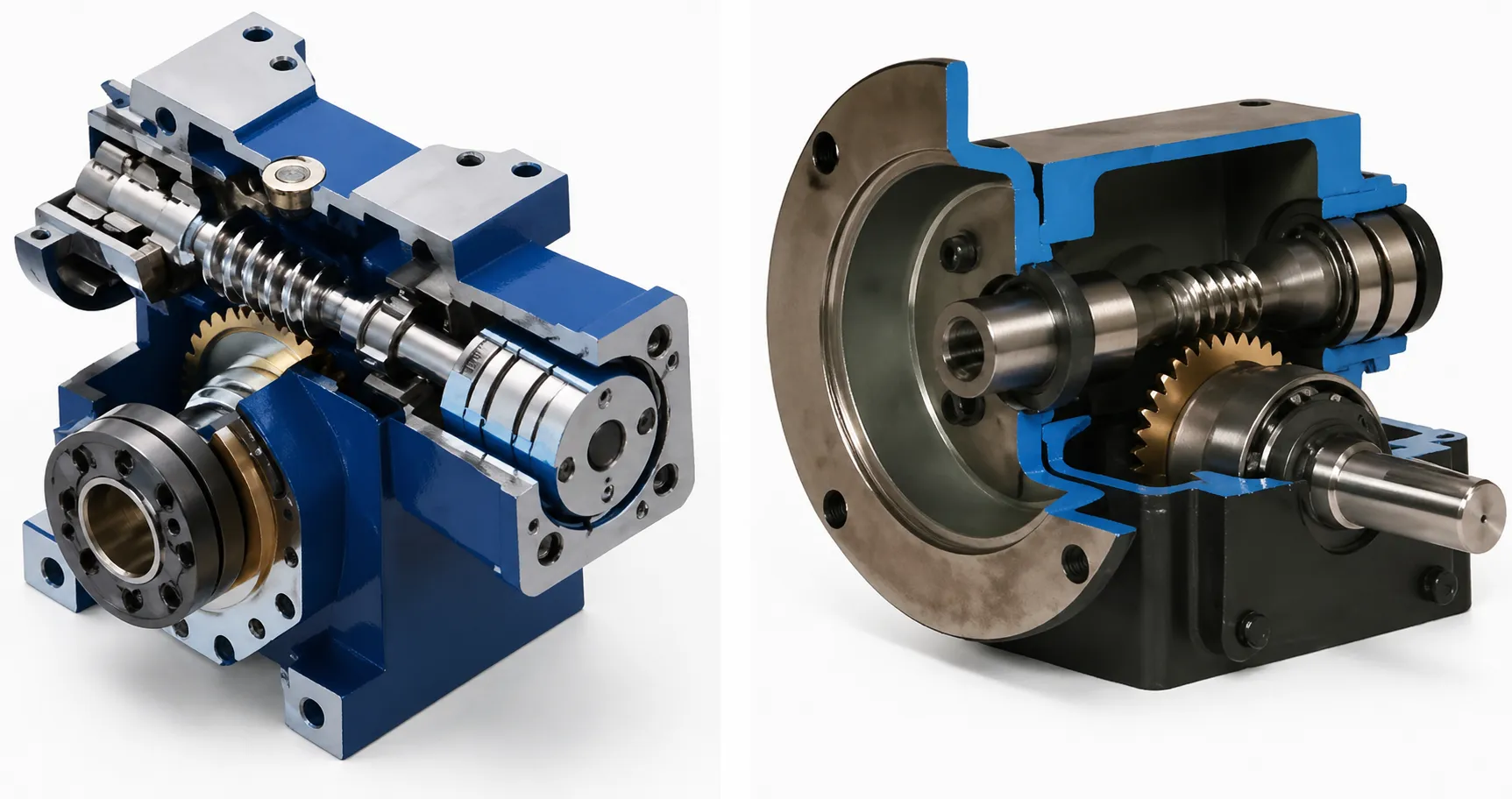
Sizing Worm Gear Reducer for Common Heavy-Duty Drives
⌬ HEAVY-DUTY 01
Cement screw conveyor
Output 1.5-7.5 kW, output speed 30-90 rpm. Cement dust environment. Frame WPA 110-WPA 130. SF 1.4 + dust defense 3-layer mandatory.
⌬ HEAVY-DUTY 02
Mine head pulley
Output 11-30 kW, output speed 40-80 rpm, 200%+ shock peaks. Frame WPDS 175-WPDS 250. SF_compound 2.0+ minimum.
⌬ HEAVY-DUTY 03
Concrete mixer drum drive
Output 7.5-22 kW, output speed 5-20 rpm, very high SF. Frame WPDS 200+. Two-stage helical-worm preferred for ratio >60.
⌬ HEAVY-DUTY 04
Aggregate stockpile feeder
Output 4-11 kW, output speed 30-80 rpm. Variable load with starting torque spikes. Frame WPA 130-WPA 150. SF 1.6.
⌬ HEAVY-DUTY 05
Drilling rig top-drive auxiliary
Output 2.2-7.5 kW. Vibration-mounted, drilling-fluid splash zone. Frame NMRV 110-WPA 130. FKM seals + anti-vibration pads + chemical-resistant coating system.
Common Heavy-Duty Specification Mistakes
⚠ MISTAKE 01
Using catalogue SF without compound multiplier
Catalogue SF 1.4 looks adequate, but mining service compounds 1.4 × 1.15 starts × 1.30 overload = 2.10. Skipping compound calculation undersizes the unit by 50%+.
⚠ MISTAKE 02
Single-layer dust defense
High-grade FKM seal alone cannot stop fine dust if the breather is unfiltered. Specify 3-layer system as a unit.
⚠ MISTAKE 03
Rigid-bolt mounting on flexing skid
Mobile equipment skids flex under dynamic load. Anti-vibration pads + Nyloc bolts mandatory. Standard plain-nut hardware loosens within 2,000-4,000 hours.
⚠ MISTAKE 04
Mineral oil at high ambient + dust
Mineral CLP oxidises rapidly with abrasive contamination. Synthetic PAG with high TBN preferred for mining service.
Construction Mining Worm Gear Reducer FAQ
Q: How much does the heavy-duty specification add to capital cost?
A: A typical heavy-duty mining specification (oversized for SF 2.0, 3-layer dust defense, FKM seals, anti-vibration pads, synthetic PAG fill) runs 35-60% more than a generic industrial worm gearbox of the same nominal frame. The premium is recovered 4-7× through avoided replacement cycles — generic industrial units fail in 18-24 months in mining service while properly specified equivalents reach 7-12 years to first major overhaul. The TCO calculation favors heavy-duty specification by 60-75% over a 5-year horizon.
Q: Should crusher feed conveyors use a worm gearbox or a helical gearbox?
A: Crusher feed conveyors typically need ratios 30-60 with self-locking on motor power-down (so the belt does not roll back when the motor cuts out, especially on inclined runs). Worm-architecture excels here — self-locking is inherent above ratio 30, and the compact right-angle layout fits the typical conveyor head pulley assembly. Pure helical at the same ratio either lacks self-locking or requires a separate brake. The trade-off is efficiency: worm 70-85% vs helical 92-96%. For continuous high-power runs (>30 kW) this efficiency gap can dominate; for <30 kW the worm advantages typically win.
Q: Is ATEX or other hazardous-area certification required for mining drives?
A: It depends on the mine type and zone classification. Underground coal mines typically require ATEX or local equivalent certification (Mine Safety and Health Administration in the US, MSHA permissibility) for any equipment in the working face area. Surface mines and quarries generally do not require ATEX unless dust concentration exceeds explosive threshold. Concrete batching plants are non-ATEX. Confirm the mine permit’s hazardous-area scope with the operator before quoting; ATEX-certified worm gearbox runs 30-50% premium over standard heavy-duty specification.
Q: What inspection interval applies to heavy-duty mining service?
A: Weekly: external visual inspection for dust accumulation, oil leaks, mounting bolt witness marks. Monthly: oil sample for laboratory analysis (ISO 4406 cleanliness, water content, viscosity); breather filter replacement if visibly contaminated. Quarterly: bolt torque verification on mounting and access cover bolts; seal condition inspection. Annually: oil change (mineral) or extended (synthetic 12,000-18,000 hours under heavy-duty conditions); bearing condition assessment via vibration analysis. Heavy-duty service compresses inspection intervals to roughly half the equivalent industrial timing.
Q: Do mobile and stationary equipment carry the same gearbox specification?
A: Mobile equipment (track-mounted crushers, mobile screens, mobile concrete plants) requires anti-vibration mounts and Nyloc fasteners that stationary installations can omit. Mobile equipment also encounters wider ambient temperature swings (sub-zero overnight to 50 °C operating) so synthetic PAG with wider VI is preferred. Stationary equipment in protected enclosures can use standard mineral CLP without VI penalty. The capital premium for mobile-specific specification is typically 8-15% over equivalent stationary, recovered quickly through avoided field service.
Q: How do I get a sized recommendation for my mining or construction drive?
A: Send our engineering team the application details: drive purpose (head pulley, screw conveyor, etc.), output power and speed, ratio, starts/hour estimate, peak overload as % nominal, ambient temperature range, dust loading (cement, silica, coal, aggregate), mounting platform (stationary, mobile, marine), and any hazardous-area certification scope. We return a sized recommendation with compound SF calculation, dust defense system specification and lead time within 24-48 hours. Browse our каталог червячных редукторов for heavy-duty frame variants.
Specifying a Heavy-Duty Worm Gearbox?
Send us drive parameters, dust loading category, mounting platform type and any hazardous-area certification scope. Our Korean engineering team returns sized recommendations with compound SF calculation, 3-layer dust defense system and lead time within 24-48 hours.
Редактор: Cxm