Worm Gear Reducer for Marine Engineering: Saltwater Deck Specification
Saltwater corrosion defense, IP66-IP68 submersion rating ladder, ABS/DNV/Lloyd’s class certification paths and sized recommendations for anchor windlass, capstan, winch and propulsion-auxiliary drives.
Marine engineering applications combine four environmental stresses that no land-based industrial worm gear reducer specification fully prepares for — chloride-driven corrosion from continuous salt-air or splash exposure, hull-transmitted vibration from main propulsion and wave impact, mounting tilt from sea state, and class society certification obligations from ABS, DNV, Lloyd’s Register or Nippon Kaiji Kyokai. Generic terrestrial worm gearbox specifications fail within 18-30 months on open decks and within months on splash-zone deployments. The article below walks the saltwater corrosion defense layers, the IP submersion ladder above the standard wash-down ratings, the major drive categories on a typical commercial vessel, and class society certification paths.
Marine Operating Environment — Four Stress Layers
A marine-deployed worm gear reducer faces stress combinations rarely encountered in terrestrial industrial settings. Specifying for any single stress in isolation produces premature failure when the others compound it.
⚓ STRESS 01
Chloride corrosion exposure
Continuous salt-air exposure even 100 m inland reduces standard cast iron service life to 24-36 months. Direct splash zone reduces to 6-12 months. Coatings and material selection drive this curve.
⚓ STRESS 02
Hull-transmitted vibration
Main engine vibration transmits through the hull at 2-15 Hz with peaks at 0.5-2 g acceleration. Mounting bolts loosen over months; gear-mesh tooth wear accelerates 2-3× vs static-mount drives.
⚓ STRESS 03
Mounting tilt / sea state
Sea state 4-6 induces 15-25° dynamic mounting tilt. Standard oil-bath worm gearbox lubrication assumes ±5° static tilt. Heavy-tilt operation can leave the worm wheel mesh dry on the up-side.
⚓ STRESS 04
Class society compliance
Vessels classed by ABS, DNV, Lloyd’s or NK require certified equipment. Generic industrial worm gearbox certificates do not satisfy class — material traceability and witness testing are required.
Saltwater Corrosion Defense — Material and Coating Layers
Marine-duty corrosion defense is not a single specification choice — it is layered, with each layer compensating for the limits of the others. A properly specified marine worm gear reducer combines four protection layers:
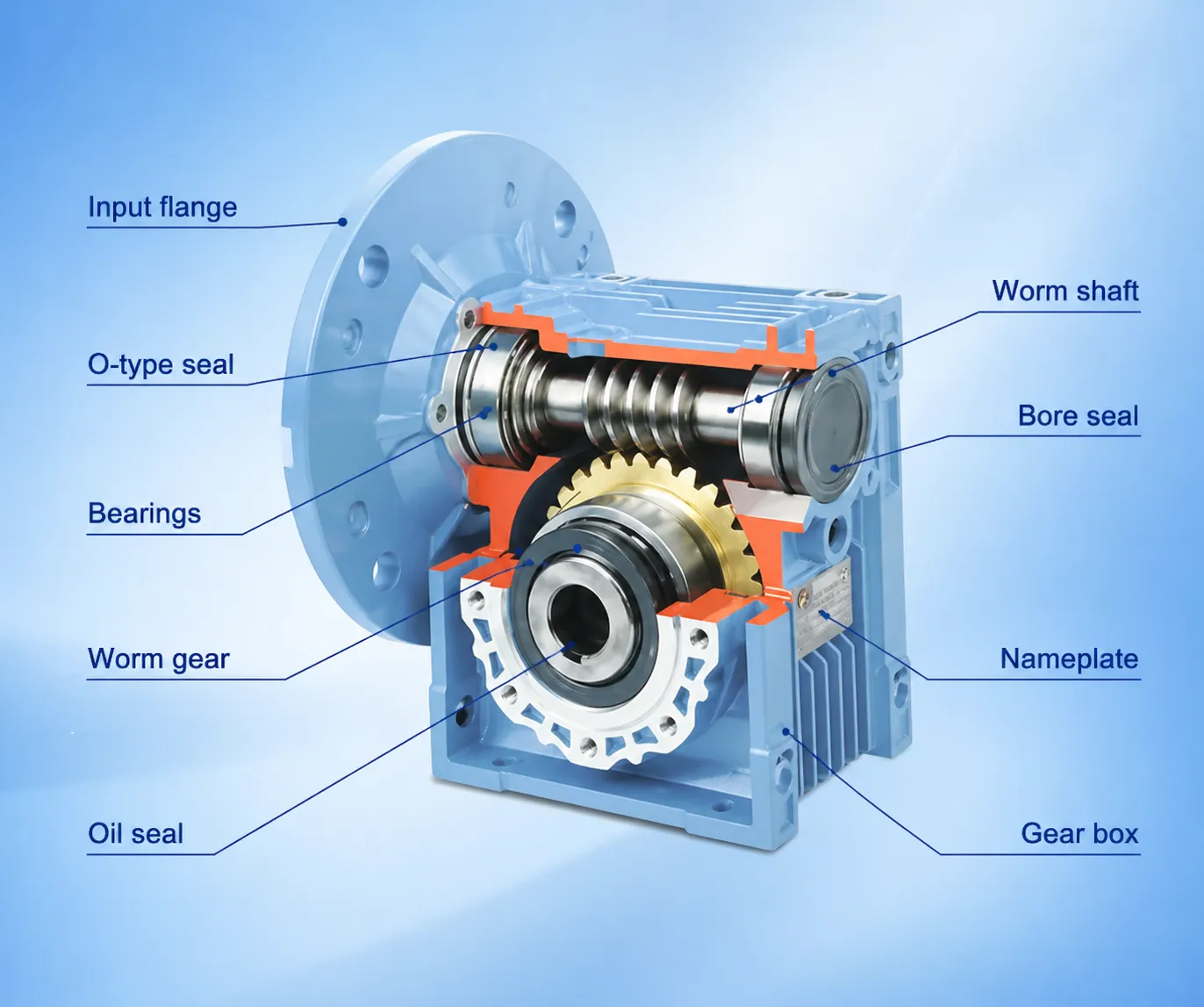
L1Материалы для корпуса
316L stainless for splash zone (mandatory). Aluminum bronze (CuAl10Fe5Ni5) for fully submerged. Coated cast iron acceptable for sheltered open-deck only.
L2Coating system
Two-pack epoxy primer + polyurethane topcoat per ISO 12944 C5-M (marine high-corrosivity). Total film thickness 240-320 μm. Single-coat alkyd enamel fails within months in marine atmosphere.
L3Sealing system
Triple-lip FKM with stainless dust deflector on output shaft. Breather plug replaced with sealed pressure-equalising membrane element. Mineral-oil sight glass replaced with magnetic dipstick.
L4Sacrificial anode
For submerged worm gear reducer installations: zinc or aluminum sacrificial anode bolted to housing exterior. Inspection interval 6 months; replacement when 50% consumed.
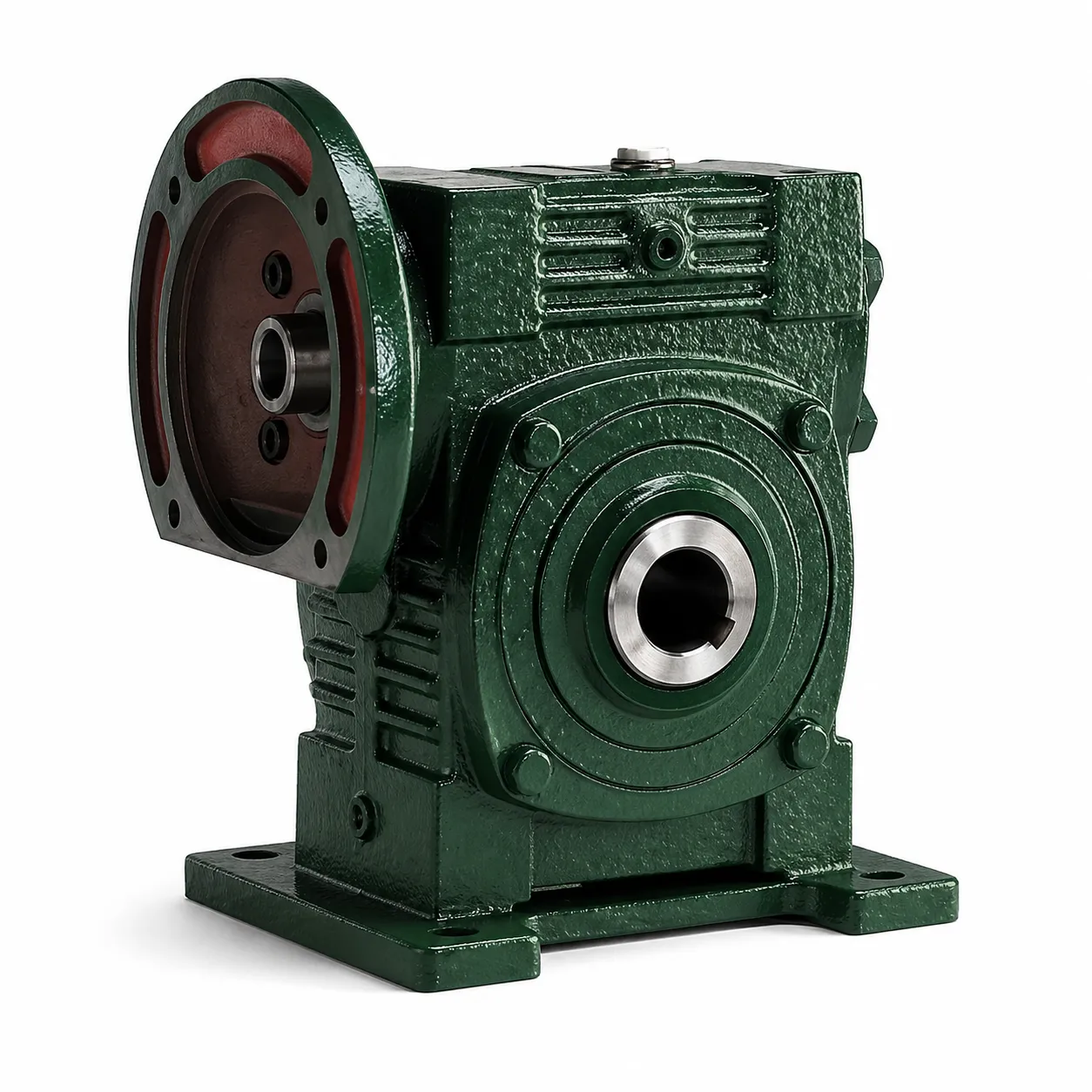
IP66 Through IP68 — Marine Submersion Rating Ladder
Marine ingress protection extends above the wash-down ratings adequate for food and indoor industrial environments. Three IP rating tiers cover the marine deployment envelope:
Five Common Marine Drive Categories
Five drive categories account for most marine worm gear reducer demand on commercial vessels and offshore platforms. Each carries a distinctive load profile and IP rating requirement.
⚓ DRIVE 01
Anchor windlass
Output 7.5-30 kW, low-speed high-torque. Fore-deck splash zone. Frame WPDS 175-WPDS 250. IP67 + 316L housing + class certification.
⚓ DRIVE 02
Mooring capstan
Output 4-15 kW, intermittent shock load. Aft-deck splash zone. Frame WPA 130-WPDS 175. IP67 + heavy SF margin (1.6+).
⚓ DRIVE 03
Cargo / stores winch
Output 1.5-7.5 kW, smooth load. Sheltered above-deck. Frame NMRV 090-WPA 130. IP66 minimum + epoxy-coated cast iron acceptable.
⚓ DRIVE 04
Engine room auxiliary
Output 0.55-4 kW (fuel pumps, ventilator dampers). Indoor sheltered. Frame NMRV 063-NMRV 110. IP55-IP65 + standard industrial coating.
⚓ DRIVE 05
Bow thruster auxiliary / submerged drive
Output 4-22 kW continuous, fully submerged or thruster-tunnel mounted. Frame WPDS 200+ with aluminum bronze housing or 316L. IP68 (3-10 m depth-rated) + sacrificial anode + class certification.
Class Society Certification Paths — ABS, DNV, Lloyd’s, NK
Vessels classed by major societies — American Bureau of Shipping, Det Norske Veritas, Lloyd’s Register, Nippon Kaiji Kyokai, Korean Register, China Classification Society — require certified equipment for safety-critical drive applications. The certification process includes material composition traceability (mill certificates for housing castings), witness testing of ratio and torque under class society survey, and class-stamped data plate. Generic industrial worm gearbox certificates do not satisfy class.
Drive categories typically requiring class certification include anchor windlass, mooring capstan, lifeboat davit, lifeboat winch, fire-pump auxiliary, and any drive feeding propulsion or steering systems. Drive categories generally not requiring class certification include cargo winch (depending on vessel), engine room ventilation, and most non-safety-critical auxiliary. The vessel’s class society survey scope dictates which worm gear reducer specifications need certification — confirm with the shipowner or shipyard project engineer before quoting. Browse our каталог червячных редукторов for class-certifiable variants.
Common Marine Specification Mistakes
⚠ MISTAKE 01
IP66 on a wave-washed deck
IP66 survives wash-down spray but not direct wave wash. Open fore-deck installations require IP67 minimum. Specifying IP66 here causes ingress within the first heavy weather event.
⚠ MISTAKE 02
Single-coat paint above the splash line
Standard alkyd enamel fails within 6-12 months in marine atmosphere. Specify ISO 12944 C5-M two-pack epoxy + polyurethane coating system.
⚠ MISTAKE 03
Skipping class certification on safety drives
A non-certified worm gearbox on a windlass causes class survey failure during sea trials. Cost of replacement plus delay exceeds the certification premium 5-10×.
⚠ MISTAKE 04
Standard tilt-rated lubricant level
Catalogue oil-bath fill assumes ±5° static tilt. For sea state 4+ specify oversized oil sump (130-150% catalogue volume) or forced lubrication.
Marine Worm Gear Reducer FAQ
Q: Is 316L stainless always required for marine deployment?
A: No — 316L is mandatory for direct splash zone (anchor windlass, fore-deck capstan, exposed winches), strongly recommended for sheltered open deck (cargo winch, lifeboat davit), and not strictly required for fully indoor installations (engine room auxiliary, bridge winch). Specifying 316L everywhere doubles or triples capital cost without benefit on the indoor drives. The decision is made per-drive based on actual exposure category, not blanket vessel-wide.
Q: How long does a properly specified marine worm gearbox last on an open deck?
A: With 316L housing, ISO 12944 C5-M coating system, IP67 sealing, FKM triple-lip seals and synthetic PAG lubricant, the typical service life on a sheltered open-deck installation (cargo winch, davit) is 12-18 years to first major overhaul. On wave-washed fore-deck (windlass, capstan), service life is 8-12 years. Generic industrial specification drops these figures to 2-4 years and 6-18 months respectively. The capital premium for marine-grade specification is recovered 4-8× through avoided replacement cycles.
Q: What documentation does the class surveyor need at delivery?
A: Five documents are typical: (1) Class society type approval certificate or material certificates; (2) Mill certificate for housing castings showing chemistry and mechanical properties; (3) Witness test report from class society surveyor showing ratio, torque and noise verification; (4) Coating system certificate identifying ISO 12944 corrosivity class and total film thickness; (5) Lubricant certificate identifying viscosity grade and any class society approval. Specific drive categories may require additional witness items (overload test, brake holding test).
Q: Does an offshore platform have the same requirements as a vessel?
A: Offshore platforms generally apply the same or more demanding specifications than commercial vessels. Fixed platforms add ATEX or IECEx hazardous-area requirements for many drive locations (zone 1 or zone 2 classifications). Floating platforms (FPSO, semi-submersible) add motion criteria similar to vessels but with longer dwell times in adverse conditions. The class society scope is similar (ABS, DNV typical) but the additional hazardous-area certification can change the worm gearbox base specification substantially. Always confirm both class and ATEX/IECEx scope before quoting.
Q: Can a Korean marine-grade unit replace a discontinued European OEM model?
A: Yes — for most class-certified drive categories, Korean factories can produce a dimensionally compatible marine-grade equivalent provided the original drawings or photographs are available. Class certification is recoverable; either through type approval transfer (if the same class society) or through fresh witness testing. Lead time for a fresh class-certified unit is 8-14 weeks vs 16-24 weeks for European OEM channel. Capital savings 30-45% typical. Send our engineering team the original nameplate, drawings and class society survey scope for a sized recommendation.
Q: How do I lubricate a tilted-installation marine worm gear reducer?
A: Three options scale with severity. Mild tilt (5-10° static, sea state 1-3): increase oil-bath fill to 130% catalogue volume, use synthetic PAG with high VI. Moderate tilt (10-20° dynamic): retrofit second drain plug at the up-tilt face plus oversized breather, monitor oil-bath level monthly. Heavy tilt (>20° dynamic, sea state 5+): forced lubrication with motorised pump and external reservoir. The forced-lubrication option doubles capital cost but is mandatory for high-duty windlass and tug winch drives in heavy weather operating envelopes.
Specifying a Marine-Duty Worm Gearbox?
Send us drive parameters (output power, speed, exposure zone, sea state envelope), the vessel class society and survey scope, and any existing OEM nameplate. Our Korean engineering team returns sized recommendations with class certification path, coating spec and lead time within 24-48 hours.
Редактор: Cxm