Comment trouver un équivalent moderne pour une ancienne boîte de vitesses à vis sans fin
A 4-step procedure that has caught 90% of mismatches before shipment — nameplate photography, dimensional measurement, ratio identification, and application-specific options. Send the right replacement worm gear reducer to your customer the first time.
Replacing an aged-out worm gearbox is rarely a search through a single catalogue. Twenty- and thirty-year-old units in Korean and Asian plants carry brand names that no longer exist in their original form — Fenner, Renold, Brevini, ELU, SEW old-frame, Hindustan, and dozens of regional badges. Cross-referencing them to a modern worm gear reducer requires a structured procedure rather than guesswork. The four steps below have caught 90% of potential mismatches before shipment across three years of retrofit projects. For sizing a brand-new replacement worm gear reducer that does not need to match an existing footprint, see our companion Guide des tailles en 6 étapes instead.
THE 4-STEP CROSS-REFERENCE WORKFLOW
Photograph
Nameplate, housing markings, mounting orientation
Measure
Centre distance, output bore, foot PCD, motor flange
Identify
Ratio, motor power, mounting orientation code
Document
Backstop, paint, ATEX, special options
Why Cross-Reference Matters — The Hidden Cost of Mismatch
A wrong-sized worm gear reducer replacement that arrives at site looks correct from across the room. The bolt holes line up roughly with the existing footprint, the output shaft pokes out approximately the right distance, the motor adapter accepts the existing motor flange. Field installation begins, and the problem only surfaces when the assembly team tries to torque the foundation bolts and finds two of the four holes are 5 mm out, or when the output shaft turns out to be 3 mm undersized for the existing coupling.
Each mismatch event costs more than the gearbox itself. Direct labour for re-installation, rented lifting equipment for a second mounting attempt, downtime on the production line, and the lead-time of a corrected unit all add up. Industrial maintenance teams in Korea, Japan, Vietnam and Thailand consistently report retrofit miscost rates of 8-15% on cross-referencing projects done casually — typically when a procurement engineer matched the gearbox by frame size and ratio without verifying the four critical dimensions or the application-specific options.
The four steps below are the worm gear reducer cross-reference procedure that drops the miscost rate to roughly 1%. Each step takes 5-15 minutes on-site at the existing installation. The complete workflow takes around 30 minutes per unit and produces a documentation pack that any modern worm gear reducer manufacturer can quote against directly.
Step 1 — Photograph the Existing Nameplate
The nameplate is the single highest-value piece of cross-reference data on the existing worm gearbox. Capture the worm gear reducer nameplate before doing anything else — even if it is dirty, painted-over, or partly illegible. A blurry photograph still preserves frame numbers and ratio codes that can be cross-referenced through manufacturer archives.
📸 WHAT TO CAPTURE
- ▸ Nameplate close-up at 90° angle (avoid glare)
- ▸ Wide shot showing the gearbox in mounted context
- ▸ Output shaft end with coupling or driven element
- ▸ Motor adapter face with motor still attached
- ▸ Any cast-in markings on the housing exterior
Many older Korean and Indian-pattern worm gearboxes carry secondary markings cast into the housing — frame size, foundry code, year of manufacture. These cast markings often survive when the riveted nameplate has fallen off or corroded beyond reading. Photograph every visible marking on the housing before deciding which is the primary identifier.
Common gotcha: nameplates riveted to the housing weather faster than cast markings. If the nameplate is unreadable, shift to the cast frame number — usually visible on the side opposite the motor adapter.
Step 2 — Measure the Four Critical Dimensions
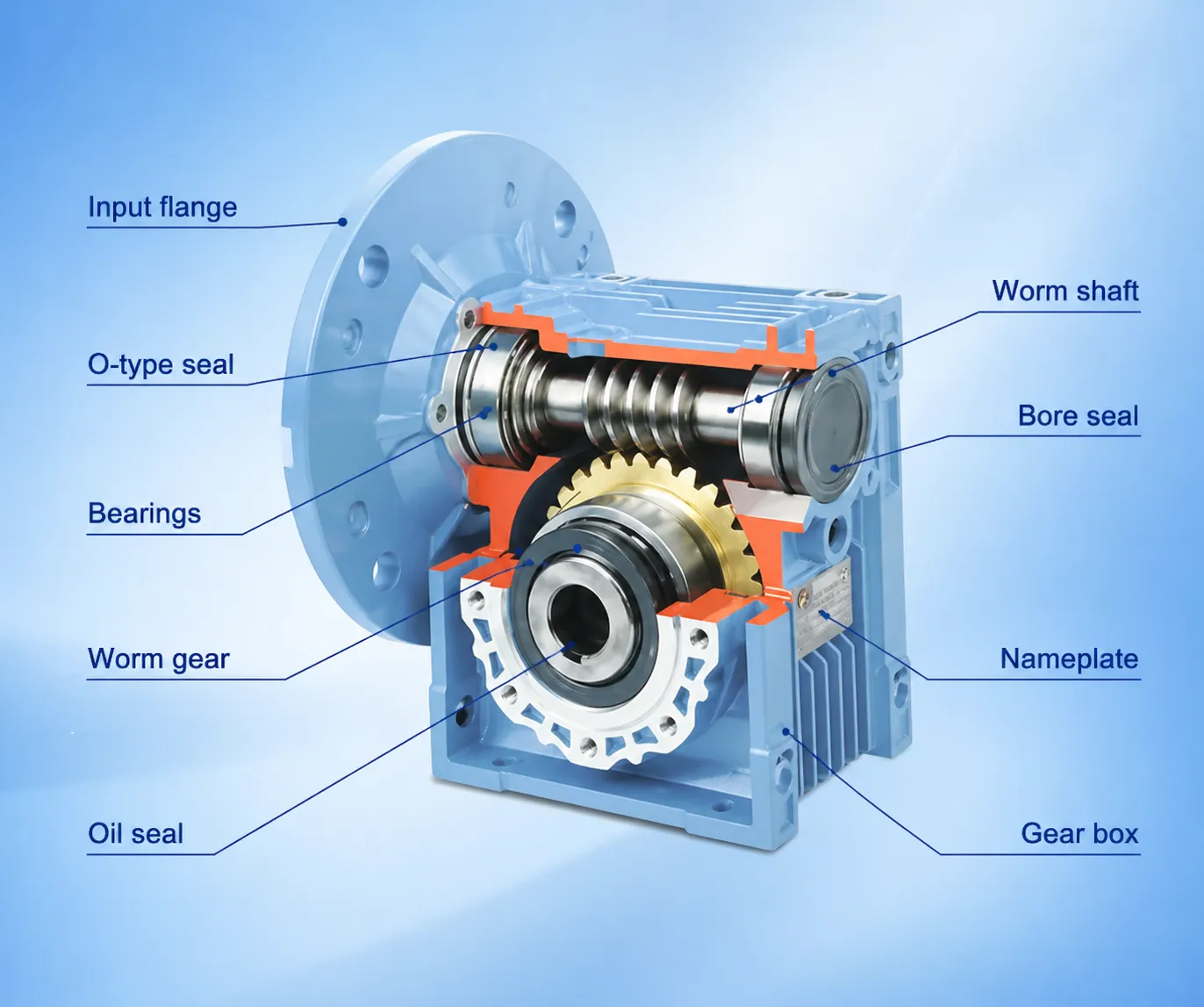
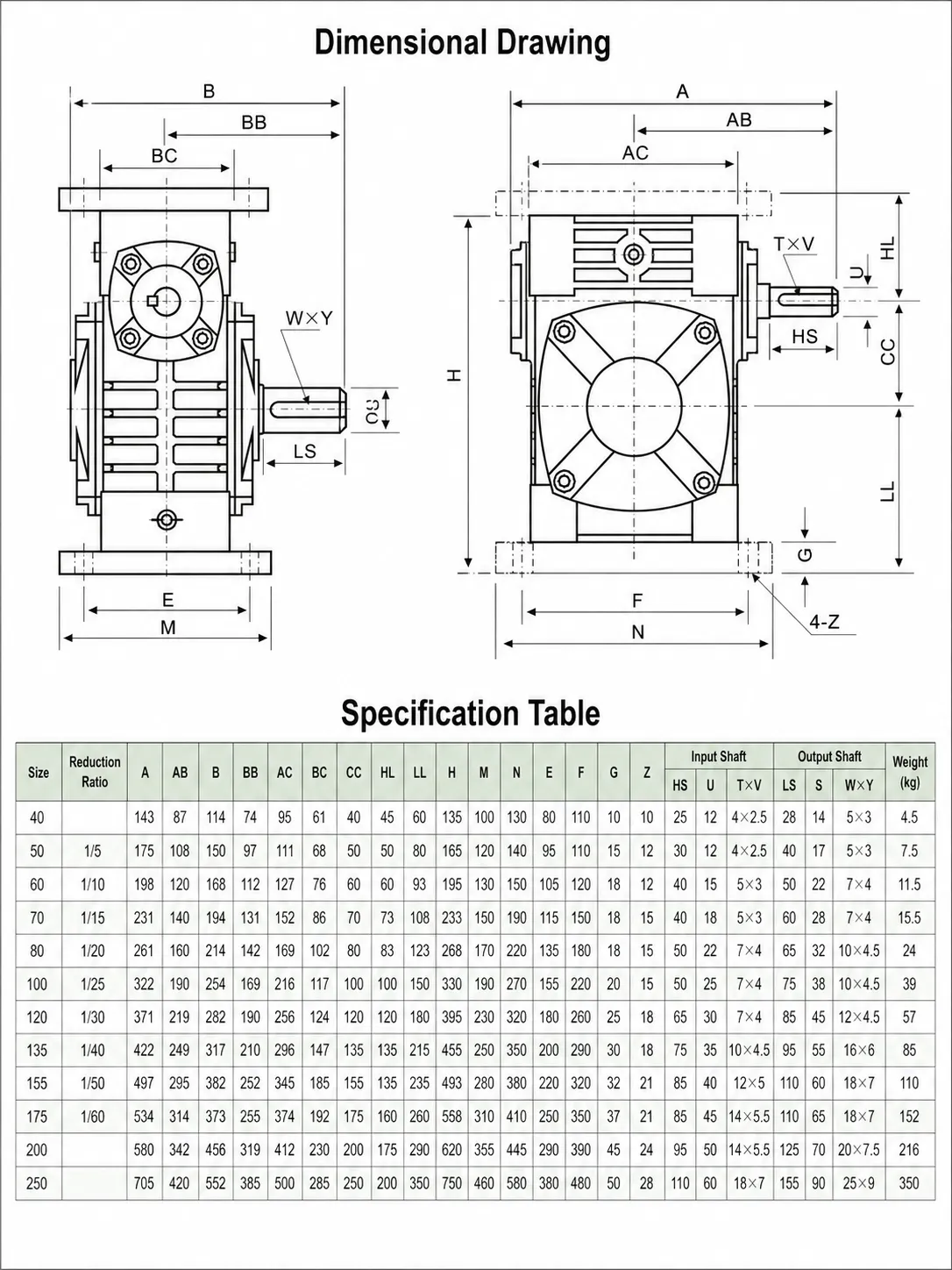
Four dimensions on the existing worm gear reducer determine whether a modern replacement frame fits without a machined adapter plate. Each measurement is straightforward with a caliper or measuring tape, but skipping any one is the single most common source of post-shipment retrofit problems.
📏 THE FOUR CRITICAL DIMENSIONS
- D1 Worm centre distance — output shaft centreline to worm shaft centreline. Defines the basic frame size (NMRV050 = 50mm, FU1000 = 100mm, etc.).
- D2 Output shaft Ø and length — measure shaft diameter (caliper across the keyway flanks) and free-length protruding from the housing.
- D3 Foot mount bolt PCD — pitch circle diameter of the foot mounting bolt holes. Measure across diagonal pairs.
- D4 Motor flange spigot Ø and PCD — IEC B5/B14 or NEMA C-face register diameter and bolt pattern.
Older worm gear reducer units sometimes carry non-standard centre distances — common 75 mm, 90 mm and 110 mm intermediates exist between the modern standard NMRV/RV step series. If the measured centre distance does not match a current catalogue value, expect either an adapter plate or a one-frame-up substitute from the modern range.
Step 3 — Identify Ratio and Motor Power from the Nameplate
Reduction ratio is the second-most-important worm gear reducer parameter after centre distance. Ratio appears on the nameplate in one of three formats: as a colon ratio (i=30:1), as a decimal (i=30.0), or as a fractional number embedded in the model code (e.g., FU 1000-30 where -30 is the ratio). Catalogue ratio steps are 5, 7.5, 10, 15, 20, 25, 30, 40, 50, 60, 80, 100; non-standard values like 28 or 35 indicate either a custom unit or an early-generation legacy unit predating the modern step series.
🔍 OTHER NAMEPLATE FIELDS TO CAPTURE
- ▸ Motor power (kW or HP) — defines input power class
- ▸ Input speed (rpm) — distinguishes 4-pole 1440 from 6-pole 960 motor coupling
- ▸ Mounting orientation code (B3, B5, B7, B8, V5, V6 per IEC 60034-7)
- ▸ Service factor and duty class if printed
- ▸ Lubricant type marking if specified
Common gotcha: nameplate-stamped ratio sometimes uses the input/output speed ratio rather than the wheel-tooth/worm-start ratio. A nameplate reading “1440/48 rpm” implies i=30 — confirm by dividing in both directions before quoting.
Step 4 — Document Application-Specific Options
The four critical dimensions and the nameplate data identify the basic worm gear reducer frame and ratio. Worm gear reducer application-specific options add the build details that determine whether the modern replacement actually integrates with the existing installation environment.
📋 OPTIONS TO RECORD
- ▸ Backstop or brake — irreversible drive features for lifting applications
- ▸ Paint or coating — RAL colour code if customer-specified, or stainless steel for marine or food applications
- ▸ ATEX zone classification — Zone 22 dust or Zone 2 gas if installed in a hazardous area
- ▸ Output shaft style — solid keyed, hollow keyed, or hollow with shrink disc
- ▸ Lubricant type — mineral CLP, synthetic PAG, or food-grade H1 specification
- ▸ Cooling system — input shaft fan duct, oil cooler, or no forced cooling
Each worm gear reducer application-specific option that has to be replicated on the modern replacement adds 1-3 weeks of build-to-order lead time. Record them upfront — discovering the original had a backstop only after the new unit ships forces a return-to-factory rebuild that doubles the project timeline.
Brand Prefix Decoder — Reading the Nameplate Like a Specialist
Cross-referencing a worm gear reducer across decades of legacy units becomes much faster when the brand prefix is decoded immediately. The reference table below covers the most common worm gear reducer brand prefixes our cross-reference team encounters across Korean and Asian retrofit projects.
| Prefix Code | Original Manufacturer | Pattern | Era |
|---|---|---|---|
| FU / FA / FV | Fenner (UK / India) | Cast iron, BS 721 standard | 1960-present |
| NMRV / VF / MI | Bonfiglioli / Motovario / SITI (Italy) | Aluminum die-cast, IEC standard | 1985-present |
| SK / SHVW / SCUA | Nord (DE) / Mitsubishi (JP) | UNICASE single-piece, helical-worm | 1990-present |
| WP / WPA / WPS | Chinese industrial pattern | Cast iron, GB 8-pattern | 1980-present |
| RV / MRV | Korean / Italian right-angle | Aluminum or cast iron, RV step series | 1990-present |
| SNU / SVD / SNV | Elecon (India) | Heavy-duty mining pattern | 1970-present |
| HHM / HSM | Chenta (Taiwan) | Aluminum precision pattern | 1995-present |
| RX / Cyclo | Sumitomo / Renold (legacy) | Mostly cycloidal, some worm hybrids | 1965-2005 |
Each pattern family has its own dimensional convention, and modern Korean and Asian replacement worm gear reducer manufacturers stock the dimensional equivalents to most of the patterns above. Pattern recognition shrinks the cross-reference search from a global parts database to a single dimensional series.
Adapter Plate vs Full Retrofit — When Each Fits
When the four critical dimensions of an old worm gear reducer don’t quite line up with a modern catalogue frame, three resolution paths exist: machine an adapter plate (cheapest), specify a custom-bored output shaft (mid-cost), or step to the next frame size up (most expensive, sometimes oversizes). The deciding factor is usually how big the dimensional gap is, and whether the customer wants minimum cost or minimum lead time.
An adapter plate is a flat steel plate machined to bridge the old foundation bolt pattern to the new worm gear reducer foot dimensions. It adds 5-8 mm to the overall mounting height — usually acceptable on conveyor and mixer drives where the application has shimming flexibility. Adapter plates are the standard solution when the centre-distance dimension matches and only the bolt pattern differs.
Where the retrofit physically relocates the worm gear reducer to a different point on the machine — and the motor sits remotely from the new gearbox position — a CV-jointed drive shaft handles the angular and axial misalignment that develops between motor and gearbox under load and thermal expansion. Matched-length shafts for the typical retrofit distances are stocked at our partner site for CV joint drive shafts; specify the centre-to-centre distance from motor flange to gearbox input shaft when ordering.
Pre-1985 Vintage Units — Special Considerations
Worm gearboxes manufactured before about 1985 carry several characteristics that complicate cross-reference to modern frames. The standardisation of NMRV-pattern centre distances (50, 63, 75, 90, 110, 130, 150 mm) only arrived in the early 1990s; pre-1985 worm gear reducer units commonly use intermediate centre distances that don’t align cleanly with current catalogues. The IEC motor flange standard (B5 / B14) replaced earlier flange patterns in the same period; pre-1985 units may have proprietary motor mounting holes that need adapter machining.
⚙ TYPICAL PRE-1985 SIGNATURES
- ▸ Riveted brass nameplate (corroded but readable)
- ▸ Imperial-unit dimensions (inches and fractions)
- ▸ Non-standard centre distances (75, 87.5 mm)
- ▸ Ratio expressed as wheel-tooth number only
- ▸ Phosphor bronze wheel rather than tin bronze
🔧 RETROFIT APPROACH
- → Always specify adapter plate from outset
- → Convert imperial to metric, round up to nearest standard
- → Plan motor adapter machining if proprietary flange
- → Allow 4-week build lead time minimum
- → Pre-test fit with the customer’s coupling
For pre-1985 units beyond economical adapter retrofit — typically those where motor flange, output shaft and foot pattern all differ from modern norms — the simpler path is usually to specify a complete modern worm gear reducer drop-in package with custom-machined interface plates. Browse the modern dimensional series across the broader worm gear reducer manufacturer catalogue to identify the closest dimensional match for any aged-out unit.
Six Cross-Reference Mistakes That Send the Wrong Replacement
Six recurring worm gear reducer cross-reference errors account for the bulk of post-shipment retrofit problems we see across Korean and Asian projects. Each is preventable at the data-collection stage with the four-step procedure above.
✗
PITFALL 01
Matching by frame size only, not by centre distance
Two units with the same frame number but different brand prefixes can have centre distances differing by 5-10 mm. Always verify dimensional D1 directly.
✗
PITFALL 02
Reading nameplate ratio backwards (input/output flipped)
An “i=30” nameplate could mean 30:1 reduction or 1:30 ratio depending on the original manufacturer’s convention. Confirm by measuring input vs output speeds.
✗
PITFALL 03
Skipping the motor flange register diameter measurement
Spigot register diameter determines whether the customer’s motor mounts concentrically. Even matching bolt PCD with wrong register Ø means a misaligned drive train.
✗
PITFALL 04
Forgetting to specify the original mounting orientation
B3 horizontal, V5 vertical-output-down, V6 vertical-output-up — each affects oil fill quantity and breather plug position. Wrong orientation seizes within 100 hours.
✗
PITFALL 05
Missing the backstop or brake on the original unit
A backstop wheel inside the housing is invisible from outside but critical for bucket elevators and lifting drives. Photograph the input shaft end with the cover off if possible.
✗
PITFALL 06
Cross-referencing without inspecting the application load
If the application has changed in 20 years (longer hours, heavier loads), a like-for-like worm gear reducer replacement may now be undersized. Sanity-check actual duty against the original spec.
Cross-Reference FAQ
Q: The original nameplate is unreadable — what should I send the manufacturer for cross-reference?
A: Photograph everything visible on the housing exterior, even cast markings that look like foundry codes. Measure the four critical dimensions with a caliper and tape measure, and document the application context (drive type, motor power, output speed, duty cycle). With those data points, our cross-reference team can identify the original brand and pattern within 24 hours roughly 85% of the time, and recommend a modern worm gear reducer match.
Q: Should I always replace like-for-like, or use this opportunity to upgrade the worm gear reducer?
A: It depends on the application’s history. If the original has run reliably for 20+ years on its current sizing, like-for-like is the safe choice — the duty profile is well-characterised. If the original ran hot, leaked, or failed prematurely, the retrofit is an opportunity to step up one frame size, switch to synthetic PAG lubrication, or specify thermal margin properly. Document the worm gear reducer failure history before deciding.
Q: How do I cross-reference an imperial-dimension worm gearbox to a metric replacement?
A: Convert the worm gear reducer’s four critical dimensions from inches to millimetres (1 inch = 25.4 mm) and round up to the nearest standard metric value. A 4-inch (101.6 mm) centre distance maps to a 110 mm modern frame; a 1.5-inch (38.1 mm) output shaft maps to a 40 mm modern shaft, with a stepped-down keyed insert if the existing coupling needs to retain the imperial bore. Adapter plates absorb the small bolt pattern differences.
Q: How long does a typical cross-reference quotation take from photo submission?
A: 24-48 hours for a brand we have catalogued (the eight prefix families in the decoder table cover 90% of incoming requests). 3-5 days for legacy worm gear reducer units predating those families, where the cross-reference team works through manufacturer archives or international service-parts databases. Standard catalogue replacement worm gear reducer frames ship from Korean stock in 3-5 working days; build-to-order configurations (custom adapter plate, ATEX certification, IE4 motor) ship in 4 weeks.
Q: Can a single modern frame size cover multiple legacy gearbox patterns?
A: For worm gear reducer cross-reference, frequently yes. The modern NMRV/RV/WP standards have absorbed most of the dimensional conventions across legacy patterns, so a single 110 mm centre distance frame typically handles cross-references from old Fenner FU110, Bonfiglioli VF110, NMRV110, WPDA110 and several Asian-pattern units. Adapter plates handle the small bolt-pattern differences. This consolidation is what makes modern catalogue maintenance economically viable on multi-unit retrofit fleets.
Q: What documentation should the modern worm gear reducer ship with for a retrofit project?
A: Cross-reference statement matching the old unit nameplate to the new model code, dimensional drawing of the new unit overlaid on the old footprint, factory test record, installation note covering any interface adaptations (adapter plate, output shaft bushing), CE conformity, ISO 9001 manufacturing certificate, and lubricant SDS. Korean buyers needing KS-marked end-machine assembly receive the supplementary KS reference set on request.
Got an Old Worm Gearbox That Needs a Modern Replacement?
Send the four-step worm gear reducer data pack — nameplate photographs, four critical dimensions, ratio and motor power, application options. Our Korean cross-reference team identifies the modern replacement match within 24-48 hours and ships from stock for catalogue patterns.
Éditeur : Cxm